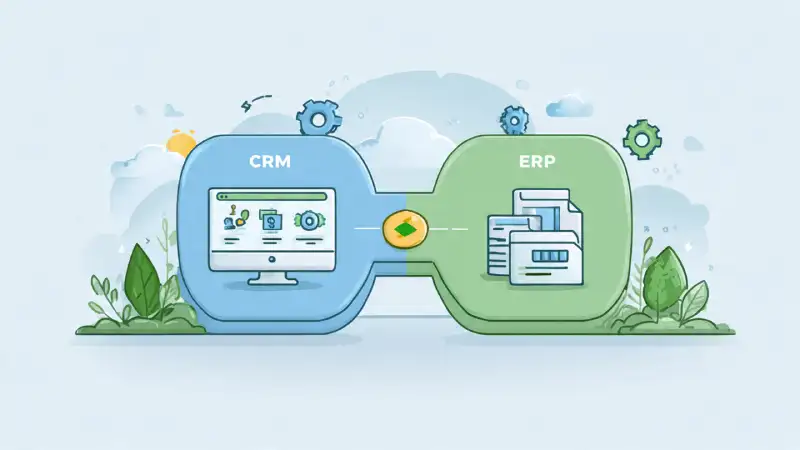
If you’ve ever evaluated business software, chances are you’ve heard CRM and ERP spoken about as if they’re two sides of the same coin—or worse, as if one can easily replace the other.
Some vendors pitch CRM as a “lightweight ERP.”
Others claim their ERP has “built-in CRM,” so you don’t need anything else.
And many business owners walk away thinking, “Let’s buy one system and solve everything.”
After 18+ years of hands-on ERP implementations, I can tell you this clearly:
CRM and ERP are not interchangeable—and treating them as such can quietly bleed money from your business.
I’ve seen companies grow rapidly when they chose the right system at the right time. I’ve also seen businesses struggle for years—not because they lacked effort, but because they misunderstood what these systems are actually meant to do.
So let’s break this down in plain, practical language—no jargon, no vendor hype.
Why CRM vs ERP Is So Often Misunderstood
The confusion usually comes from surface-level similarities.
Both CRM and ERP:
- Store business data
- Generate reports
- Claim to improve visibility and control
But they are built for very different moments in your business process.
To understand the difference, ask yourself one simple question:
Are we trying to win business—or deliver business efficiently?
The answer determines whether you need CRM, ERP, or both.
CRM: Managing Relationships Before and Around the Sale
CRM stands for Customer Relationship Management.
At its core, CRM is about people, conversations, and opportunities.
A CRM system helps you manage everything that happens before a deal is closed—and how you continue the relationship afterward.
What CRM Does Well
A typical CRM system tracks:
- Leads from websites, referrals, ads, or events
- Sales calls, meetings, emails, and follow-ups
- Opportunity pipelines and deal stages
- Marketing campaign responses
- Customer service tickets and interaction history
Tools like Salesforce, HubSpot, Zoho CRM, and Freshsales are designed primarily for:
- Sales teams
- Marketing teams
- Customer success and support teams
CRM answers questions like:
- Which lead should I call today?
- Which deals are likely to close this month?
- Why did we lose that opportunity?
- Which campaign actually generated revenue?
If your business struggles with:
- Missed follow-ups
- Poor sales visibility
- Leads slipping through the cracks
Then CRM is essential.
But CRM has a limit—and this is where many businesses get stuck.
Where CRM Stops—and Operational Reality Begins
CRM works brilliantly until the deal is closed.
After that, a different set of questions appear:
- Do we have enough inventory?
- Are prices aligned with actual costs?
- Can production meet this delivery date?
- Has finance recorded revenue correctly?
- Will procurement need to reorder materials?
Most CRMs were never designed to handle these questions reliably.
This is exactly where ERP becomes critical.
ERP: The Backbone That Runs Your Business
ERP stands for Enterprise Resource Planning, but a more practical definition is this:
ERP is the system that ensures your business can actually deliver what sales promised.
While CRM looks outward—toward customers and prospects—ERP looks inward, connecting every internal function that keeps the business running.
What ERP Controls
A true ERP system integrates:
- Finance and accounting (GL, AR, AP, compliance)
- Inventory and warehouse management
- Procurement and supplier control
- Sales order processing and billing
- Manufacturing, MRP, and production planning
- Costing, margins, and profitability reporting
- Often HR and payroll
ERP is not about individual departments—it’s about flow.
One action triggers many processes automatically.
A Real-World Example: When CRM Alone Wasn’t Enough
A few years ago, I worked with a manufacturing client in Dubai facing a problem I’ve seen many times.
Their sales team loved their CRM.
Leads were tracked properly. Follow-ups were happening. Deals were closing.
But the moment a deal was won—chaos began.
Here’s what was happening:
- Sales emailed order details to operations
- Finance manually entered data into Excel
- The shop floor received incomplete or outdated specifications
- Wrong items were manufactured and shipped
- Returns and customer complaints started piling up
From the sales team’s perspective, everything looked fine.
From the operations side, it was a daily fire fight.
The issue wasn’t people.
It wasn’t effort.
It was a missing ERP backbone.
What We Changed
We didn’t rip out their CRM.
Instead, we implemented an ERP that integrated seamlessly with it.
Sales continued using the CRM they were comfortable with.
But now, with a single click:
- A won deal became a validated sales order in ERP
- Pricing was checked automatically
- Inventory availability was verified
- Production routing was triggered correctly
- Finance entries were created without retyping
The Results Spoke for Themselves
- Order processing time dropped by 70%
- Customer complaints fell by nearly 50%
- The CFO finally received weekly P&L reports on time
The CRM didn’t replace the ERP.
The ERP didn’t replace the CRM.
Together, they created harmony.
That’s how these systems are meant to work.
ERP Is Not Just Software—It’s Operational Discipline
Many businesses think ERP is just “big software.”
In reality, ERP introduces:
- Process clarity
- Data discipline
- Accountability across departments
This is why ERP implementations fail when:
- Processes aren’t understood
- Systems are over-customized
- Users are forced to adapt to software instead of the reverse
I’ve seen the large ERPs like SAP, Oracle, and Dynamics. They are powerful—but often complex, expensive, and heavily consultant-driven.
After years of seeing businesses struggle with bloated systems, we decided to do things differently.
Building ERP for Real People: The BRS Infotek Philosophy
At BRS Infotek, our ERP work is guided by one belief:
ERP should serve the people who run the business—not just consultants or feature lists.
This philosophy is embedded in both Cyprus ERP and Onfinity ERP, implemented and supported by BRS Infotek.
- Cyprus ERP is our in-house ERP, built on Adempiere, shaped by real usage across manufacturing floors, warehouses, accounts teams, and owner-led businesses.
- Onfinity ERP, where BRS Infotek is a legal and implementation partner, applies the same execution-first thinking with added enterprise scalability and structure.
What These ERPs Focus On
- Unified finance, inventory, sales, and manufacturing
- Clean, intuitive screens users adopt quickly
- Role-based workflows built into daily operations
- Smart configuration instead of fragile customizations
- Real-time costing, MRP, and reliable reporting
- Predictable implementation with no hidden surprises
Both platforms avoid feature overload and focus on operational clarity, control, and decision accuracy.
👉 Want to see how Cyprus ERP or Onfinity ERP works with your own data?
Request a practical demo with BRS Infotek at www.cypruserp.com or Onfinity ERP
About the Author
Founder & ERP Solution Architect – BRS Infotek
With 18+ years of hands-on ERP experience, he has implemented systems for businesses ranging from small manufacturing workshops to multi-country distribution networks.
He co-designed Cyprus ERP and leads Onfinity ERP implementations as BRS Infotek’s legal partner.
His belief is simple:
ERP should work for people—not the other way around.


