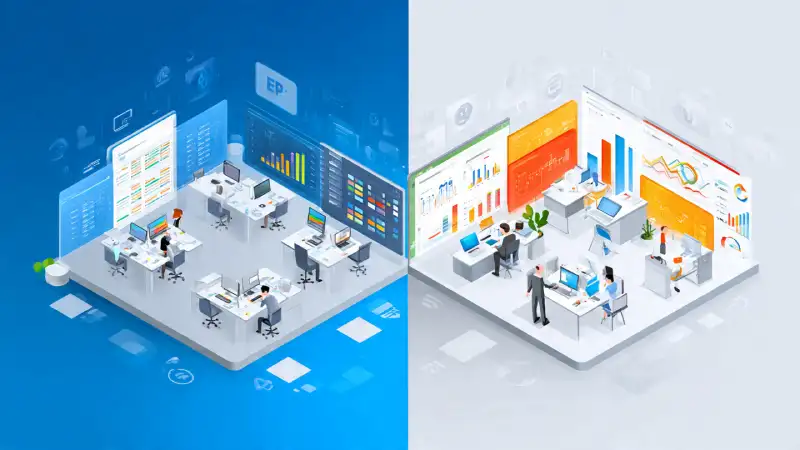
For years, ERP systems were considered the backbone of business operations.
They helped companies:
- Track inventory
- Manage sales and purchases
- Control finance
- Run manufacturing
And for a long time, that was enough.
But in 2026, something has clearly changed.
Businesses today are faster, more complex, and far less forgiving of delays and mistakes. Customers expect quicker deliveries. Margins are thinner. Competition is global. And decisions can no longer wait until month-end reports.
Yet many organizations are still running traditional ERP systems designed for a slower world.
From my experience working closely with ERP implementations for nearly two decades, I can say this honestly:
Traditional ERP does not fail because it is bad software.
It fails because it no longer keeps up with how businesses operate today.
This blog explains why traditional ERP struggles in 2026-2027, where AI changes the equation, and how businesses should think practically—without hype.
Traditional ERP Was Built for Stability, Not Speed
Let’s start with an important truth.
Traditional ERP systems were designed in a time when:
- Data entry was mostly manual
- Decisions were taken weekly or monthly
- Volumes were predictable
- Competition was local or regional
These systems are very good at:
- Recording transactions
- Enforcing rules
- Maintaining audit trails
But they are reactive by nature.
They tell you what has already happened.
In 2027, businesses don’t just need records.
They need early signals.
The Gap Between Data and Decisions
In almost every ERP project I’ve worked on, users say:
“The data is there, but we don’t know what to do with it.”
Traditional ERP gives you:
- Hundreds of reports
- Thousands of rows of data
- Static dashboards
But it still expects humans to:
- Analyze patterns
- Spot risks
- Predict outcomes
This worked when volumes were low.
In 2026-2027, it doesn’t.
Real-Life Problem #1: Inventory Looks Right, But Reality Is Different
This problem exists in almost every industry.
The ERP shows:
- Stock available
- Reorder levels defined
- Consumption reports generated
Yet:
- Production stops
- Sales orders are delayed
- Emergency purchases increase
Why?
Because traditional ERP:
- Looks at current stock, not future demand
- Uses static reorder rules
- Doesn’t learn from past shortages
What I’ve Seen on the Ground
A manufacturing client once told me:
“ERP says material is available, but the wrong items are always lying in the store.”
They had data.
They had reports.
But they had no intelligence.
Where AI Changes the Game
AI looks beyond today’s numbers:
- Consumption trends
- Sales velocity
- Supplier reliability
- Seasonal behavior
Instead of saying “Stock available = Yes”, AI says:
“At the current consumption rate, this item will be short in 12 days.”
That difference matters in 2026-2027.
Real-Life Problem #2: Sales Are Growing, But Profits Are Shrinking
This is one of the most dangerous situations for any business.
Sales teams celebrate growth.
Finance teams quietly worry about margins.
Traditional ERP reports show:
- Revenue by customer
- Sales quantity by product
- Invoice totals
But they often fail to show:
- True profitability
- Hidden costs
- Customer behavior patterns
What Happens in Reality
From real ERP implementations, I’ve seen:
- High-value customers with poor margins
- Heavy discounting normalized over time
- Logistics and return costs ignored
Traditional ERP records all this—but doesn’t connect the dots.
How AI Helps in 2026-2027
AI continuously compares:
- Revenue vs margin
- Customer buying patterns
- Discount trends
- Return frequency
Instead of waiting for finance analysis, AI flags:
“Customer A contributes 20% of revenue but only 6% of profit.”
That insight changes sales strategy immediately.
Real-Life Problem #3: Manufacturing Plans That Never Match Reality
Ask any production manager this question:
“Does actual production match the plan?”
The answer is almost always “No.”
Traditional ERP planning assumes:
- Standard times are accurate
- Machines behave consistently
- Resources are interchangeable
Reality is very different.
What Traditional ERP Misses
ERP captures:
- Planned time
- Actual time
But it doesn’t learn from the gap.
Over time, the same delays repeat:
- Same work center
- Same operation
- Same product category
AI’s Role in 2026 Manufacturing
AI identifies patterns like:
- Which machines cause repeated delays
- Which products are always underestimated
- Which shifts perform better
Real example:
“Operation ‘Packing-03’ consistently exceeds planned time by 15% during peak season.”
Traditional ERP stores this data.
AI turns it into insight.
Real-Life Problem #4: Finance Discovers Issues Too Late
Finance teams rely heavily on ERP.
Yet many still face:
- Month-end surprises
- Last-minute corrections
- Stressful audits
Why?
Because traditional ERP:
- Posts entries correctly
- But doesn’t question them
Real Experience
In one project, a costing issue continued for three months because:
- Entries were technically correct
- Variance reports were reviewed late
AI Adds Early Warning
AI monitors:
- Cost deviations
- Abnormal postings
- Sudden spikes
And raises alerts like:
“This job’s material cost is unusually high compared to similar jobs.”
In 2026-2027, early warning matters more than perfect reports.
A Quick Reality Pause
If these situations sound familiar, you are not alone.
In most ERP projects I’ve worked on, these issues existed long before AI entered the discussion.
AI does not magically fix problems—it reveals them early, before they turn into losses.
The Core Problem: Traditional ERP Is Reactive
This is the heart of the issue.
Traditional ERP answers:
- What happened?
- What was posted?
- What is the balance?
But businesses in 2026-2027 need answers to:
- What is likely to happen?
- Where is the risk?
- What needs attention now?
Without AI, ERP remains a rear-view mirror.
AI Is Not About Replacing ERP Users
There is a big misconception here.
AI does not replace:
- Accountants
- Planners
- Managers
AI supports them.
Think of AI as:
- A silent analyst
- A pattern observer
- A risk indicator
Good AI does not command.
It suggests and highlights.
Why Some Businesses Still Fail With AI
AI alone doesn’t guarantee success.
From experience, failures happen when:
- Data quality is poor
- Processes are broken
- Users don’t trust the system
AI amplifies reality—good or bad.
That’s why foundation matters.
Cyprus ERP: Why Process Discipline Still Matters
Cyprus ERP is currently not AI-enabled—and that is by design.
Cyprus ERP focuses on:
- Clean workflows
- Strong costing structure
- Simple, understandable screens
- Operational discipline
Many businesses I’ve worked with first needed:
- Process stability
- Control over transactions
- Clear ownership
Cyprus ERP delivers that.
It proves an important point:
Without discipline, AI has nothing meaningful to learn from.
Cyprus ERP is ideal for organizations that want to:
- Fix fundamentals
- Build data maturity
- Regain operational control
👉 Cyprus ERP AI capabilities are planned to be introduced from 1st February 2027, built on this strong process foundation—so intelligence comes after discipline, not before.
Onfinity ERP: Why AI Becomes Critical in 2026-2027
Onfinity ERP is AI-enabled today, built for organizations that have moved beyond basics.
In Onfinity ERP, AI is used for:
- Predictive demand planning
- Inventory movement intelligence
- Profitability and margin analysis
- Early warning signals across operations
The focus is not flashy dashboards.
The focus is:
- Faster decisions
- Fewer surprises
- Better control at scale
In 2026-2027, as data volumes grow and decisions become faster, AI becomes less optional and more necessary.
Traditional ERP vs AI-Enabled ERP: The Real Difference
Traditional ERP:
- Records data
- Enforces rules
- Generates reports
AI-enabled ERP:
- Observes patterns
- Highlights risks
- Supports decisions
Both are important—but only one keeps pace with modern business complexity.
Final Thought: ERP Without AI Feels Heavier Every Year
Traditional ERP didn’t suddenly become bad.
The world simply moved faster.
In 2026-2027:
- Waiting for reports is costly
- Manual analysis is slow
- Missed signals are expensive
That’s why traditional ERP increasingly feels:
- Heavy
- Reactive
- Stressful
AI doesn’t replace ERP.
It completes it.
About the Author
Surya Sagar
Founder & ERP Solution Architect – BRS Infotek
Surya Sagar has over 18 years of hands-on ERP experience, working across manufacturing, trading, and service industries in multiple countries.
He has played a key role in the evolution of Onfinity ERP and is the architect behind Cyprus ERP, both designed to solve real operational problems—not just showcase features.
His belief remains simple:
ERP success is not about software.
It is about clarity, discipline, and confident decision-making.
A Gentle Next Step
If you are evaluating whether your business needs process stability first or is ready for AI-assisted decision-making, exploring real workflows matters more than reading feature lists.
Understanding where you stand today is the first step to choosing the right ERP direction.


