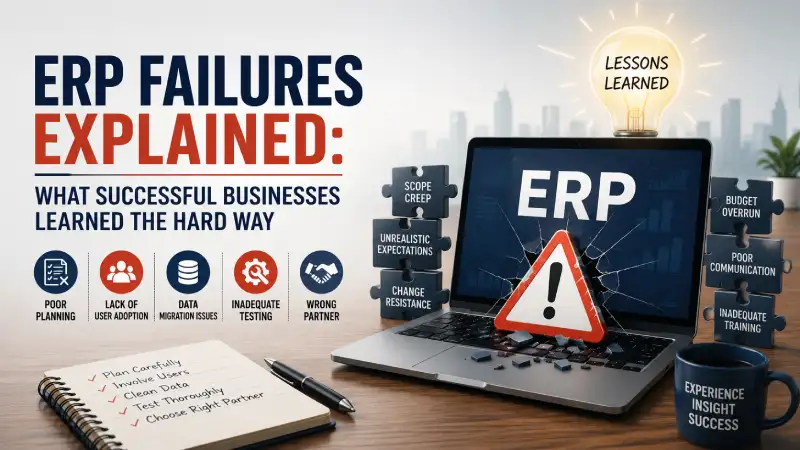
Why ERP Projects Fail, What Successful Companies Do Differently, and How You Can Avoid Costly Mistakes
By Surya Sagar
ERP Solution Architect | 18+ Years of ERP Implementation Experience | 100+ ERP Projects Across Multiple Industries
Introduction: The Monday Morning Every Business Fears
It’s 9:00 AM on a Monday.
The factory floor is full of workers waiting for instructions.
Forklifts are standing still.
The warehouse team cannot locate raw materials.
The production supervisor is asking why the system isn’t generating work orders.
The sales department is receiving calls from customers asking where their shipments are.
Finance cannot generate invoices.
The Managing Director walks into the conference room and asks one simple question:
“What exactly is happening?”
The answer surprises everyone.
Just two days earlier, the company had gone live with its brand-new ERP system.
Instead of making the business faster, it had brought the entire operation to a standstill.
Although this sounds like the plot of a business drama, similar situations have happened in real companies across the world. Some organizations recovered after weeks of hard work. Others lost customers, money, and years of trust that were difficult to rebuild.
After working on ERP implementations for more than 18 years across manufacturing, trading, retail, pharmaceuticals, engineering, construction, and distribution industries, I have learned one important truth:
ERP software rarely destroys businesses. Poor implementation decisions do.
Many organizations spend months selecting the best ERP software but only a few weeks planning how people, processes, and data will actually work together after go-live.
That is where most ERP failures begin.
This article shares real ERP disaster stories, practical lessons from actual implementations, and the mistakes I have repeatedly seen businesses make. If your company is planning an ERP implementation—or struggling with an existing one—the experiences shared here may save you months of frustration and significant financial loss.
Why Do ERP Projects Fail?
One of the biggest myths surrounding ERP implementation is that buying the right software guarantees success.
It doesn’t.
Even the most powerful ERP system cannot fix unclear business processes, inaccurate master data, poor management decisions, or lack of employee involvement.
Think of ERP as the engine of a car.
A powerful engine cannot help if the driver doesn’t know the destination, the fuel tank is empty, or the wheels are pointing in different directions.
ERP works exactly the same way.
The software only reflects how the business is managed.
If the business process is broken, the ERP simply makes those problems visible much faster.
That is why successful ERP projects are business transformation projects—not software installation projects.
Story 1: The Weekend Go-Live That Shut Down Operations
Several years ago, a large manufacturing company decided to replace its legacy systems with a modern ERP solution.
The management wanted a “big bang” implementation.
Their plan looked simple.
Complete the migration over the weekend.
Start using the new ERP on Monday morning.
Everything appeared ready.
Servers had been installed.
Users had received basic training.
The implementation team had completed technical testing.
Management proudly announced the go-live.
Monday morning arrived.
Within two hours, the problems started.
Purchase Orders couldn’t be approved.
Warehouse staff couldn’t locate inventory because storage locations had changed during migration.
Production couldn’t issue components to the shop floor.
Sales Orders were waiting because inventory appeared unavailable.
Finance couldn’t generate customer invoices.
Customer deliveries were delayed.
The phones never stopped ringing.
Every department blamed another department.
The ERP software wasn’t completely broken.
The implementation strategy was.
What Actually Went Wrong?
After several weeks of investigation, the company identified the real reasons.
- User Acceptance Testing (UAT) had been rushed.
- Master data validation was incomplete.
- Employees had practiced only simple transactions instead of real business scenarios.
- There was no contingency plan if problems occurred after go-live.
- Business users depended entirely on the implementation partner.
The organization eventually stabilized the ERP system, but it took months before operations returned to normal.
Business Lesson
Going live is not the finish line.
It is the day your business begins depending on the ERP for every important decision.
Have You Ever Experienced Something Similar?
Many companies believe ERP implementation is complete when the software is installed.
In reality, installation is often only 20% of the project.
The remaining 80% involves:
- Employee adoption
- Process discipline
- Master data accuracy
- Continuous monitoring
- Change management
If any of these areas are ignored, the software simply exposes the weaknesses already present inside the organization.
Story 2: A Multi-Million Dollar ERP… But Everyone Still Used Excel
This is probably the most common ERP failure I have seen.
A growing distribution company invested heavily in a new ERP platform.
Management expected every department to stop using spreadsheets immediately.
Six months later, they conducted an internal audit.
The findings were shocking.
The warehouse maintained inventory in Excel.
Sales maintained customer pricing in Excel.
Purchase teams tracked suppliers in Excel.
Production planners scheduled manufacturing using Excel.
Finance prepared management reports using Excel because they didn’t trust the ERP reports.
The ERP had become little more than an expensive data-entry system.
The real business continued outside the software.
Why Did Employees Ignore the ERP?
The answer wasn’t technical.
It was psychological.
Employees had worked with spreadsheets for years.
They trusted them.
Nobody explained why the ERP was better.
Nobody showed how integrated information could reduce mistakes.
Instead of helping employees change their habits, management simply instructed them to stop using Excel.
Human beings rarely change because someone tells them to.
They change when they understand the benefit.
Business Lesson
ERP implementation is not about installing software.
It is about changing behaviour.
Until people trust the ERP, they will continue maintaining parallel systems.
Story 3: The Master Data Disaster Nobody Expected
One manufacturing company proudly completed its ERP implementation within the planned schedule.
Everything looked perfect.
The dashboard displayed real-time information.
Reports were available.
Transactions were posting correctly.
Management celebrated a successful implementation.
Two weeks later, production planning became a nightmare.
The ERP generated purchase recommendations for materials that were already available in the warehouse.
Critical raw materials were missing from procurement plans.
Finished goods couldn’t be produced on time.
Customers started receiving delayed deliveries.
Initially, everyone blamed the ERP system.
After detailed analysis, the implementation team discovered the actual problem.
The ERP had done exactly what it was supposed to do.
The data inside the system was wrong.
Bill of Materials contained incorrect quantities.
Lead times had never been updated.
Supplier delivery schedules were outdated.
Product dimensions were inaccurate.
Warehouse stock balances didn’t match physical inventory.
The MRP engine simply followed the information it had been given.
Business Lesson
An ERP system is only as intelligent as the data entered into it.
Bad master data always produces bad business decisions.
My Personal Experience: The Day We Delayed Go-Live
One of the most valuable lessons in my ERP career came from a manufacturing implementation where the customer wanted to complete User Acceptance Testing within a single week.
Their argument seemed reasonable.
“The software team has already tested everything.”
Technically, they were right.
The development team had verified every screen, every button, every workflow, and every report.
But technical testing is very different from business testing.
I requested one additional week for proper User Acceptance Testing.
Initially, the management was unhappy.
They believed the project was being delayed unnecessarily.
Instead of testing individual screens, we recreated an entire business cycle.
We started with a Purchase Requisition.
Converted it into a Purchase Order.
Received the materials.
Performed Quality Inspection.
Generated the Accounts Payable Invoice.
Issued materials to production.
Created Production Orders.
Recorded Production Execution.
Transferred Finished Goods to inventory.
Created Sales Orders.
Delivered goods to customers.
Generated Customer Invoices.
Verified financial postings.
Only after completing the entire business cycle did the real issues become visible.
Some pricing rules required modification.
Tax calculations behaved differently under specific business scenarios.
Warehouse approvals needed refinement.
One production process required an additional validation that had never been discussed during workshops.
Had these issues been discovered after go-live, daily business operations would have been affected immediately.
That extra week of testing probably saved the customer several months of operational disruption.
It also reinforced something I continue telling every customer today:
A delayed go-live is far less expensive than a failed go-live.
Story 4: The Fastest ERP Implementation That Became the Longest
Every ERP consultant has heard this sentence:
“We need to finish before the financial year closes.”
One company wanted its ERP implementation completed in just three months.
The implementation partner repeatedly explained that the timeline was unrealistic.
The customer insisted.
Management wanted to announce the project as completed during the annual board meeting.
To meet the deadline, compromises began one after another.
Business process workshops were shortened.
Testing cycles were reduced.
Training sessions were cancelled.
Reports were postponed.
Several integrations were marked as “Phase Two.”
The ERP went live exactly on schedule.
Everyone celebrated.
Three weeks later, reality returned.
Employees couldn’t perform routine transactions.
Approval workflows didn’t match business requirements.
Several reports were missing.
Finance struggled during month-end closing.
The implementation that officially finished in three months ultimately required nearly another year of stabilization.
The project wasn’t delayed.
It was simply postponed after go-live.
Business Lesson
The fastest ERP implementation often becomes the longest recovery project.
Choosing speed over quality almost always increases the total implementation cost.
Story 5: The ERP Nobody Asked Employees About
A medium-sized engineering company decided to implement a new ERP system after months of evaluating different software vendors.
The management team attended demonstrations.
Department heads approved the budget.
The implementation partner started the project.
Everything looked well organized.
Except for one thing.
The people who would actually use the ERP every day were never involved.
The warehouse supervisor wasn’t invited to the workshops.
The purchase executives weren’t asked about their daily challenges.
Production planners never reviewed the proposed workflow.
Accounts executives saw the ERP for the first time during training.
Within a few days, the complaints started.
“This isn’t how we receive materials.”
“Why are there so many approval steps?”
“Our customer pricing doesn’t work like this.”
“We were never asked how we actually do our work.”
The implementation partner had built exactly what management had requested.
Unfortunately, management and end users had different expectations.
Hundreds of customization requests started arriving after development was almost complete.
The project became slower.
More expensive.
And far more complicated than it should have been.
Business Lesson
The people who perform the work every day usually understand business processes better than anyone else.
Ignoring their experience during ERP implementation is one of the fastest ways to increase project cost and reduce user adoption.
Story 6: When Customization Became the Biggest Disaster
One company believed their existing processes were already perfect.
Instead of adapting to ERP best practices, they wanted the ERP to behave exactly like their old software.
Every screen required customization.
Every approval needed modification.
Every report had to match the previous format.
Every department wanted something different.
The project that was originally estimated for eight months continued for almost two years.
Whenever a new ERP version was released, upgrading became another project because hundreds of customizations had to be rewritten.
Eventually, the company realized they no longer had a standard ERP.
They had a completely different software that happened to run on an ERP platform.
Business Lesson
Customization should solve genuine business problems—not preserve outdated habits.
The best ERP implementations strike a balance between business requirements and standard ERP capabilities.
The Hidden Cost of an ERP Failure
When businesses calculate ERP costs, they usually think about software licenses, implementation charges, hardware, infrastructure, and training.
Unfortunately, those are only the visible costs.
The biggest losses usually appear after a failed implementation.
Imagine a manufacturing company with:
- 250 employees
- Three production lines
- Daily dispatches to more than 150 customers
- Annual turnover of ₹100 Crore
Now imagine the ERP remains unstable for just one week.
What happens?
Production slows down because materials cannot be issued correctly.
Purchase teams order items that already exist in the warehouse.
Customer deliveries are delayed.
Sales teams spend their day answering complaint calls.
Finance works overtime to reconcile transactions manually.
Management meetings become longer because nobody trusts the reports.
Existing customers begin looking for alternative suppliers.
The actual financial loss is rarely visible in accounting reports.
It appears in missed opportunities, damaged customer relationships, employee frustration, overtime expenses, delayed collections, and reduced productivity.
A failed ERP project doesn’t only cost money.
It costs confidence.
Six Mistakes I Continue Seeing After 18+ Years in ERP Consulting
Across more than 100 ERP implementations, I continue seeing the same mistakes repeated regardless of industry.
1. Treating ERP as an IT Project
ERP belongs to the business.
Technology supports it.
Successful projects are led by business leadership—not only by the IT department.
2. Believing Software Will Automatically Improve Processes
ERP can automate your processes.
It cannot improve processes that are fundamentally broken.
Fix the business first.
Then automate it.
3. Ignoring Master Data Quality
Many organizations spend months selecting ERP software.
But only a few weeks preparing master data.
- Customers.
- Suppliers.
- Products.
- Bills of Materials.
- Price Lists.
- Lead Times.
- Warehouses.
- Cost Centers.
Every incorrect record eventually becomes an operational problem.
4. Underestimating User Training
Training is not a PowerPoint presentation.
Users should perform actual business transactions.
People learn ERP by doing—not by watching.
5. Expecting Instant Return on Investment
ERP implementation is not like switching on a machine.
The first few months focus on stabilization.
As users gain confidence, the real business benefits begin to appear.
Organizations that remain patient usually achieve significantly better long-term results.
6. Assuming Go-Live Means Success
Many companies celebrate on go-live day.
Experienced ERP consultants know that go-live is simply the beginning.
The real success is measured six months later.
- Are users confident?
- Are reports trusted?
- Is production smoother?
- Has customer service improved?
If the answer is yes, the ERP implementation has truly succeeded.
Warning Signs Your ERP Project Is Heading Towards Trouble
If you notice any of these warning signs, don’t ignore them.
Small issues become major failures when left unresolved.
- Project meetings keep getting postponed.
- Business users rarely attend workshops.
- Every week brings new requirements.
- Departments continue maintaining Excel sheets.
- Master data preparation is incomplete.
- User Acceptance Testing is repeatedly shortened.
- Employee training is treated as a formality.
- Everyone is requesting unnecessary customization.
- Nobody clearly owns project decisions.
- Management focuses only on the go-live date instead of implementation quality.
Recognizing these warning signs early can prevent months of unnecessary delays and costs.
What Successful ERP Projects Do Differently
After working with organizations that achieved excellent ERP results, I noticed several common characteristics.
Successful companies:
- Clearly define business objectives before selecting software.
- Appoint an internal project champion.
- Involve employees from every department.
- Clean and validate master data before migration.
- Perform multiple rounds of User Acceptance Testing.
- Train users using real business scenarios.
- Limit unnecessary customization.
- Review project progress every week.
- Continue supporting users after go-live.
- Treat ERP as a long-term business improvement initiative.
The software may be the same.
The difference lies in how the project is managed.
Building ERP the Right Way: Lessons Behind Cyprus ERP and Onfinity ERP
During my ERP consulting journey, I have worked with organizations ranging from small manufacturers to large enterprises across industries such as pharmaceuticals, engineering, retail, distribution, construction, food processing, and discrete manufacturing.
Every implementation taught us something new.
Some projects reinforced best practices.
Others highlighted mistakes that should never be repeated.
These real-world experiences have significantly influenced the implementation methodology followed for both Cyprus ERP and Onfinity ERP.
Rather than focusing only on software features, our approach emphasizes business readiness.
We strongly believe that a successful ERP implementation begins long before the first screen is developed or the first transaction is entered.
That is why every implementation focuses on:
- Business Process Study and Gap Analysis
- Detailed Blueprint Documentation
- Clean Master Data Preparation
- Phase-wise Implementation
- Practical User Training
- End-to-End User Acceptance Testing
- Controlled Go-Live Planning
- Continuous Post Go-Live Support
Both Cyprus ERP and Onfinity ERP provide integrated capabilities for CRM, Sales, Procurement, Inventory Management, Warehouse Management, Material Requirement Planning (MRP), Manufacturing, Finance, Fixed Assets, Human Resources, Project Management, and Business Intelligence.
However, we believe software alone never guarantees success.
A disciplined implementation methodology does.
Whether an organization chooses Cyprus ERP, Onfinity ERP, or any other ERP platform, the principles discussed throughout this article remain equally important.
Good planning always delivers better results than expensive software alone.
Final Thoughts
Every ERP disaster has one thing in common.
The warning signs were usually visible long before the failure happened.
Unfortunately, many organizations ignored them.
An ERP implementation is much more than a software project.
It changes the way people work.
It changes how departments communicate.
It changes how decisions are made.
Most importantly, it changes how a business grows.
Companies that invest time in planning, involve their employees, prepare quality master data, and follow a disciplined implementation approach rarely experience the horror stories discussed in this article.
Those who rush the journey often spend much longer recovering from avoidable mistakes.
If there is one lesson I have learned after nearly two decades of ERP consulting, it is this:
A successful ERP implementation is never built on technology alone. It is built on people, processes, preparation, and patience.
Technology simply brings those four elements together.
Ready to Start Your ERP Journey?
Whether you are planning your first ERP implementation, replacing an outdated system, or trying to recover a struggling ERP project, the decisions made before implementation will determine the success of the entire journey.
At BRS Infotek, we help organizations:
- Select the right ERP solution.
- Map and optimize business processes.
- Design manufacturing and MRP workflows.
- Plan master data migration.
- Conduct ERP health checks.
- Execute phased ERP implementations.
- Prepare users through practical training.
- Ensure a smooth and controlled go-live.
Our objective is simple:
Help businesses implement ERP correctly the first time.
Because recovering from a failed ERP project is always more expensive than implementing it properly.
About the Author
Surya Sagar is an ERP Solution Architect with more than 18+ years of experience in enterprise business solutions and digital transformation. He has successfully delivered over 100+ ERP implementations across manufacturing, pharmaceuticals, engineering, retail, construction, distribution, and service industries.
As the Founder of BRS Infotek, Surya specializes in ERP strategy, business process consulting, Material Requirement Planning (MRP), Manufacturing Execution, Supply Chain Management, Warehouse Management, Finance, and Business Intelligence.
He is also the driving force behind Cyprus ERP and Onfinity ERP, helping organizations simplify complex business operations through practical, scalable, and future-ready ERP solutions.
Through ERP Pilot, Surya regularly shares practical implementation experiences, industry insights, and lessons learned from real ERP projects with one objective—to help businesses avoid costly mistakes and build successful digital transformation journeys.
Because the best ERP success stories are the ones where the business grows quietly, efficiently, and confidently—without ever becoming the next ERP disaster story.


