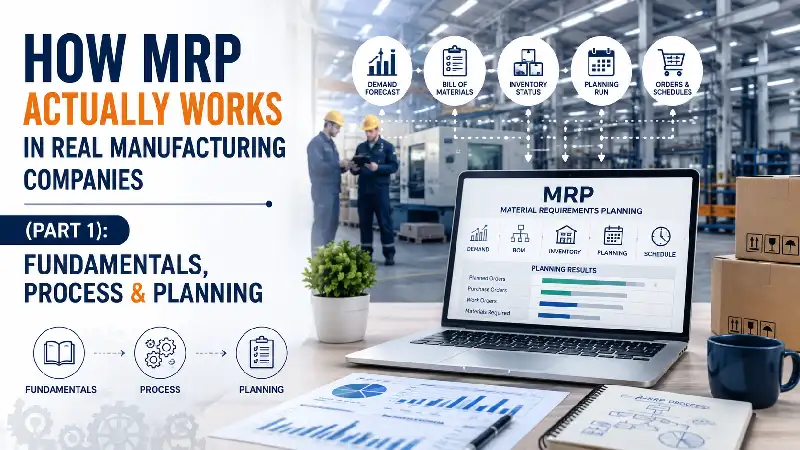
The Complete Guide to Material Requirements Planning from the Factory Floor
“Our warehouse is full, but production has stopped.”
When I first heard this statement nearly two decades ago during an ERP implementation, I thought it was impossible.
How could a factory worth hundreds of crores stop production when every warehouse was packed with inventory?
Curious, I walked into the warehouse.
Every rack was occupied.
Raw materials were stacked from floor to ceiling.
Semi-finished goods were waiting for the next operation.
Finished products were ready for dispatch.
Everything looked perfect.
Then I entered the shop floor.
One of the most expensive CNC machines in the factory stood completely idle.
Operators were waiting.
Production supervisors looked frustrated.
I asked the Production Manager,
“Why has production stopped?”
He smiled and replied,
“We’re waiting for six bearings worth less than ₹500. Without them, we cannot complete products worth more than ₹35 lakh.”
That single sentence explains one of the biggest challenges in manufacturing.
Factories rarely stop because they don’t have inventory.
They stop because they don’t have the right inventory at the right time.
And that is exactly why Material Requirements Planning (MRP) exists.
The Biggest Myth About MRP
Ask ten manufacturing professionals,
“What is MRP?”
Most answers sound like this.
- It is an ERP module.
- It generates Purchase Requisitions.
- It creates Production Orders.
- It plans inventory.
- It calculates shortages.
All of these answers are correct.
But they are incomplete.
MRP is not simply another ERP module.
It is the brain of manufacturing planning.
Imagine trying to manufacture thousands of products every month.
Every finished product may contain:
- Hundreds of components
- Multiple sub-assemblies
- Different suppliers
- Different lead times
- Different warehouses
- Different production processes
Now imagine calculating all of this manually.
Almost impossible.
That is exactly what MRP does within seconds.
It thinks.
It calculates.
It predicts.
It recommends.
Most importantly,
it helps manufacturers avoid expensive planning mistakes.
Why Most Manufacturing Companies Struggle with Planning
Over the last 19 years, I have implemented ERP systems in pharmaceutical companies, engineering industries, FMCG manufacturers, retail businesses, food processing companies, plastic industries, and many other sectors.
Interestingly, almost every manufacturing company faces similar problems.
The products are different.
The machines are different.
The customers are different.
But the planning problems remain almost identical.
For example,
Production says:
“Purchase didn’t arrange material.”
Purchase replies:
“Production changed the schedule again.”
Warehouse says:
“Inventory is available.”
Production responds:
“Yes, but not the material we actually need.”
Sales asks:
“Can we deliver by Friday?”
Production answers:
“Only if raw material arrives tomorrow.”
Finance asks:
“Why is inventory increasing every month?”
Management asks:
“Why are we still buying materials urgently?”
If these conversations sound familiar, your factory is not alone.
These are exactly the problems MRP is designed to solve.
Manufacturing Is Like Solving a Giant Puzzle
Many people believe manufacturing begins when production starts.
Actually, production starts much earlier.
Let’s imagine you manufacture industrial pumps.
A customer places an order for 500 pumps.
Most people think the next step is production.
It isn’t.
The planner immediately starts asking dozens of questions.
- Do we have enough motors?
- Do we have enough bearings?
- Are pump housings available?
- Which materials must be purchased?
- Which materials can be manufactured?
- Which suppliers have long delivery times?
- Which machines are available?
- Which production orders should receive priority?
- Can we still meet the customer’s delivery date?
Every answer depends on accurate planning.
Without planning, production becomes guesswork.
With planning, manufacturing becomes predictable.
This planning process is known as Material Requirements Planning (MRP).
What Exactly Is Material Requirements Planning?
Let’s forget complicated ERP terminology for a moment.
Imagine your daughter is getting married.
The wedding is three months away.
Would you purchase everything today?
Probably not.
Instead, you prepare a plan.
You estimate:
- Number of guests
- Food requirements
- Decoration
- Invitation cards
- Accommodation
- Transportation
- Photography
- Gifts
Then you ask:
What do we already have?
What must be purchased?
Who will supply it?
When should each item arrive?
What happens if something gets delayed?
Without realizing it, you have already performed Material Requirements Planning.
The only difference is that instead of planning a wedding,
MRP plans an entire factory.
It answers five important questions.
- What materials are required?
- How much is required?
- When are they required?
- Should they be purchased or manufactured?
- When should planning activities begin?
Everything else is simply mathematics.
The One Sentence That Explains MRP
If someone asks me to explain MRP in one sentence, I always say:
MRP ensures that the right material is available at the right place, in the right quantity, at the right time—without investing unnecessary money in excess inventory.
This is the real objective.
Not purchasing more.
Not reducing inventory blindly.
But maintaining the right inventory.
MRP Is Not Only for Large Manufacturers
Another misconception I hear frequently is:
“Our company is too small for MRP.”
This couldn’t be further from the truth.
Whether you manufacture:
- Pharmaceutical tablets
- Automobile components
- Electrical panels
- Furniture
- Plastic bottles
- Garments
- Food products
- Engineering equipment
- Consumer electronics
the planning questions remain exactly the same.
Every manufacturer wants answers to these questions.
- What do we need?
- When do we need it?
- Where will it come from?
- Can we manufacture it ourselves?
- Should we purchase it?
- Will we deliver on time?
MRP answers these questions every single day.
How MRP Actually Thinks
One interesting observation during ERP demonstrations is that many users imagine MRP as some mysterious algorithm.
In reality, MRP thinks very logically.
Before generating a single recommendation, it asks itself five questions.
Question 1 – What Is the Demand?
Everything begins with demand.
Without demand,
there is no planning.
Demand may come from:
- Sales Orders
- Sales Forecast
- Master Production Schedule (MPS)
- Safety Stock
- Distribution Requirements
- Inter-Plant Requirements
If demand changes,
the entire planning process changes.
Question 2 – What Materials Are Needed?
Now ERP checks the Bill of Materials (BOM).
Think of BOM as the recipe for manufacturing.
If you want to bake a cake,
you need flour,
sugar,
eggs,
butter,
milk,
and baking powder.
Similarly,
if you want to manufacture an industrial pump,
the ERP checks every required component.
The BOM tells ERP exactly what is needed.
Question 3 – Do We Already Have the Material?
This is where many people misunderstand MRP.
ERP doesn’t immediately recommend purchasing.
Instead, it first checks every possible source.
It looks for:
- Warehouse Inventory
- Reserved Stock
- Goods Under Inspection
- Existing Purchase Orders
- Existing Production Orders
- Inter-Plant Stock
- Transfer Orders
If the material already exists,
there is absolutely no reason to buy it again.
Question 4 – When Is the Material Required?
Timing is everything.
Suppose a customer requires delivery on 30 September.
One imported component takes 60 days.
Another locally purchased item requires 5 days.
Internal machining requires 3 days.
Painting requires 2 days.
Assembly requires 1 day.
Packaging requires 1 day.
MRP performs backward scheduling.
Instead of asking,
“When should production start?”
it asks,
“If dispatch is on 30 September, when should every activity begin?”
This is one of the smartest calculations inside any ERP system.
Question 5 – Should We Buy or Manufacture?
Not every component follows the same path.
Some materials should be purchased.
Some are manufactured internally.
Some are outsourced to job workers.
Some arrive from another manufacturing plant.
MRP identifies the appropriate planning strategy for each item.
The Five Building Blocks of Every Successful MRP System
No matter which ERP software you use,
SAP,
Oracle,
Microsoft,
Infor,
or any other manufacturing ERP,
every MRP engine depends on five critical building blocks.
If even one of these is incorrect,
the planning recommendations become unreliable.
These building blocks are:
1. Demand
No demand.
No planning.
Simple.
2. Bill of Materials (BOM)
The manufacturing recipe.
Every component must be correct.
3. Inventory
The ERP must know exactly what is available.
Incorrect inventory creates incorrect planning.
4. Lead Time
Every purchased and manufactured item requires time.
Without accurate lead times,
MRP cannot predict delivery dates.
5. Planning Policies
Every organization follows planning rules.
For example:
- Safety Stock
- Lot-for-Lot
- Fixed Order Quantity
- Minimum Order Quantity
- Maximum Order Quantity
- Economic Order Quantity
These policies guide MRP in generating practical recommendations.
Why Master Production Schedule (MPS) Comes Before MRP
One concept many organizations overlook is the relationship between MPS and MRP.
Think of MPS as answering the question:
“What finished products are we planning to build?”
MRP then answers:
“What materials do we need to build them?”
A simple flow looks like this:
Sales Forecast / Customer Orders
⬇
Master Production Schedule (MPS)
⬇
Material Requirements Planning (MRP)
⬇
Purchase Planning
⬇
Production Planning
⬇
Shop Floor Execution
⬇
Finished Goods
⬇
Customer Delivery
Without a proper Master Production Schedule, MRP is simply reacting to transactions instead of supporting a planned manufacturing strategy.
From Customer Order to Material Planning: How MRP Actually Makes Decisions
Now let’s go one step further.
Let’s see what actually happens inside an ERP system when a customer places an order.
This is the stage where most manufacturing managers become curious.
They often ask me,
“What exactly happens after I click the ‘Run MRP’ button?”
The answer is fascinating.
An ERP system doesn’t simply check inventory and generate Purchase Requisitions.
It performs hundreds of logical calculations within a few seconds.
Let’s understand this using a real manufacturing example.
A Real Manufacturing Scenario
Imagine a company called ABC Pumps Pvt. Ltd. that manufactures industrial water pumps.
One Monday morning, the Sales Department receives a customer order.
Customer Requirement
- Product: Industrial Water Pump
- Quantity: 500 Units
- Delivery Date: 30 September
The Sales Executive confirms the order.
Immediately, the Planning Department receives a notification.
Now the planner has one objective.
“Can we manufacture and deliver 500 pumps before 30 September?”
Instead of manually checking thousands of inventory records, the planner runs MRP.
Within seconds, ERP begins its calculations.
Step 1 – Understanding the Bill of Materials (BOM)
Every manufactured product has a recipe.
In manufacturing, this recipe is called the Bill of Materials (BOM).
Suppose one industrial pump requires:
| Component | Quantity |
| Motor | 1 |
| Pump Housing | 1 |
| Shaft | 1 |
| Bearings | 2 |
| Mechanical Seal | 1 |
| Bolts | 8 |
| Name Plate | 1 |
| Packing Material | 1 |
The customer ordered 500 pumps.
Immediately, ERP performs its first major calculation.
BOM Explosion – The Heart of MRP
The term BOM Explosion sounds technical, but the concept is simple.
Instead of planning only the finished product, ERP “explodes” the BOM into individual material requirements.
For our order of 500 pumps, the ERP calculates:
| Component | Required Quantity |
| Motors | 500 |
| Pump Housings | 500 |
| Shafts | 500 |
| Bearings | 1,000 |
| Mechanical Seals | 500 |
| Bolts | 4,000 |
| Name Plates | 500 |
| Packing Material | 500 |
This calculation happens almost instantly.
Now imagine performing this manually for:
- 8,000 finished products
- 75,000 raw materials
- Multiple warehouses
- Multiple factories
That is exactly why manufacturers depend on ERP.
Multi-Level BOM – Where MRP Becomes Really Powerful
Real factories rarely manufacture simple products.
Let’s look deeper.
Suppose the Motor itself is manufactured internally.
The motor contains:
- Rotor
- Stator
- Bearings
- Fan
- Terminal Box
Now the Rotor contains:
- Shaft
- Copper Winding
- Laminations
The Shaft requires:
- Steel Bar
The Steel Bar originates from:
- Steel Billets
Notice what happened.
A customer simply ordered:
500 Pumps
But ERP has now reached the raw material level several stages below.
This is called a Multi-Level BOM Explosion.
Without ERP, calculating this manually would take days.
ERP completes it in seconds.
Inventory Check – The Next Critical Step
After identifying every required material, ERP performs another important calculation.
It asks:
“Do we already have these materials?”
Suppose the warehouse contains:
| Material | Required | Available |
| Motors | 500 | 200 |
| Bearings | 1,000 | 900 |
| Bolts | 4,000 | 7,000 |
| Mechanical Seals | 500 | 120 |
Notice something interesting.
The company has more than enough bolts.
Therefore,
ERP will not recommend purchasing bolts.
Instead,
it concentrates only on shortages.
This prevents unnecessary inventory investment.
Gross Requirement vs Net Requirement
This is one of the most important MRP calculations.
Many new ERP users become confused here.
Let’s simplify it.
Suppose ERP calculates:
Gross Requirement
= 1,000 Bearings
Current Inventory
= 700
Open Purchase Orders
= 150
Open Production Orders
= 50
Safety Stock
= 100
ERP calculates:
Available Supply
= 700 + 150 + 50
= 900
Net Requirement
= 1,000 – 900
= 100 Bearings
Instead of recommending 1,000 bearings,
ERP recommends purchasing only 100 bearings.
That is why MRP helps reduce inventory.
It purchases only what is actually needed.
Why Safety Stock Exists
Suppose your factory consumes
100 bearings every day.
Supplier Lead Time
= 10 Days
If your supplier delays delivery by three days,
production may stop.
To avoid this,
companies maintain Safety Stock.
For example:
Daily Consumption
= 100 Bearings
Lead Time
= 10 Days
Safety Stock
= 300 Bearings
Even if demand suddenly increases,
or the supplier delays shipment,
production can continue.
MRP automatically considers this safety stock before generating recommendations.
Planning Using Lead Time
Lead Time is one of the smartest parts of MRP.
Let’s understand why.
Suppose the customer requires delivery on:
30 September
Final Assembly
requires
3 Days
Painting
requires
2 Days
Machining
requires
5 Days
Purchased Bearings
require
25 Days
Imported Motor
requires
60 Days
ERP performs Backward Scheduling.
Instead of asking,
“When should we buy motors?”
It asks,
“If customer delivery is on 30 September,
when should every activity begin?”
The ERP may calculate something like this:
Customer Delivery
30 September
↓
Packaging
29 September
↓
Assembly
26 September
↓
Painting
24 September
↓
Machining
19 September
↓
Raw Material Availability
18 September
↓
Purchase Order Release
20 July
Without this backward planning,
purchasing teams often place orders too late.
What About Manufacturing Scrap?
Real manufacturing is never perfect.
Every process generates some loss.
Suppose your product requires
100 kg Steel.
Historical scrap
= 5%
ERP doesn’t recommend
100 kg.
It recommends:
105 kg.
Because approximately
5 kg
will become scrap during manufacturing.
This ensures production receives sufficient material.
Without scrap planning,
shortages become common.
Yield Loss – Especially Important in Pharmaceutical and Food Industries
Let’s consider a pharmaceutical company manufacturing tablets.
Input Material
100 kg
Expected Manufacturing Yield
98%
Expected Process Loss
2%
To produce
98 kg
of finished granules,
ERP recommends
100 kg
of raw material.
Similarly,
food manufacturers,
chemical companies,
paint industries,
and FMCG organizations
all use yield calculations during MRP.
Without yield planning,
production quantities become inaccurate.
MRP vs Capacity Planning
One misconception is that MRP plans everything.
Actually,
MRP plans materials.
Capacity Planning plans machines and labour.
Imagine MRP recommends producing
2,000 pumps next week.
Wonderful.
But now another question appears.
Do we actually have enough machine hours?
Do we have enough operators?
Is one CNC machine under maintenance?
Can the paint booth handle this quantity?
These questions belong to Capacity Planning, not MRP.
Think of it this way.
MRP asks
“Do we have material?”
Capacity Planning asks
“Can we actually manufacture it?”
Both must work together.
About the Author
Surya Sagar is an ERP Solution Architect and Manufacturing Consultant with more than 19 years of experience in Enterprise Resource Planning (ERP), Manufacturing, Supply Chain Management, Material Requirements Planning (MRP), Warehouse Management, Costing, and Digital Transformation.
Throughout his career, he has successfully delivered more than 100 ERP implementation projects across industries including pharmaceuticals, engineering, retail, food processing, distribution, construction, consumer goods, and industrial manufacturing.
His expertise lies in helping organizations simplify complex business processes, improve production planning, optimize inventory, strengthen supply chain operations, and implement ERP solutions that deliver measurable business outcomes.
Rather than focusing solely on software implementation, Surya believes that successful ERP projects are built on strong business processes, accurate data, and continuous improvement.
Through ERPPilot, Cyprus ERP, and Onfinity ERP, he regularly shares practical implementation experiences, manufacturing insights, and ERP best practices to help organizations maximize the return on their digital transformation investments.
In Part 2, we’ll explore how MRP works in real factories, how planners manage exceptions, how purchase and production orders are generated, and the best practices that successful manufacturers follow


