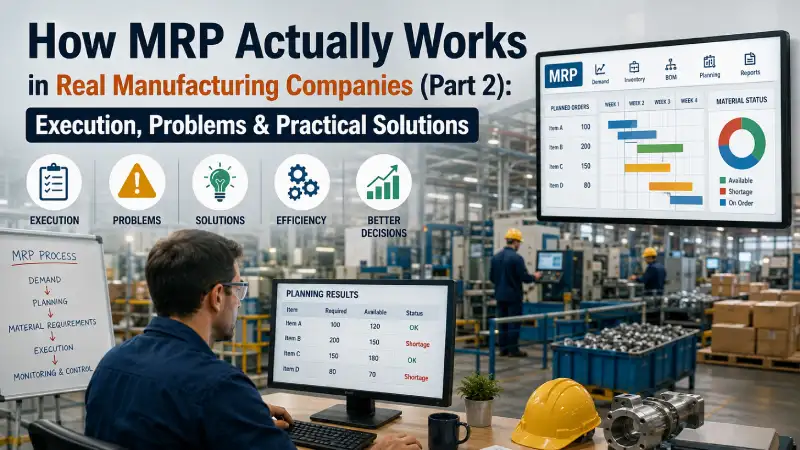
A Complete MRP Run Inside ERP
Now let’s connect everything we’ve learned.
This is what happens inside an ERP system after receiving a customer order.
Customer Order
│
▼
Master Production Schedule (MPS)
│
▼
MRP Run Starts
│
▼
Read Bill of Materials
│
▼
Perform Multi-Level BOM Explosion
│
▼
Check Current Inventory
│
▼
Check Open Purchase Orders
│
▼
Check Open Production Orders
│
▼
Calculate Gross Requirement
│
▼
Calculate Net Requirement
│
▼
Apply Safety Stock Rules
│
▼
Apply Lead Time Calculation
│
▼
Apply Lot Size & Planning Policies
│
▼
Generate Planning Recommendations
│
├── Purchase Requisition
├── Planned Production Order
├── Transfer Order
└── Job Work Recommendation
This is why an ERP system can complete in minutes what would take planners several days using spreadsheets.
Why Planners Still Matter
One common fear during ERP implementation is:
“Will MRP replace production planners?”
Absolutely not.
MRP is a planning assistant.
It provides recommendations.
Experienced planners still make the final decision.
For example,
Suppose ERP recommends purchasing steel today.
But the planner knows:
- Supplier prices are expected to drop next week.
- A customer may postpone delivery.
- Another plant has excess inventory.
- Machine maintenance has been scheduled.
Only an experienced planner can make these judgement calls.
The best manufacturing companies combine:
- Intelligent ERP recommendations
- Experienced production planners
That combination produces outstanding results.
The Biggest Lesson I’ve Learned
After implementing ERP systems in manufacturing companies for more than 19 years,
one lesson has remained constant.
Factories do not become successful because they purchase expensive ERP software.
They become successful because they trust data,
maintain accurate master information,
continuously improve planning,
and make timely decisions.
ERP simply provides the intelligence.
People create the results.
Why MRP Fails in Real Manufacturing Companies (And How Successful Companies Get It Right)
If you’ve reached this point, you now understand how MRP works.
You know how ERP reads demand, explodes the Bill of Materials, checks inventory, considers lead times, and generates purchase and production recommendations.
So the obvious question is:
“If MRP is so powerful, why do so many manufacturing companies still struggle with planning?”
This is probably the question I have been asked most during my ERP consulting career.
Interestingly, after implementing ERP systems across manufacturing companies for more than 19 years, I have discovered something important.
MRP rarely fails.
Business processes fail.
The ERP simply reflects the quality of the information it receives.
Think of MRP like the GPS in your car.
If the destination entered into the GPS is wrong, the GPS will faithfully guide you to the wrong place.
It isn’t the GPS that failed.
The input was incorrect.
MRP behaves exactly the same way.
If demand, inventory, BOMs, lead times, or planning rules are incorrect, MRP produces incorrect recommendations.
Let’s look at the most common reasons.
1. Poor Bill of Materials (BOM)
Every successful MRP implementation starts with one thing.
A correct Bill of Materials.
Unfortunately, this is also one of the most neglected areas.
I once worked with an engineering company where production repeatedly stopped before final assembly.
The ERP appeared to be functioning correctly.
Inventory levels looked healthy.
Purchase Orders were generated on time.
Yet every week the same problem occurred.
After investigating, we discovered that a small stainless-steel washer had never been added to the Bill of Materials.
Its value was less than ₹10.
But without it, machines worth several lakhs could not be assembled.
The ERP never planned it because it didn’t know the component existed.
One missing line in the BOM affected production for months.
The lesson was simple.
MRP can only plan what exists in the Bill of Materials.
2. Incorrect Inventory Records
Many organizations proudly say,
“Our inventory is updated in ERP.”
But accurate inventory is much more than entering stock transactions.
Suppose ERP shows:
Steel Plates
Available Stock
= 500 Sheets
The planner trusts the system.
MRP trusts the system.
Production planning begins.
The next morning,
the warehouse team discovers only
420 sheets
are actually available.
Why?
Because:
- Goods were issued without recording them.
- Scrap was never updated.
- Inventory adjustments were delayed.
- Materials were shifted between warehouses without proper transactions.
Suddenly,
production is delayed,
purchase orders become urgent,
and management blames MRP.
The problem isn’t MRP.
The problem is inventory accuracy.
3. Incorrect Lead Times
Lead Time is one of the most overlooked planning parameters.
During implementation,
many companies estimate supplier lead times.
Six months later,
those lead times are no longer valid.
Imagine this situation.
ERP assumes:
Imported Motor
Lead Time
30 Days
But due to shipping delays,
actual delivery now requires
60 Days.
MRP continues planning using the old value.
Production schedules become unrealistic.
Customer deliveries get delayed.
Everyone wonders why MRP failed.
In reality,
the ERP simply followed outdated information.
Successful companies review supplier lead times regularly rather than treating them as permanent values.
4. Wrong Planning Policies
Every company has unique planning rules.
Some materials are purchased only once every month.
Some are ordered weekly.
Some require minimum order quantities.
Some must always maintain safety stock.
If these planning policies are incorrect,
MRP recommendations quickly become unrealistic.
For example,
suppose a supplier accepts orders only in multiples of 500 units.
But ERP has been configured with
Lot-for-Lot Planning.
The customer orders
35 units.
MRP recommends purchasing
35 units.
The supplier refuses.
Planning immediately breaks down.
The ERP did exactly what it was configured to do.
Configuration matters.
5. People Continue Planning in Excel
This is one of the biggest challenges I have seen.
Organizations invest in ERP.
Users receive training.
MRP is implemented successfully.
Then quietly,
planning moves back into Excel.
Why?
Because people trust spreadsheets more than ERP.
Soon,
there are two versions of reality.
ERP says one thing.
Excel says another.
Meetings become arguments instead of discussions.
The Production Manager trusts Excel.
Purchase trusts ERP.
Finance trusts inventory valuation.
Warehouse trusts physical stock.
Nobody trusts each other.
Whenever planning exists in multiple places,
confusion becomes inevitable.
A successful manufacturer establishes one rule:
ERP becomes the single source of truth.
6. Management Stops Reviewing ERP Data
Another common mistake is believing ERP implementation ends after Go-Live.
Actually,
Go-Live is only the beginning.
The organizations that gain maximum value from ERP are the ones where leadership actively uses ERP information every day.
Instead of asking,
“Can someone prepare this report?”
they ask,
“Let’s open the dashboard.”
This simple habit changes everything.
Employees maintain better data.
Departments collaborate more effectively.
Decisions become faster.
Data quality improves naturally.
Leadership creates ERP culture.
7. Lack of Continuous Improvement
Manufacturing never stands still.
Customer demand changes.
Suppliers change.
Technology changes.
Markets change.
Planning should change too.
Yet many organizations freeze their ERP setup immediately after implementation.
The same planning parameters remain unchanged for years.
The same reports are used.
The same manual workarounds continue.
Successful manufacturers continuously improve:
- Planning Parameters
- Dashboards
- Reports
- Approval Workflows
- MRP Policies
- Supplier Performance Analysis
- Demand Forecasting
ERP is never a finished project.
It evolves with the business.
A Real-Life Story Every Manufacturer Can Relate To
One manufacturing company I worked with had invested significantly in ERP.
The implementation was technically successful.
Yet the Planning Department continued maintaining a massive Excel workbook.
Every morning,
three planners spent almost three hours updating spreadsheets before beginning actual planning.
When I asked,
“Why aren’t you using ERP planning recommendations?”
the answer surprised me.
“We don’t fully trust MRP.”
Instead of changing the software,
we reviewed the planning process.
Within two weeks, we discovered:
- Incorrect supplier lead times.
- Duplicate Bills of Materials.
- Safety stock values that had not been updated in years.
- Inventory mismatches.
- Obsolete planning policies.
After correcting the master data,
the planners stopped using Excel.
Not because we forced them.
Because ERP recommendations had become reliable.
The software hadn’t changed.
The quality of information had.
That experience reinforced an important lesson.
Good data creates confidence.
Why MRP Recommendations Change Every Day
One concern I hear frequently is:
“Yesterday MRP recommended purchasing 500 bearings. Today it recommends only 120. Tomorrow it recommends 850. Why?”
The answer is simple.
Manufacturing is dynamic.
Every day something changes.
For example:
- New customer orders arrive.
- Existing orders get postponed.
- Production consumes inventory.
- Suppliers deliver materials.
- Machines break down.
- Quality rejects components.
- Purchase Orders are cancelled.
- Safety stock policies change.
MRP always calculates using the latest information available.
Changing recommendations are usually a sign that your ERP is responding to business reality—not making mistakes.
The goal of MRP is not to produce the same answer every day.
The goal is to produce the right answer based on current conditions.
How Artificial Intelligence Is Changing MRP
Traditional MRP is excellent at calculating material requirements based on the information available today.
Artificial Intelligence takes planning one step further.
Instead of asking,
“What do we need?”
AI begins asking,
“What are we likely to need?”
Modern AI-powered planning can analyze:
- Historical Sales Trends
- Seasonal Demand
- Supplier Performance
- Customer Buying Patterns
- Production Delays
- Machine Utilization
- Market Trends
- Inventory Consumption
- Delivery Performance
Imagine a system that identifies a supplier who has been delivering late for the past three months and automatically recommends placing future purchase orders earlier.
Or a system that predicts increased demand before the festival season based on previous years’ sales.
That is where manufacturing planning is heading.
AI doesn’t replace MRP.
It makes MRP smarter.
Five Lessons I’ve Learned After More Than 19 Years in ERP Consulting
Every ERP implementation teaches something new.
But these five lessons remain true in almost every manufacturing company.
Lesson 1
The most expensive ERP cannot compensate for poor business processes.
Lesson 2
Good master data is often more valuable than additional software customizations.
Lesson 3
Successful planning depends on collaboration between Sales, Purchase, Production, Warehouse, and Finance—not on one department working alone.
Lesson 4
ERP implementation is a project.
ERP optimization is a continuous journey.
Lesson 5
Factories that make decisions using data consistently outperform factories that rely on assumptions.
That is perhaps the greatest value ERP brings to manufacturing.
Best Practices for Building a Successful MRP Environment
Organizations planning to improve MRP should focus on the following areas.
Keep Bills of Materials Accurate
Review engineering changes regularly.
Ensure every component is represented correctly.
Improve Inventory Accuracy
Regular cycle counting and disciplined transaction recording improve planning reliability.
Review Lead Times Frequently
Supplier performance changes over time.
Planning parameters should reflect current business conditions.
Train Users Beyond Software
Employees should understand why MRP generates recommendations—not just how to run the process.
Monitor KPIs
Measure improvements through:
- Inventory Turnover
- Material Availability
- On-Time Delivery
- Production Efficiency
- Stock-Out Frequency
- Purchase Lead Time
Continuous measurement drives continuous improvement.
Building a World-Class Manufacturing Planning System with MRP
In the previous sections, we’ve explored how MRP works, why it sometimes fails, and what successful manufacturers do differently.
Now comes the most important question.
“How do we move from reactive planning to a truly world-class manufacturing planning process?”
The answer is surprisingly simple.
It isn’t about purchasing the most expensive ERP software.
It isn’t about hiring more planners.
It isn’t about maintaining larger inventories.
The most successful manufacturers focus on three things:
- Accurate Data
- Standardized Processes
- Continuous Improvement
When these three elements come together, MRP becomes far more than a planning engine.
It becomes a competitive advantage.
A Practical MRP Maturity Checklist
Before investing time or money in improving your planning process, ask yourself these questions.
Demand Planning
✅ Are customer forecasts reviewed regularly?
✅ Are Sales Orders updated immediately?
✅ Is your Master Production Schedule (MPS) reviewed every week?
Bill of Materials
✅ Are Engineering Change Notices reflected immediately?
✅ Are all BOM revisions properly controlled?
✅ Are obsolete components removed?
Inventory
✅ Is inventory accuracy consistently above 98%?
✅ Are cycle counts performed regularly?
✅ Are stock transfers updated immediately?
Lead Time
✅ Are supplier lead times reviewed periodically?
✅ Are manufacturing lead times updated after process improvements?
Production Planning
✅ Are planners using ERP recommendations?
✅ Has manual Excel planning been minimized?
Management
✅ Does leadership review ERP dashboards regularly?
✅ Are planning decisions based on ERP data rather than assumptions?
If your answer is “No” to several of these questions, there is significant opportunity to improve your manufacturing planning.
The Future of Manufacturing Planning
Manufacturing has changed dramatically over the last decade.
Earlier, planners spent hours collecting information.
Today, ERP systems collect information automatically.
Tomorrow, Artificial Intelligence will help planners make better decisions before problems occur.
Manufacturing planning is evolving from:
Reactive Planning
↓
Planned Manufacturing
↓
Predictive Planning
↓
AI-Assisted Decision Making
↓
Autonomous Manufacturing
Factories that begin preparing today will gain a significant competitive advantage over those that continue relying on spreadsheets and manual planning.
How Cyprus ERP and Onfinity ERP Simplify Manufacturing Planning
At Cyprus ERP and Onfinity ERP, our philosophy has always been simple.
ERP should simplify manufacturing—not complicate it.
During many ERP implementations, we noticed that manufacturers didn’t struggle because they lacked software.
They struggled because planning information was scattered across spreadsheets, emails, manual registers, and disconnected departments.
Our objective was to bring everything together into one integrated platform where every department works from the same information.
Both Cyprus ERP and Onfinity ERP are designed around real manufacturing operations and support industries such as engineering, pharmaceuticals, food processing, plastics, furniture, consumer goods, chemicals, automotive components, and many more.
A Real Experience from an ERP Implementation
One of the most rewarding implementation projects involved a manufacturing organization operating three production units under a single legal entity.
Each plant had a different responsibility.
- Plant 1 manufactured semi-finished components.
- Plant 2 assembled the finished product.
- Plant 3 produced specialized sub-assemblies.
Initially, each plant planned its materials independently.
One plant often had excess inventory while another faced shortages of the very same component.
Inter-plant transfers were largely reactive.
Production schedules changed frequently.
Management believed the solution was simply to purchase more inventory.
After reviewing the planning process, it became clear that the issue wasn’t inventory levels—it was the lack of integrated planning.
By implementing centralized MRP, standardized Bills of Materials, synchronized lead times, and coordinated production schedules, the planning process became significantly more reliable.
The results over the following months included:
- Better visibility across all manufacturing units.
- Reduced emergency purchasing.
- Improved material availability.
- Better coordination between production plants.
- More predictable production schedules.
- Greater confidence in ERP planning recommendations.
This experience reinforced an important lesson:
Successful MRP is not just about software. It is about ensuring every department plans together instead of planning in isolation.
Frequently Asked Questions (FAQs)
1. What is Material Requirements Planning (MRP)?
MRP is a planning process that calculates what materials are required, how much is needed, and when those materials should be purchased or manufactured to meet production demand.
2. What is the difference between MRP and ERP?
MRP is a manufacturing planning function.
ERP is an integrated business system that includes finance, procurement, sales, inventory, manufacturing, human resources, and many other business processes.
MRP is one important component of an ERP system.
3. What information does MRP require?
MRP depends on:
- Customer Demand
- Sales Forecast
- Bill of Materials
- Inventory
- Lead Time
- Planning Policies
- Production Schedule
The quality of recommendations depends on the quality of this information.
4. Why does MRP recommend purchasing materials that appear to be available?
This can happen when inventory is reserved for another order, allocated to an existing production order, under quality inspection, or when safety stock policies prevent it from being consumed.
5. Does MRP automatically generate Purchase Orders?
Most ERP systems first generate planned recommendations or Purchase Requisitions.
Organizations usually review and approve these before converting them into Purchase Orders.
6. Can MRP reduce inventory?
Yes.
When master data and planning policies are accurate, MRP helps organizations purchase and manufacture only what is needed, reducing excess inventory while maintaining material availability.
7. Can small manufacturers benefit from MRP?
Absolutely.
Whether a company manufactures furniture, pharmaceuticals, garments, engineering products, food items, or electronics, MRP helps improve planning and reduce operational uncertainty.
8. How often should MRP be run?
The answer depends on the business.
Many manufacturers run MRP daily, while organizations with rapidly changing demand may run it several times a day.
9. What is the biggest reason MRP implementations fail?
In most real-world projects, poor master data, inaccurate inventory, outdated planning parameters, and lack of process discipline cause more problems than the software itself.
10. Is Artificial Intelligence replacing MRP?
No.
AI enhances MRP by improving forecasting, identifying trends, and providing predictive insights.
MRP remains the foundation of manufacturing planning.
About the Author
Surya Sagar is an ERP Solution Architect and Manufacturing Consultant with more than 19 years of experience in Enterprise Resource Planning (ERP), Manufacturing, Supply Chain Management, Material Requirements Planning (MRP), Warehouse Management, Costing, and Digital Transformation.
Throughout his career, he has successfully delivered more than 100 ERP implementation projects across industries including pharmaceuticals, engineering, retail, food processing, distribution, construction, consumer goods, and industrial manufacturing.
His expertise lies in helping organizations simplify complex business processes, improve production planning, optimize inventory, strengthen supply chain operations, and implement ERP solutions that deliver measurable business outcomes.
Rather than focusing solely on software implementation, Surya believes that successful ERP projects are built on strong business processes, accurate data, and continuous improvement.
Through ERPPilot, Cyprus ERP, and Onfinity ERP, he regularly shares practical implementation experiences, manufacturing insights, and ERP best practices to help organizations maximize the return on their digital transformation investments.
Final Thoughts
If there is one lesson, I hope you take away from this article, it is this:
MRP is not a magic button.
It will not fix poor planning.
It will not correct inaccurate inventory.
It will not repair incomplete Bills of Materials.
It will not replace experienced planners.
But when combined with disciplined processes, accurate master data, and engaged people, MRP becomes one of the most valuable tools a manufacturer can have.
The companies that consistently deliver on time, maintain healthy inventory levels, reduce emergency purchases, and improve profitability are rarely the ones with the biggest warehouses.
They are the ones with the best planning.
In today’s competitive manufacturing environment, planning is no longer just an operational activity.
It is a strategic advantage.
Organizations that invest in better planning today will be better prepared for tomorrow’s challenges.
Ready to Transform Your Manufacturing Planning?
If your manufacturing company is experiencing any of these challenges:
- Frequent raw material shortages
- Excess inventory but poor material availability
- Last-minute purchasing
- Daily production schedule changes
- Planners depending on spreadsheets
- Missed customer delivery dates
- Low confidence in MRP recommendations
- Difficulty coordinating multiple manufacturing plants
then the opportunity may not be to purchase another software solution—it may be to improve the way your current planning process works.
At Cyprus ERP and Onfinity ERP, we help manufacturers build integrated planning environments where sales, procurement, inventory, production, warehouse, and finance work together using a single source of reliable information.
Whether you’re implementing ERP for the first time, upgrading an existing manufacturing system, or looking to optimize your MRP process, our team can help you design a planning strategy that supports sustainable growth.
The goal isn’t simply to run MRP.
The goal is to build a manufacturing organization where the right material reaches the right machine at the right time—every single day.


