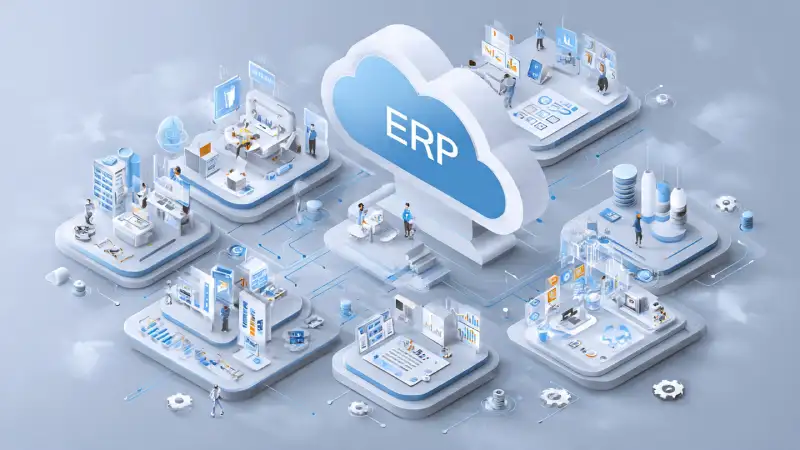
In our fast-moving digital age, companies are under pressure to be more efficient, adaptable, and data-focused than ever. Handling areas like finance, inventory, production, and HR separately can often lead to unnecessary duplication, delays, and data silos. That’s where ERP software (Enterprise Resource Planning) comes into play — it’s a single system that combines all your key business processes in one place.
What Is ERP Software?
Enterprise Resource Planning (ERP) refers to an integrated computer-based system designed to manage an organization’s internal and external resources — this includes finance, inventory, materials, operations, and human resources.
The aim of ERP is straightforward but impactful: to enhance the flow of information across departments, boost productivity, and provide a unified source of truth for the entire organization. An ERP system merges all business functions into one centralized platform, doing away with the need for separate, disconnected systems for each department.
How ERP Software Works
ERP software typically operates on a centralized database and often features a modular design. This means that each module (like Sales, Purchasing, Finance, HR, or Manufacturing) addresses a specific function while easily integrating with others.
Depending on the size and structure of a business, ERP systems can be:
- Centralized: All modules hosted on one server for better control.
- Distributed: Modules are installed across different servers or networks, communicating via APIs or service-oriented architecture (SOA).
- This modular, service-based layout helps organizations to:
- Start off small and grow as needed.
- Easily connect various vendors’ solutions.
- Reduce unnecessary IT infrastructure costs.
- Access real-time data across departments.
Key Modules in an ERP System
Modern ERP systems cover nearly all functional areas of a business. Core modules usually include:
- Financial Management: Takes care of the general ledger, accounts receivable/payable, budgeting, and financial reporting.
- Procurement & Inventory Management: Manages purchasing, supplier relations, material receipts, and stock control.
- Sales & Distribution: Deals with sales orders, quotes, invoicing, and tracking deliveries.
- Manufacturing & Production Planning: Includes Bill of Materials (BOM), routing, work orders, MRP (Material Requirements Planning), and shop floor control.
- Human Resources & Payroll: Manages employee records, payroll, attendance, and performance tracking.
- CRM (Customer Relationship Management): Helps track customer interactions, leads, and service requests.
- Project Management: Allows for project tracking, resource allocation, and cost monitoring.
- Business Intelligence & Analytics: Provides dashboards and reports for data-driven decision-making.
Each module talks to the others in real time — for example, when a sales order is entered, inventory levels, production plans, and accounting entries automatically get updated.
Popular ERP Systems Available
While SAP is one of the most recognized ERP systems, it’s certainly not the only choice. The ERP landscape is varied, with both commercial and open-source options catering to different needs and budgets.
Some well-known ERP systems include:
- SAP S/4HANA
- Oracle NetSuite
- Microsoft Dynamics 365
- Infor CloudSuite
- Odoo (Open Source)
- Onfinity ERP
- Cyprus ERP – an innovative open-source ERP from BRS Infotek for growing businesses.
Why Open-Source ERP Systems Are Becoming Popular
Open-source ERP solutions are changing the landscape of the ERP industry, offering functionality comparable to high-end software but at a much lower cost.
Some key benefits include:
- No hefty licensing fees — most open-source ERPs are free to use or charge only for setup and support.
- Customizability — businesses can tweak the source code to fit their exact requirements.
- Easy integration — open APIs allow for simpler connections to eCommerce, CRM, and other third-party systems.
- Community support — active developer and user communities assist with updates, extensions, and troubleshooting.
For small and medium-sized enterprises (SMEs), open-source ERP presents an excellent way to kick off their digital transformation without breaking the bank.
Challenges When Implementing ERP
Even with its many advantages, rolling out ERP software isn’t without its hurdles. Businesses should be ready for:
Data migration challenges — merging old systems into one database.
Employee training — getting staff to adapt to new workflows.
Balancing customization — finding the right mix between standard features and specific business needs.
Time and cost of implementation — careful planning and choosing the right partner is crucial.
That said, with a skilled ERP implementation partner and clear project governance, you can minimize these challenges.
Cyprus ERP & Onfinity ERP: Smart ERP Choices for Modern Businesses
For organizations looking for reliable and scalable ERP solutions, Cyprus ERP and Onfinity ERP address different business needs while sharing a common goal—process efficiency and growth.
Cyprus ERP, developed by BRS Infotek on the Adempiere framework, is a cost-effective and highly customizable solution that integrates Sales, Purchase, Inventory, Manufacturing, Finance, HR, and Projects into a single web-based platform. It is ideal for businesses seeking flexibility without high ownership costs.
Onfinity ERP, implemented by BRS Infotek as its official legal partner, offers an enterprise-grade platform with structured processes, strong compliance, and scalability for growing and multi-location organizations.
Key Highlights:
- Web-based with cloud or on-premise deployment
- Modular, scalable architecture
- Strong reporting and operational control
👉 Discover the right ERP for your business with Cyprus ERP or Onfinity ERP.
About the Author
Surya Sagar is the Founder and ERP Solution Architect at BRS Infotek, with over 18 years of experience in ERP consulting and implementations.
He is the co-creator of Cyprus ERP and leads Onfinity ERP implementations, helping businesses adopt ERP systems that simplify operations and enable digital growth.


