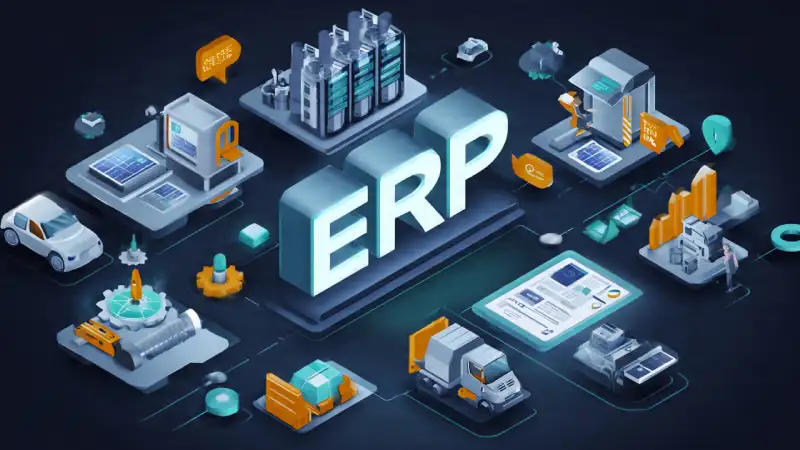
Nowadays, in a fast-paced and competitive business landscape, companies are constantly trying to boost efficiency, streamline their operations, and offer greater value to their customers. Whether it’s about tackling the rising production costs in manufacturing, navigating complex supply chain issues in retail, or trying to improve service quality in the hospitality sector, businesses across various fields are grappling with similar challenges. To tackle these hurdles, more organizations are turning to a powerful solution known as Enterprise Resource Planning (ERP).
An ERP system brings together internal and external business processes into a single, unified platform. Instead of juggling separate applications for finance, procurement, manufacturing, logistics, sales, HR, and customer service, ERP consolidates everything into one central system that relies on a shared database. This integrated approach ensures that every department operates with real-time, consistent, and accurate data. It cuts down on manual work, prevents data duplication, speeds up workflows, and facilitates quicker decision-making based on reliable insights.
When done right, ERP becomes an organization’s digital backbone, aligning people, processes, and technology. It boosts collaboration, improves visibility across departments, strengthens control, and allows businesses to react swiftly to market changes—ultimately creating a more agile and future-ready organization.
Key Characteristics of Modern ERP Systems
While ERP solutions can differ in scale, features, and the industries they focus on, the most advanced and effective ERP platforms typically share a few key characteristics that make them crucial for high-performing enterprises.
1. Integrated Platform
A modern ERP system merges all business functions—from finance and accounting to supply chain, production, and customer management—onto a single platform. This integration dismantles information silos, enhancing accuracy, transparency, and teamwork across all departments.
2. Real-Time Processing
Every action taken in an ERP system updates instantly. So, if a sales order is created, you’ll see changes in inventory availability, production plans, and financial forecasts right away. These real-time updates help leadership teams respond quickly to market changes and customer needs.
3. Centralized Database
All operational and financial data is housed in one single database. This setup guarantees consistency, boosts data accuracy, supports reliable reporting, and creates a unified source of truth for the entire organization.
4. Uniform User Interface
ERP systems are crafted with consistent layouts and controls across all modules, making them simpler for employees to learn and use. This cuts down on training time and enhances user satisfaction and productivity.
5. Reduced Dependency on IT
Unlike older systems that needed extensive customization and programming expertise, today’s ERP solutions are highly configurable, easily scalable, and designed for seamless integration with other applications. Many cloud-based ERP platforms offer automatic upgrades with little technical hassle.
These characteristics make it possible for companies to foster data-driven cultures, where decisions are informed by facts and analytics instead of assumptions or manual spreadsheets—leading to better operational efficiency and long-term profitability.
Understanding the Meaning of ERP
While ERP is widely recognized as Enterprise Resource Planning, it’s important to delve deeper into what each word really means:
- Enterprise
This refers to any organization involved in business, whether in manufacturing, retail, distribution, healthcare, services, construction, or government.
- Resource
This represents anything valuable to the organization—employees, raw materials, equipment, capital, information, or time.
- Planning
This involves organizing and optimizing those resources and processes to effectively achieve strategic goals.
So, ERP is essentially about the strategic coordination and management of an organization’s resources through an integrated digital system, aimed at achieving operational excellence and maximizing profits. It’s not just software; it’s a framework for business transformation supported by modern technology.
A Comprehensive Definition of ERP Software
A more thorough industry definition frames ERP as:
“A business strategy and suite of industry-specific applications that enhance value creation by enabling and optimizing enterprise-wide and inter-enterprise operational and financial processes.”
This definition highlights two main components:
ERP as a Strategic Business Tool
It enhances planning, strengthens process control, improves visibility, and aligns operations with long-term organizational goals.
ERP as a Technology Enabler
It connects internal and external stakeholders—including suppliers, customers, employees, and partners—facilitating seamless collaboration and integrated digital ecosystems.
The Evolution and History of ERP Systems
ERP has a rich history that’s evolved significantly, starting in manufacturing and expanding into nearly every industry.
Early Manufacturing Origins
The origins of ERP can be traced back to technologies aimed at improving production planning:
| System | Purpose |
| MRP (Material Requirements Planning) | Controlled material planning and production scheduling |
| MRP II (Manufacturing Resource Planning) | Expanded scope to include all manufacturing resources |
| CIM (Computer-Integrated Manufacturing) | Integrated production processes using digital tools |
In 1990, the term Enterprise Resource Planning was coined by the Gartner Group to describe comprehensive systems that extended beyond manufacturing to include finance, HR, and broader enterprise operations.
Rapid Growth in the 1990s
ERP adoption skyrocketed in the mid-to-late ’90s due to the Y2K challenge and the introduction of the Euro, prompting organizations to replace outdated legacy systems with modern, standardized platforms.
The Rise of ERP II and Digital Integration
In the early 2000s, ERP systems began to encompass external processes:
- Integration of CRM, SRM, SCM, and e-commerce
- Web-based access for partners and customers
- The emergence of cloud-based ERP and mobile accessibility
Today’s ERP platforms support AI-driven analytics, IoT connectivity, advanced automation, predictive forecasting, embedded BI (Business Intelligence), and scalable global operations.
Why ERP Implementation Matters
Organizations that implement ERP systems experience substantial operational transformations. Some key benefits include:
- Streamlined processes and lower manual workloads
- Integration of all departments on one platform
- Real-time visibility and performance tracking
- Faster, more accurate decision-making
- Lower operational costs and fewer errors
- Improved audit trails and regulatory compliance
- Better collaboration across teams and locations
Whether it’s a small business or a large enterprise with multiple locations, ERP promotes consistency, control, and smart growth.
Cyprus ERP & Onfinity ERP: Smarter ERP Choices for Modern Businesses
For organizations seeking reliable and scalable ERP solutions, Cyprus ERP and Onfinity ERP offer proven platforms to simplify and integrate business operations.
Cyprus ERP, developed by BRS Infotek on the Adempiere framework, is a cost-effective, customizable ERP designed for manufacturing, distribution, construction, healthcare, and service industries. It delivers enterprise-grade functionality with lower implementation and maintenance costs.
Onfinity ERP, implemented by BRS Infotek as its official legal partner, provides a structured, enterprise-ready solution with strong process control, compliance support, and scalability for growing and multi-location businesses.
Key Highlights
- Fully web-based with cloud or on-premise deployment
- Modular, scalable architecture
- Advanced manufacturing and costing
- Strong reporting and business analytics
👉 Discover the right ERP for your organization with Cyprus ERP or Onfinity ERP.
About the Author
Surya Sagar is the Founder and ERP Solution Architect at BRS Infotek, with over 18 years of experience in ERP consulting and implementations. He is the architect behind Cyprus ERP and leads Onfinity ERP implementations, helping organizations adopt ERP systems that drive efficiency and long-term growth.
Conclusion
ERP is a foundation for digital transformation, enabling businesses to centralize data, improve visibility, and scale efficiently. Whether through Cyprus ERP or Onfinity ERP, the right ERP platform can empower organizations to operate smarter and grow with confidence.
