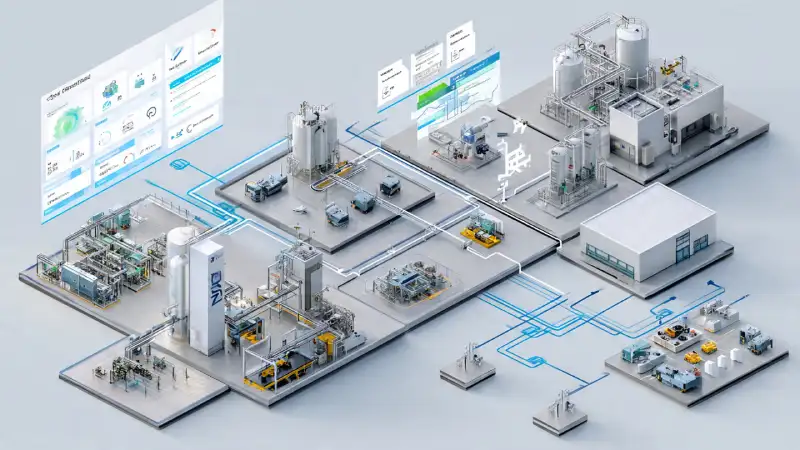
Manufacturing is absolutely essential to every industrial economy. Whether it’s cars or medicines, manufacturers play a vital role in turning ideas and raw materials into real products. But, not all manufacturing processes are the same. Two major types are Discrete Manufacturing and Process Manufacturing. They might sound alike, but their operations, goals, and ERP needs are pretty different. Grasping these differences is key for selecting the right manufacturing strategy and the ERP system to back it up.
What Is Discrete Manufacturing?
Discrete manufacturing is all about taking distinct parts and components and assembling them into a finished product. Each stage of the process is clearly defined, which makes it possible for manufacturers to track every single piece from beginning to end.
Key Characteristics of Discrete Manufacturing
- Assembly of Individual Components: You create a product by combining different parts or subassemblies in a certain order.
- Focus on Customization: This approach often caters to custom or made-to-order products, shaped by customer-specific requirements.
- Examples of Products: Think about cars, smartphones, computers, and home appliances — they’re all made from a variety of components.
- Unique and Traceable Finished Goods: Each final product can be identified with serial numbers, which helps in tracking and managing after-sales service.
- Defined Process Steps: The process usually includes design, production planning, scheduling, material sourcing, assembly, and quality control.
- Bill of Materials (BOM): A BOM is crucial in discrete manufacturing, listing all components required to create the final product.
- No By-products or Co-products: Unlike process manufacturing, discrete manufacturing typically doesn’t produce secondary products. The focus is solely on putting together the final item.
Discrete manufacturing works best in industries where products are countable, customizable, and traceable, and where precise assembly matters.
What Is Process Manufacturing?
Process manufacturing, on the flip side, concentrates on changing raw materials through chemical, biological, or physical processes. The end result is a product that can’t be easily separated back into its original ingredients.
Key Characteristics of Process Manufacturing
- Transformation Through Chemical or Physical Reactions: Raw materials are changed through reactions or blending to make new substances or products.
- Continuous or Batch Flow: Depending on the field, process manufacturing can either run continuously (think oil refineries) or in batches (like in pharmaceuticals).
- Products That Cannot Be Disassembled: Once a batch is made, you can’t break it down into its original components — you can’t unbake a cake or take the milk back out of yogurt.
- Homogeneous Final Product: The end product is consistent in quality and composition, whether it’s a liquid, powder, or gas.
- Examples of Industries: You find process manufacturing in areas like food and beverage, chemicals, plastics, and pharmaceuticals.
- Changing Material Characteristics: Material properties change at each stage due to reactions or processing steps, which calls for careful monitoring and control.
- By-products and Co-products:
- By-products: Secondary materials that aren’t as valuable, which might be reused or sold.
- Co-products: Secondary outputs that are equally or more valuable, produced from the same raw material.
- Complex Material Handling: Managing these by-products and co-products demands close tracking, as they can have varying costs, quality standards, and market values.
Process manufacturing fits well in industries where materials flow continuously and chemical or physical changes are intrinsic to the final product.
Core Differences Between Discrete and Process Manufacturing
| Aspect | Discrete Manufacturing | Process Manufacturing |
| Nature of Product | Built from individual components | Created through transformation of raw materials |
| Examples | Cars, electronics, machinery | Food, chemicals, medicines |
| Production Method | Assembly-based | Chemical or physical conversion |
| Product Identifiability | Unique and traceable items | Homogeneous products |
| Documentation | Bill of Materials (BOM) | Formula or Recipe |
| Production Flow | Step-by-step discrete process | Continuous or batch flow |
| By-products/Co-products | Rarely produced | Commonly produced |
| Flexibility | Easier to customize | Changes require reformulation |
| Inventory Type | Units or subassemblies | Bulk materials or lots |
Why These Differences Matter for ERP Systems
The differences between discrete and process manufacturing go beyond just how things work — they also influence how ERP systems should be set up.
1. ERP Structure and Data Setup
- Discrete Manufacturing ERP depends on BOMs, routing, and work orders.
- Process Manufacturing ERP relies on recipes, batch management, and yield control.
2. Inventory and Costing
- In discrete manufacturing, parts and finished goods are tracked on an individual basis.
- Process manufacturing manages inventory based on weight, volume, and lots.
3. Quality and Compliance
- Discrete industries check specific units for quality.
- Process industries focus on batch quality, purity, and compliance with regulations (like FDA or HACCP standards).
4. Production Planning
- Discrete systems are planned around assembly schedules.
- Process systems focus on chemical formulas, production capacity, and resource availability.
How Cyprus ERP and Onfinity ERP Support Modern Manufacturing
Manufacturers today need ERP systems that can adapt to different production models while maintaining end-to-end visibility.
Cyprus ERP and Onfinity ERP are designed to support both discrete and complex manufacturing environments.
Cyprus ERP, developed by BRS Infotek and based on the Adempiere framework, is ideal for small and mid-sized manufacturers. It supports advanced BOM and routing management, serial and batch tracking, work orders, MRP planning, and production costing—all within a flexible and modular platform.
Onfinity ERP is an enterprise-grade solution built for organizations with large-scale or multi-plant manufacturing operations. As the legal partner of Onfinity ERP, BRS Infotek delivers implementation expertise, localization, and long-term support to help manufacturers scale with confidence.
Both solutions provide unified visibility across procurement, production, inventory, and sales—enabling data-driven decisions and operational efficiency.
👉 Learn more about Cyprus ERP: www.cypruserp.com
👉 Learn more about Onfinity ERP: https://onfinity.io/in/demo.php
Conclusion: Turning ERP Risks into Opportunities
ERP implementations can be complex, but choosing the right solution and partner significantly reduces risk. Whether it’s the flexibility of Cyprus ERP or the scalability of Onfinity ERP, the right-fit ERP helps transform implementation challenges into long-term business value.
About the Author
Surya Sagar, Founder and ERP Solution Architect at BRS Infotek, has over 18 years of experience in ERP design and implementation.
He works closely with manufacturers and service organizations to deliver practical, scalable ERP solutions using Cyprus ERP and Onfinity ERP‘s through smart automation and process efficiency.
