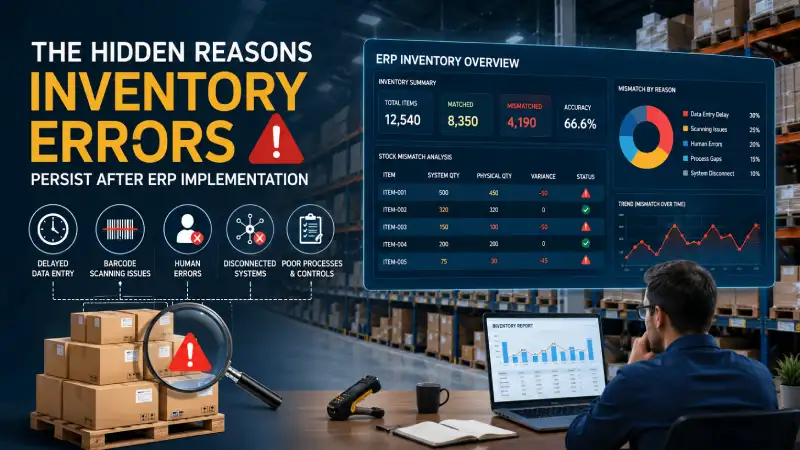
“We Have an ERP. Then Why Doesn’t Our Stock Match?”
A warehouse manager once called me during an annual stock audit.
His voice carried the frustration that many business owners, inventory managers, and production heads have experienced.
“Surya, our ERP shows inventory worth ₹1.2 Crore, but our physical count is showing barely ₹1.08 Crore. We invested in ERP to avoid this. What went wrong?”
The management team was convinced that the ERP system had a problem.
The finance department suspected inventory valuation issues.
The warehouse team blamed production.
Production blamed stores.
Everyone blamed the software.
After a detailed investigation, we discovered something interesting.
The ERP system was working exactly as designed.
The real problem was a combination of undocumented material movements, delayed transaction entries, missing production consumption records, and poor inventory discipline.
Over my 18+ years of ERP implementation experience across manufacturing, trading, distribution, retail, engineering, and warehouse management businesses, I have seen this situation repeatedly.
Many companies assume that implementing an ERP system will automatically eliminate inventory mismatches.
Unfortunately, inventory accuracy does not come from software alone.
It comes from a combination of technology, processes, and people.
Let’s understand why inventory mismatches continue to happen even after ERP implementation and what businesses can do to prevent them.
What Is Inventory Mismatch?
Inventory mismatch occurs when the physical stock available in the warehouse differs from the stock quantity recorded in the ERP system.
For example:
- ERP shows 1,000 units of a product.
- Physical stock count shows only 950 units.
Or:
- ERP shows 500 units.
- Physical count shows 540 units.
In both cases, inventory accuracy has been compromised.
Many businesses treat these differences as minor issues.
In reality, they often indicate deeper operational problems that can impact profitability, customer satisfaction, and business growth.
What Inventory Mismatch Really Costs a Business
Before discussing the causes, let’s understand the actual impact.
Many companies focus only on stock differences but fail to realize the hidden costs associated with inventory inaccuracies.
Production Delays
When ERP shows stock that does not physically exist, production schedules get disrupted.
Machines sit idle.
Operators wait.
Customer commitments get delayed.
Excess Purchasing
When warehouse teams cannot locate materials, purchasing departments often reorder items unnecessarily.
This increases inventory carrying costs and blocks valuable working capital.
Cash Flow Problems
Every extra rupee invested in excess inventory is money that cannot be used elsewhere in the business.
Inventory inaccuracies directly affect cash flow.
Customer Dissatisfaction
Nothing damages customer trust faster than promising delivery based on ERP stock and later discovering the inventory is unavailable.
Financial Reporting Issues
Inventory is often one of the largest assets on a company’s balance sheet.
Incorrect inventory directly affects profitability, valuation, and audit accuracy.
This is why inventory mismatch is not just a warehouse problem.
It is a business problem.
The Biggest Myth About ERP
One of the biggest misconceptions in the industry is:
“Once ERP is implemented, inventory mismatches will disappear.”
The reality is very different.
ERP records transactions.
ERP does not physically move inventory.
ERP does not stop employees from bypassing processes.
ERP does not automatically correct incorrect entries.
Think of ERP as a mirror.
If the underlying process is inaccurate, the ERP system will simply reflect that inaccuracy.
In most situations, inventory mismatches are process problems disguised as software problems.
The Three Major Categories of Inventory Mismatch
After working on dozens of ERP implementations, I have found that inventory issues usually fall into three categories:
1. Operational Issues
Problems related to warehouse activities and material handling.
2. System Usage Issues
Problems caused by incorrect transaction entry and user practices.
3. Manufacturing Process Issues
Problems arising during production and material consumption.
Let’s look at each category in detail.
Operational Issues
Reason #1: Material Movement Without System Entry
This is probably the most common cause of inventory mismatch.
Material is moved physically but not recorded in ERP.
Real-Life Example
A production supervisor urgently needs raw material.
Instead of waiting for stores to issue the material properly, he takes it directly from the warehouse rack.
Production receives the material.
ERP does not.
A few weeks later, stock verification reveals shortages.
Management blames ERP.
The actual problem was an undocumented material movement.
Reason #2: Warehouse Location Errors
Modern warehouses often have:
- Multiple warehouses
- Multiple racks
- Multiple bins
- Multiple locators
Inventory may physically exist but not in the location recorded by ERP.
Example
ERP shows:
Warehouse A → Rack 01 → Bin 05
Actual stock is located at:
Warehouse A → Rack 03 → Bin 02
The material exists.
The warehouse team cannot find it.
As a result:
- Emergency purchases are raised.
- Inventory carrying costs increase.
- Deliveries get delayed.
Reason #3: No Regular Cycle Counting
Many organizations perform stock verification only once a year.
By then, it becomes nearly impossible to identify the source of discrepancies.
Best Practice
Successful organizations perform:
- Daily counts for critical items
- Weekly counts for fast-moving items
- Monthly counts for standard inventory
- Quarterly counts for slow-moving items
Frequent counting helps identify issues before they become major problems.
System Usage Issues
Reason #4: Backdated Transactions
Backdated entries create significant inventory confusion.
Example
Material arrives on 1st June.
Goods Receipt is entered on 10th June but backdated to 1st June.
Meanwhile:
- Production has consumed inventory.
- Reports have already been generated.
- Stock valuations have been reviewed.
Suddenly inventory balances change unexpectedly.
Users begin questioning report accuracy.
The actual issue is delayed transaction posting.
Reason #5: Incorrect Unit of Measure (UOM)
UOM errors often remain hidden for months.
Example
A company purchases material in kilograms.
Production consumes material in grams.
The conversion factor should be:
1 KG = 1000 Grams
Someone mistakenly configures:
1 KG = 100 Grams
Inventory discrepancies start accumulating silently.
By the time the issue is detected, the difference may be substantial.
Reason #6: Duplicate or Incorrect Transactions
Human errors still remain one of the largest contributors to inventory mismatch.
Common examples include:
- Duplicate Goods Receipts
- Duplicate Material Issues
- Wrong Product Selection
- Wrong Quantity Entry
- Wrong Warehouse Selection
Example
A user intends to enter:
100 Units
But accidentally enters:
1000 Units
Inventory becomes inaccurate instantly.
Manufacturing Process Issues
Reason #7: Production Consumption Not Recorded Properly
Manufacturing organizations face unique inventory challenges.
Inventory accuracy depends on proper recording of:
- Raw Material Consumption
- Finished Goods Receipt
- Scrap
- Rework
Missing even one transaction creates inventory differences.
Real-Life Example
A production order consumes:
100 KG Raw Material
The operator records only:
90 KG Consumption
ERP assumes 10 KG still exists.
Physically, it has already been consumed.
Over time these small differences become significant inventory variances.
Reason #8: Scrap and Wastage Not Reported
Every manufacturing process generates some level of scrap.
The problem occurs when scrap transactions are ignored.
Example
Production issues:
500 KG Raw Material
Results:
- 470 KG Finished Goods
- 30 KG Scrap
If scrap is not recorded, ERP assumes the entire quantity should still be available somewhere.
This creates unexplained inventory balances.
Reason #9: Incomplete Goods Receipt and Quality Process
Receiving inventory involves more than unloading material.
A proper process includes:
- Physical Receipt
- Quality Inspection
- Acceptance or Rejection
- ERP Posting
Example
1000 units arrive from a supplier.
Quality team rejects 100 units.
ERP still shows all 1000 units as accepted inventory.
Inventory records immediately become inaccurate.
Reason #10: Lack of Process Discipline
This is the root cause behind most inventory problems.
The software may be excellent.
The implementation may be successful.
The reports may be accurate.
But if people bypass processes, inventory accuracy suffers.
Common Situations
- Urgent production requirements
- Manual inventory adjustments
- Unapproved material movements
- Temporary shortcuts
- Missing approvals
Over time these shortcuts become normal business practice.
Inventory reliability starts deteriorating.
Real-Life Inventory Stories I Have Seen
Pharmaceutical Manufacturing Company
A pharmaceutical manufacturer reported inventory differences exceeding 8%.
Management believed there was a costing issue in the ERP system.
After investigation, we found that raw materials were issued in bulk to production.
Actual consumption was never recorded.
ERP showed inventory available.
Physically, it had already been consumed.
The problem was not ERP.
The problem was process discipline.
Distribution Company
A distributor repeatedly purchased products that were already available in stock.
The purchasing team claimed inventory shortages.
After a warehouse audit, we discovered the stock existed physically but was stored in locations different from those recorded in ERP.
Thousands of dollars were unnecessarily invested in duplicate inventory.
Engineering Manufacturing Company
An engineering company regularly faced production delays despite maintaining high inventory levels.
The reason?
Incorrect warehouse locator management.
The material was available but could not be located when required.
A barcode-driven warehouse process solved the issue within a few months.
Warning Signs That Your Inventory Process Has Problems
Watch for these indicators:
- Frequent inventory adjustments
- Negative inventory balances
- Production shortages despite stock availability
- Excess emergency purchases
- Regular stock audit differences
- Customer delivery delays
- Large inventory write-offs
- Constant complaints about stock accuracy
If these situations sound familiar, your inventory process likely needs attention.
How Successful Companies Maintain 98%+ Inventory Accuracy
Organizations with highly accurate inventory usually follow these practices:
Real-Time Transaction Entry
Transactions are entered immediately.
Barcode or QR Code Scanning
Manual errors are significantly reduced.
Strong Approval Controls
Inventory adjustments require authorization.
Regular Cycle Counting
Issues are identified quickly.
User Training
Employees understand process importance.
Warehouse Standardization
Storage locations remain organized.
Process Discipline
No material movement occurs without system entry.
Simple practices often produce extraordinary results.
How the Right ERP Implementation Reduces Inventory Mismatches
Technology alone cannot solve inventory problems.
The right implementation approach is equally important.
Successful ERP implementations focus on:
- Business process design
- User accountability
- Warehouse controls
- Barcode integration
- Inventory audits
- Production tracking
- Approval workflows
- Quality management
- MRP planning accuracy
The objective is not simply implementing software.
The objective is creating inventory visibility and control.
How Cyprus ERP and Onfinity ERP Help Improve Inventory Accuracy
At BRS Infotek, we have implemented inventory and warehouse management solutions for organizations across multiple industries using Cyprus ERP and Onfinity ERP.
These solutions help businesses improve inventory accuracy through:
- Real-time inventory visibility
- Multi-warehouse management
- Bin and locator tracking
- Batch and lot traceability
- Barcode integration
- Material issue and receipt controls
- Production inventory management
- Inventory count management
- Quality control integration
- MRP-driven inventory planning
- Approval workflows and audit trails
More importantly, our implementation methodology focuses on improving business processes alongside software deployment.
Because inventory accuracy is not achieved through technology alone.
It is achieved through the right combination of people, processes, and technology.
Is Your Inventory Really Accurate?
If your ERP inventory does not match your physical stock, the problem may not be the software.
Start by asking:
- Are all inventory movements being recorded?
- Are users following defined procedures?
- Are warehouse locations properly managed?
- Are cycle counts performed regularly?
- Is production consumption accurately reported?
- Is scrap being tracked correctly?
In most cases, the answers to these questions reveal the real source of inventory discrepancies.
Inventory mismatch is rarely caused by ERP.
It is usually caused by the processes surrounding ERP.
Fix the process, and inventory accuracy will follow.
Need Help Identifying Inventory Mismatches?
At BRS Infotek, we help businesses identify the root causes of inventory discrepancies and implement practical solutions using Cyprus ERP and Onfinity ERP.
Whether you are struggling with:
- Inventory inaccuracies
- Warehouse management issues
- Production tracking problems
- Stock valuation differences
- MRP planning challenges
- Manufacturing inventory control
our team can help you establish the processes and controls needed to achieve accurate, reliable inventory management.
The first step is understanding where the mismatch begins.
Once that is identified, the solution becomes much easier.
About the Author
Surya Sagar is the Founder and ERP Solution Architect at BRS Infotek with over 18+ years of experience in ERP consulting, manufacturing, warehouse management, procurement, finance, MRP, inventory control, and business process optimization.
He has worked with organizations across manufacturing, pharmaceuticals, distribution, retail, engineering, construction, and service industries, helping businesses improve operational efficiency through practical ERP solutions. He has played a key role in the development, implementation, and enhancement of Cyprus ERP and Onfinity ERP, focusing on solving real-world business challenges through technology and process excellence.


