Are You Really Saving Money by Working Manually?
Imagine this.
It’s Monday morning, 9:30 AM.
Your biggest customer calls and urgently needs 2,000 units of your best-selling product.
Your sales executive confidently replies, “Yes Sir, we can deliver tomorrow.”
Within the next thirty minutes, chaos begins.
The warehouse team says only 600 units are available.
The production manager believes enough stock is ready.
The purchase department insists that raw materials are arriving today.
Accounts inform everyone that the supplier has stopped dispatching because two invoices are overdue.
Finally, after two hours of phone calls, WhatsApp messages, Excel sheets, and arguments between departments, the truth comes out.
The order cannot be fulfilled.
The customer places the order with your competitor.
The company doesn’t just lose one order. It loses a customer who may never return.
Now ask yourself honestly.
Was the problem a lack of employees?
No.
Was the problem a lack of machines?
Again, no.
The real problem was that every department was working with different information.
Unfortunately, this is not a fictional story.
During my 18+ years of implementing ERP solutions across manufacturing, pharmaceuticals, engineering, retail, trading, construction, and distribution companies, I have witnessed similar situations hundreds of times.
Business owners often believe they have a sales problem, a production problem, or an inventory problem.
In reality, they have an information problem.
And information problems become expensive.
Very expensive.
The Biggest Business Expense That Never Appears in Your Financial Statements
When business owners review their Profit & Loss Statement, they usually look at expenses like:
- Employee salaries
- Electricity
- Rent
- Raw material
- Transportation
- Taxes
- Interest
But there is one expense that never appears as a separate line item.
The Cost of Manual Operations.
It quietly eats away profits every single day.
It appears in different forms:
- Wrong purchasing decisions
- Excess inventory
- Stock shortages
- Delayed production
- Customer complaints
- Employee overtime
- Duplicate work
- Emergency freight charges
- Lost sales
- Slow collections
- Poor management decisions
Individually, these may not seem alarming.
Collectively, they can cost a business lakhs—or even crores—every year.
Ironically, many businesses spend months negotiating the price of ERP software while unknowingly losing far more because of inefficient manual processes.
What Exactly Are Manual Operations?
When people hear the word “manual,” they often imagine paper files and handwritten registers.
That is no longer true.
Today, many businesses believe they are digital simply because they use computers.
But if your business depends on:
- Excel spreadsheets
- WhatsApp messages
- Emails for approvals
- Phone calls for coordination
- Independent departmental records
- Manual report preparation
then your business is still operating manually.
Technology is being used, but information is not connected.
Each department creates its own version of reality.
Sales has one number.
Warehouse has another.
Accounts reports something different.
Production follows its own planning sheet.
Management spends valuable time trying to determine which report is actually correct.
The biggest problem is not that information is unavailable.
The biggest problem is that everyone believes their information is correct.
The Hidden Cost That Most Businesses Never Calculate
Let’s look at a simple example.
Assume your company has 25 employees involved in daily operations.
Each employee spends approximately 40 minutes every day:
- Searching files
- Confirming stock availability
- Calling other departments
- Preparing reports
- Following up on approvals
- Correcting mistakes
Forty minutes may not sound like much.
Now multiply it.
25 employees × 40 minutes = over 16 hours of productive time lost every single day.
That is equivalent to paying the salaries of two full-time employees who contribute nothing but lost productivity.
Over a year, the financial impact becomes enormous.
And this is only one hidden cost.
It doesn’t include inventory losses, delayed production, customer dissatisfaction, or wrong purchasing decisions.
“Excel Is Working Fine…”
This is probably the most common sentence I hear during ERP discussions.
“We’ve been using Excel for years. It works perfectly.”
My response is always the same.
Excel is one of the best tools ever created.
But Excel was designed to analyse information.
It was never designed to run an entire business.
Think about it.
Can Excel automatically stop duplicate purchasing?
Can it reserve inventory against confirmed sales orders?
Can it calculate production requirements across multiple warehouses?
Can it instantly tell you which supplier is delaying deliveries?
Can it prevent someone from dispatching stock that has already been committed to another customer?
No.
Because Excel doesn’t understand your business process.
ERP does.
Six Hidden Costs That Slowly Destroy Business Profitability
1. Time Lost Every Single Day
Business owners often calculate machine efficiency.
Very few calculate employee efficiency.
Consider how much time employees spend:
- Looking for documents
- Calling colleagues
- Checking previous emails
- Confirming stock
- Searching old quotations
- Preparing management reports
None of these activities generate revenue.
They simply consume valuable working hours.
An ERP system reduces these repetitive activities by keeping information available in one place, allowing employees to focus on decisions rather than searching for data.
2. Duplicate Data Entry
Let’s follow a simple customer order.
Sales creates the quotation.
Then someone prepares the sales order.
Warehouse updates inventory.
Accounts prepare the invoice.
Dispatch creates shipping documents.
Management prepares reports.
In many organisations, the same information is entered five or six times.
Every manual entry increases the possibility of mistakes.
One incorrect quantity.
One missing decimal.
One wrong customer code.
One pricing error.
Small mistakes often create much bigger business problems later.
3. Human Errors Are Expensive
People make mistakes.
That’s normal.
The problem is that manual systems depend entirely on people remembering everything correctly.
Common examples include:
- Wrong GST calculations
- Duplicate invoices
- Incorrect discounts
- Wrong customer addresses
- Incorrect stock quantities
- Missing purchase orders
- Wrong production planning
- Dispatching the wrong product
Each mistake has a cost.
Sometimes the cost is financial.
Sometimes it is customer trust.
And rebuilding trust is always more expensive than preventing mistakes.
4. Inventory Becomes a Guessing Game
Inventory is often the second-largest investment after machinery.
Yet surprisingly, many companies don’t know exactly what they own.
Business owners frequently ask:
- Do we have this item?
- Is it available in another warehouse?
- Has it already been reserved?
- Why was this purchased again?
- Which material hasn’t moved in the last year?
Without an integrated ERP, finding accurate answers becomes difficult.
As a result, companies either purchase too much or too late.
Both situations increase costs.
5. Slow Decisions Become Costly Decisions
Every business operates on speed.
Customers expect quick responses.
Suppliers require faster decisions.
Management wants real-time information.
Yet many meetings begin like this:
“Can someone prepare yesterday’s sales report?”
“Please send the latest stock.”
“What is the outstanding amount?”
“Which products are slow moving?”
Instead of discussing business strategy, employees spend the meeting collecting information.
By the time reports are ready, the business situation has already changed.
6. Customer Experience Suffers
Today’s customers have plenty of choices.
They expect accurate commitments.
If your team says a product is available when it isn’t, confidence is lost immediately.
If delivery dates keep changing, customers stop trusting future commitments.
Many companies think they lose customers because competitors offer lower prices.
In reality, they lose customers because competitors provide more reliable information and faster service.
A Real Story from an ERP Implementation
Several years ago, we began implementing ERP for a mid-sized manufacturing company.
During our initial discussions, the management confidently stated:
“Inventory is under control.”
The warehouse maintained Excel sheets.
Purchase maintained different files.
Production maintained another planning sheet.
Accounts reported inventory from the accounting software.
Everything appeared organised.
As part of the ERP implementation, we conducted a physical stock verification.
The results surprised everyone.
Some materials existed physically but were missing in Excel.
Several expensive raw materials appeared available in reports but had already been consumed months earlier.
Different departments had unknowingly purchased the same material multiple times because nobody had complete visibility.
One particular raw material worth several lakhs had not moved for almost eighteen months.
Nobody realised it because no single report showed the complete picture.
That day, the management understood something important.
They did not have an inventory problem.
They had an information problem.
After ERP went live:
- Duplicate purchasing reduced significantly.
- Inventory visibility became real-time.
- Production planning improved.
- Emergency purchases almost disappeared.
- Management meetings shifted from finding data to making decisions.
The software didn’t perform magic.
It simply ensured that everyone in the organisation worked with the same information.
The Biggest Misconception About ERP
Many business owners believe ERP is software.
It isn’t.
Software is only the tool.
ERP is about creating a single source of truth for the entire organisation.
When sales, purchase, inventory, finance, production, quality, and management all work with the same live information, decisions become faster, mistakes reduce, and profitability improves.
That is where the real value of ERP begins.
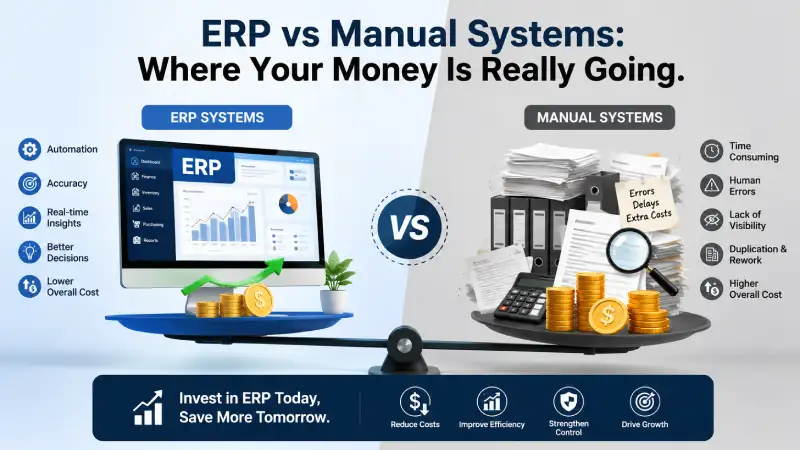
ERP vs Manual Operations: A Side-by-Side Comparison
The easiest way to understand the value of an ERP system is to compare a typical business day before and after implementation.
| Business Activity | Manual Operations | ERP-Driven Operations |
| Customer Information | Stored in multiple Excel files | Centralized customer database |
| Inventory | Updated manually | Real-time stock visibility |
| Sales Orders | Phone calls and spreadsheets | Automatically linked with inventory and finance |
| Purchase Planning | Based on assumptions | Demand-driven through MRP |
| Production Planning | Whiteboards and Excel | Capacity-based production scheduling |
| Financial Reports | Prepared after several days | Available instantly |
| Approvals | Emails, WhatsApp and paper | Digital workflow approvals |
| Decision Making | Based on incomplete information | Based on live business data |
| Audit Trail | Difficult to track | Complete transaction history |
| Business Growth | Depends on more manpower | Supported through automation |
The difference isn’t just technology.
It is the speed, accuracy, visibility, and confidence with which management can run the business.
The Real Financial Cost Comparison
Let’s compare two businesses.
Both manufacture engineering products.
Both have annual sales of ₹25 Crores.
Both employ around 75 people.
The only difference is how they manage operations.
Company A – Manual Operations
- Separate Excel files in every department
- Inventory maintained manually
- Purchase planning based on experience
- Reports prepared at month-end
- Multiple versions of the same data
Average annual hidden losses:
| Hidden Cost | Estimated Annual Loss |
| Duplicate purchases | ₹8,00,000 |
| Excess inventory carrying cost | ₹12,00,000 |
| Production delays | ₹15,00,000 |
| Employee productivity loss | ₹18,00,000 |
| Customer order cancellations | ₹20,00,000 |
| Emergency purchases & freight | ₹7,00,000 |
Total Hidden Cost: ₹80,00,000 per year
Now imagine that an ERP implementation costs significantly less than these recurring annual losses.
Suddenly, ERP is no longer an expense.
It becomes one of the highest-return investments a business can make.
The Cost of Waiting
Many companies postpone ERP for reasons like:
“Let’s do it next year.”
“Our current system is still working.”
“We’ll think about ERP once the business grows.”
Ironically, this thinking creates the biggest losses.
When manual operations continue for another two or three years, businesses don’t just lose money.
They lose opportunities.
Customers shift to competitors.
Employees become frustrated.
Inventory keeps increasing.
Cash flow becomes tighter.
Growth slows down.
The cost of delaying ERP is often much greater than the cost of implementing it.
Different Industries, Same Problems
Although every industry operates differently, the challenges caused by manual operations are remarkably similar.
Manufacturing
Production stops because one low-value component is unavailable.
Machines remain idle.
Workers wait.
Customer delivery gets delayed.
The problem isn’t production.
It is poor planning.
Trading & Distribution
Sales teams promise products that are already reserved for another customer.
Warehouse staff discover the shortage only during dispatch.
Customer confidence drops immediately.
Pharmaceutical Industry
Expiry dates.
Batch numbers.
Regulatory compliance.
Quality documentation.
Managing these manually increases operational risk and can have serious compliance implications.
Retail
The product customers want is unavailable.
Meanwhile, slow-moving products occupy valuable shelf space.
Without accurate inventory visibility, both sales and working capital suffer.
Engineering & Project-Based Businesses
Material reaches the site late.
Project schedules slip.
Costs increase.
Invoices are delayed.
Profitability reduces.
A connected ERP system allows management to monitor projects, procurement, inventory, finance, and billing from a single platform.
The Business Doesn’t Need More Employees. It Needs Better Information.
One misconception I frequently encounter is:
“As business grows, we’ll hire more people.”
More employees can help only if they work with the right information.
Otherwise, adding more people simply increases coordination problems.
I’ve seen businesses with 40 employees operating more efficiently than companies with 150 employees.
The difference wasn’t manpower.
It was systems.
ERP enables people to work smarter rather than harder.
Is Your Business Ready for ERP?
Ask yourself these questions.
If your answer is “Yes”, your business has likely outgrown manual operations.
✔ Inventory never matches physical stock.
✔ Different departments maintain different reports.
✔ Employees spend considerable time searching for information.
✔ Management reports take hours or days to prepare.
✔ Customers frequently ask for delivery updates.
✔ Purchase decisions depend on experience instead of data.
✔ Production schedules change regularly due to material shortages.
✔ Business relies heavily on one or two experienced employees.
✔ Excel files are shared through email or WhatsApp.
✔ Decision-making depends on assumptions rather than real-time information.
If these situations sound familiar, ERP isn’t simply software—it becomes a business necessity.
ERP Doesn’t Replace People—It Empowers Them
This is perhaps the biggest misunderstanding surrounding ERP.
Employees often fear that automation will replace their jobs.
In reality, ERP removes repetitive work.
Instead of:
- Copying data
- Preparing manual reports
- Searching files
- Correcting mistakes
employees can focus on:
- Customer service
- Business improvement
- Planning
- Analysis
- Decision-making
Technology should eliminate repetitive tasks—not human potential.
Why Businesses Choose Cyprus ERP and Onfinity ERP
During the past 18+ years, I have worked with organisations ranging from small businesses to large manufacturing enterprises.
Despite operating in different industries, most of them shared the same challenges:
- Information scattered across departments.
- Delayed decision-making.
- Inventory uncertainty.
- Poor production visibility.
- Manual approvals.
- Limited reporting.
These real-world implementation experiences inspired the evolution of Cyprus ERP and Onfinity ERP.
Rather than building software around screens and menus, these ERP solutions were designed around actual business processes.
Whether your organisation needs:
- Customer Relationship Management (CRM)
- Procurement Management
- Inventory & Warehouse Management
- Material Requirement Planning (MRP)
- Manufacturing & Production
- Finance & Accounting
- Fixed Asset Management
- Human Resources & Payroll
- Project Management
- Business Intelligence Dashboards
the objective remains the same:
Reduce manual work. Improve visibility. Enable faster and more informed business decisions.
With modern technologies, workflow automation, real-time dashboards, mobile accessibility, and AI-ready architecture, Cyprus ERP and Onfinity ERP help businesses prepare not just for today’s challenges but also for tomorrow’s opportunities.
Technology alone doesn’t transform a business.
Well-designed business processes supported by the right ERP platform do.
Frequently Asked Questions (FAQ)
Is Excel enough for running a business?
Excel is an excellent analysis tool, but it is not designed to manage integrated business processes involving inventory, finance, production, purchasing, sales, and customer management.
Is ERP only for large companies?
No.
Many small and medium-sized businesses benefit significantly from ERP because it improves efficiency before operational complexity becomes unmanageable.
Will ERP reduce employee requirements?
ERP generally improves employee productivity rather than replacing employees. Teams spend less time on repetitive work and more time creating value.
How long does ERP implementation take?
Implementation duration depends on the size of the organisation, number of modules, business complexity, and readiness of master data. A well-planned implementation delivers much better long-term results than a rushed deployment.
Is ERP expensive?
The better question is:
How expensive are manual operations?
Most organisations discover that the hidden cost of inefficiency exceeds the investment required for ERP.
Final Thoughts
Every successful business reaches a stage where spreadsheets, emails, and manual coordination are no longer enough.
The challenge isn’t that employees are working harder than before.
The challenge is that the business has become too complex for disconnected systems.
Businesses don’t lose money because they invest in ERP.
They lose money because they continue operating manually long after their business has outgrown those processes.
The question is no longer:
“Can we afford ERP?”
The real question is:
“How much are manual operations already costing us every month?”
Once business owners begin calculating the hidden costs—lost productivity, excess inventory, delayed production, customer dissatisfaction, emergency purchases, reporting delays, and poor decisions—they usually realise that the biggest investment isn’t ERP.
The biggest investment is continuing without it.
Digital transformation is not about replacing people.
It is about giving people the right information at the right time so they can make better decisions, serve customers more effectively, and build a stronger, more profitable business.
If your organisation is still relying on disconnected spreadsheets, manual approvals, and scattered information, now is the right time to evaluate where those hidden costs exist.
The sooner they are identified, the sooner they can be eliminated.
About the Author
Surya Sagar is an ERP Solution Architect, digital transformation consultant, and Founder of BRS Infotek, with more than 18+ years of experience in enterprise software consulting and business process optimization. Throughout his career, he has successfully delivered 100+ ERP implementations across manufacturing, pharmaceuticals, engineering, retail, trading, construction, distribution, and service industries.
His expertise spans Manufacturing, Material Requirement Planning (MRP), Supply Chain Management, Procurement, Inventory Management, Warehouse Management, CRM, Finance, Project Management, Fixed Assets, and Business Intelligence.
Surya has worked closely with business owners, CEOs, CFOs, production heads, and operations teams to solve real business challenges—not just implement software. His practical experience has contributed to the evolution of Cyprus ERP and Onfinity ERP, helping organizations streamline operations, reduce costs, improve visibility, and make data-driven decisions.
Through his articles, he shares practical implementation experiences, industry best practices, and business insights to help organizations understand how technology can create measurable business value.
Ready to Take the Next Step?
If you’re evaluating ERP for your organization—or simply want to understand how much manual operations are costing your business—start with an operational assessment before making any technology decision.
Understanding your current processes, identifying bottlenecks, and measuring hidden operational costs will help you choose the right ERP strategy and maximize your return on investment.
Because the goal is not just to implement ERP. The goal is to build a business that is faster, smarter, more efficient, and ready for sustainable growth.


