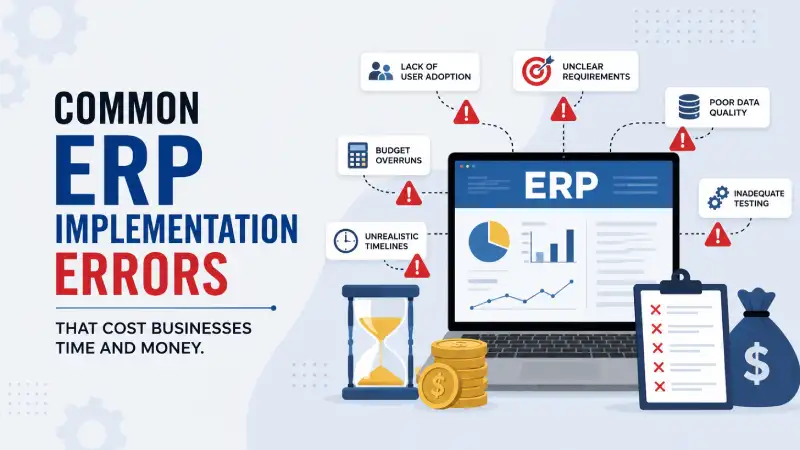
Introduction: The Costliest Mistakes Aren’t Made by the ERP Software
Imagine investing ₹50 lakhs, ₹1 crore, or even more in an ERP implementation.
Months of planning.
Hundreds of meetings.
Thousands of hours of employee effort.
Finally, the ERP goes live.
But just a few weeks later…
The warehouse team is still maintaining Excel sheets.
Finance doesn’t trust the reports.
Production planning doesn’t match the actual inventory.
Sales complains that deliveries are delayed.
Management starts hearing the same sentence every day:
“The ERP is giving wrong data.”
If this sounds familiar, you’re not alone.
During my 18+ years of implementing ERP systems across manufacturing, pharmaceuticals, engineering, retail, construction, logistics, and distribution companies, I have noticed one common pattern.
Businesses rarely regret implementing an ERP.
They regret the decisions they made during the implementation.
Interestingly, most of these mistakes have nothing to do with the ERP software itself.
They happen because of rushed planning, poor data preparation, unrealistic expectations, lack of user involvement, or simply choosing the wrong implementation strategy.
The good news?
Almost every one of these mistakes can be avoided.
In this article, I’ll share the most common regrets businesses experience during ERP implementation, along with real examples from actual projects and practical advice to help you avoid making the same costly mistakes.
Why Do ERP Implementations Fail?
Before we discuss the regrets, let’s answer one important question.
Why do ERP projects fail?
Most people think ERP failures happen because of software bugs.
In reality, software is rarely the problem.
From my implementation experience, ERP projects usually struggle because of:
- Poor planning before implementation
- Incomplete or inaccurate master data
- Excessive customization
- Lack of management involvement
- Insufficient user training
- Unrealistic project timelines
- Poor communication between departments
- Weak testing before go-live
In other words,
ERP projects fail because of business decisions—not because of ERP software.
Regret #1: “We Chose the Cheapest ERP Instead of the Right ERP”
One of the biggest mistakes businesses make is selecting ERP software based only on price.
The conversation usually sounds like this:
“Vendor A is charging ₹40 lakhs.”
“Vendor B is charging ₹28 lakhs.”
“Let’s go with the cheaper one.”
It feels like smart financial planning.
Unfortunately, ERP is not a one-time purchase.
It becomes the digital backbone of your business.
- Finance.
- Inventory.
- Sales.
- Purchasing.
- Manufacturing.
- CRM.
- Projects.
- Payroll.
Every department depends on it.
Choosing an ERP that doesn’t fit your business eventually costs far more than choosing the right solution in the first place.
Real-Life Example
One manufacturing company selected an ERP simply because it was nearly 40% cheaper than competing solutions.
Six months later they realized:
- Production Planning wasn’t complete.
- MRP couldn’t support their manufacturing process.
- Quality Management required customization.
- Several important reports were missing.
The money they thought they had saved was eventually spent on custom development and project delays.
Their Managing Director later told us:
“We should have evaluated functionality instead of comparing quotations.”
Lesson:
Never buy ERP because it’s cheaper.
Buy it because it fits your business.
Regret #2: “We Didn’t Clean Our Master Data”
Many companies think ERP implementation is about installing software.
Actually…
The biggest challenge is preparing clean business data.
Consider your product master.
If:
- Product names are inconsistent
- Units of Measure are incorrect
- Duplicate suppliers exist
- Customer GST numbers are wrong
- Bills of Materials are incomplete
Your ERP will simply continue those mistakes.
People often say,
“The ERP reports are incorrect.”
But the ERP only reports what was entered.
Garbage In = Garbage Out.
Common Data Problems We See
- Duplicate customers
- Duplicate vendors
- Wrong HSN codes
- Missing GST information
- Incorrect warehouse mapping
- Incomplete BOMs
- Incorrect Routing
- Wrong Opening Balances
In almost every ERP implementation, investing time in master data preparation saves months of frustration later.
Regret #3: “We Tried to Customize Everything”
This is probably the biggest reason ERP projects become expensive.
Many organizations want the ERP to look exactly like their previous software.
Every screen.
Every report.
Every button.
Every approval.
Instead of improving business processes, they try to copy old processes into a new ERP.
The result?
- Higher implementation costs
- Longer project timelines
- Complex future upgrades
- Increased maintenance costs
A good ERP implementation should modernize your business—not preserve outdated habits.
Whenever a customization request comes up, ask one simple question:
“Is this helping our business, or are we just resisting change?”
Regret #4: “We Ignored User Training”
Many organizations spend six months implementing ERP…
…and only one day training employees.
Then they wonder why everyone continues using Excel.
ERP success depends on people—not software.
Users should understand:
- Why they’re entering data
- What happens after saving a transaction
- How departments are connected
- Why accuracy matters
Real-Life Example
One customer repeatedly complained that inventory reports were incorrect.
After investigation, we discovered warehouse staff were skipping Goods Receipt entries because they believed they were saving time.
Every skipped transaction caused inventory mismatches.
Purchasing couldn’t see available stock.
Finance reports became inaccurate.
Production planning suffered.
The software wasn’t the problem.
Training was.
Regret #5: “We Expected ERP to Solve Management Problems”
ERP improves business processes.
It doesn’t replace management.
If:
- Responsibilities are unclear
- Approvals aren’t defined
- Departments don’t communicate
- Decisions are delayed
ERP simply exposes these weaknesses more quickly.
One client once said,
“We thought ERP would automatically solve our operational issues.”
It didn’t.
Instead, ERP showed exactly where the problems already existed.
Regret #6: “We Didn’t Involve Department Heads”
Sometimes ERP decisions are made only by Management and the IT department.
End users aren’t involved.
Then comes User Acceptance Testing.
Suddenly…
Finance wants new reports.
Production wants different workflows.
Purchasing requests new approvals.
Sales asks for additional customer fields.
Every new request delays the project.
Successful ERP implementations involve department heads from Day One.
When users participate early, they support the implementation instead of resisting it.
Regret #7: “We Rushed the Go-Live”
This happens far too often.
“We must go live before the financial year.”
“Our customer is waiting.”
“We already announced the date.”
Pressure builds.
Testing gets shortened.
Master data isn’t fully verified.
Opening balances aren’t reconciled.
The result?
- Incorrect inventory
- Wrong accounting balances
- Delayed deliveries
- Production interruptions
Going live one month later is always better than spending six months fixing avoidable problems.
ERP implementation is not a race.
It is a long-term business investment.
Regret #8: “We Didn’t Test Real Business Scenarios”
Many businesses only test simple transactions.
Create Purchase Order.
Create Sales Order.
Create Invoice.
Everything works.
But real businesses are much more complicated.
What happens when:
- Partial delivery occurs?
- Materials fail Quality Inspection?
- A customer returns products?
- Production is outsourced?
- Multiple warehouses are involved?
- Batch tracking is required?
- GST rates change?
- Inventory becomes negative?
ERP should always be tested using real-life business scenarios—not textbook examples.
Regret #9: “We Focused Only on Go-Live”
Many businesses think ERP implementation ends after Go-Live.
Actually…
That’s when the real journey begins.
The first three to six months determine long-term success.
This period should focus on:
- User support
- Report improvements
- Process optimization
- Employee feedback
- Performance monitoring
Companies that continue improving after go-live usually achieve much better results than those who consider the project complete.
Regret #10: “We Underestimated Change Management”
ERP changes how people work.
Employees naturally resist change.
Some fear technology.
Some fear accountability.
Some simply prefer familiar processes.
Ignoring these concerns creates resistance.
Successful ERP projects invest as much effort in communication as they do in software configuration.
Explain why the change is happening.
Show employees how ERP benefits them.
Celebrate quick wins.
People embrace change when they understand its purpose.
A Story I Often Share with Clients
Several years ago, I worked with a manufacturing company that believed ERP implementation would take only two months.
Their business involved:
- Multiple manufacturing plants
- Complex Bills of Materials
- Batch tracking
- Job Work
- Quality inspections
- Multi-level Production Planning
- Advanced Costing
Initially, management wanted to skip business process workshops because they believed everyone already understood the workflow.
But during implementation, we discovered something surprising.
Every department described the same process differently.
Purchasing followed one method.
Production followed another.
Finance expected something else entirely.
Instead of rushing the implementation, we paused and documented the complete business process.
Yes, the project took a little longer.
But after go-live, the business ran smoothly because every department was finally working with the same process.
Months later, the Managing Director told me:
“The biggest benefit wasn’t the ERP software. It was that every department finally started speaking the same language.”
That, in my opinion, is the real success of an ERP implementation.
Warning Signs Your ERP Project Is Going Off Track
If you notice three or more of the following warning signs, it’s time to review your implementation strategy.
✅ Budget keeps increasing
✅ Endless customization requests
✅ Employees still rely on Excel
✅ Inventory reports don’t match physical stock
✅ Departments blame each other
✅ Go-Live dates keep changing
✅ UAT never seems to finish
✅ Opening balances remain unresolved
Ignoring these warning signs often leads to costly implementation failures.
ERP Readiness Checklist
Before starting your ERP implementation, ask yourself these questions.
✔ Is your master data clean?
✔ Are Bills of Materials complete?
✔ Are Routing and Work Centers finalized?
✔ Have department heads approved business processes?
✔ Have users received proper training?
✔ Have real-life business scenarios been tested?
✔ Are opening balances verified?
✔ Is management fully committed?
If you answered “No” to more than three questions, your ERP project may already be at risk.
What Keeps CEOs Awake During ERP Implementation?
After meeting hundreds of business owners, I have realized that most CEOs worry about the same things.
- Will production stop?
- Will customer deliveries be delayed?
- Will finance lose control?
- Will employees accept the ERP?
- Will the implementation exceed budget?
- What if the ERP fails?
These concerns are genuine.
The good news is that they can all be minimized with proper planning, experienced implementation consultants, and realistic expectations.
Lessons Every Business Should Remember
If I could give only a few pieces of advice before starting an ERP project, they would be these:
- Choose ERP based on business requirements—not price.
- Invest heavily in master data preparation.
- Avoid unnecessary customization.
- Train every user.
- Test real business scenarios.
- Never rush Go-Live.
- Involve every department.
- Continue improving after implementation.
- Treat ERP as a business transformation project—not an IT project.
These principles have consistently delivered successful ERP implementations across industries.
How Cyprus ERP and Onfinity ERP Help Businesses Avoid These Regrets
At BRS Infotek, we’ve spent years helping organizations recover from difficult ERP implementations and guiding businesses through successful digital transformation initiatives.
That experience shaped the implementation methodology we use for both Cyprus ERP and Onfinity ERP.
Rather than beginning with software configuration, we begin by understanding your business.
Our implementation approach focuses on:
- Business Process Analysis before configuration
- Master Data Preparation and Validation
- Industry Best Practices
- Minimal and Meaningful Customization
- Comprehensive User Training
- End-to-End User Acceptance Testing (UAT)
- Structured Go-Live Planning
- Post Go-Live Support and Continuous Improvement
Whether you operate in manufacturing, pharmaceuticals, engineering, retail, logistics, distribution, or services, our goal is simple:
Help you achieve measurable business improvements—not just a successful software installation.
ERP software alone doesn’t guarantee success.
Success comes from combining the right software, the right implementation methodology, and the right implementation partner.
Planning an ERP Implementation?
If you’re planning to implement a new ERP system or replace an existing one, don’t make decisions based solely on software demonstrations or pricing.
Take the time to understand your business processes, prepare your data, involve your employees, and choose an implementation partner with proven industry experience.
At BRS Infotek, we have successfully delivered more than 100+ ERP implementations across multiple industries and countries.
Whether you need guidance on ERP selection, implementation planning, MRP, Manufacturing, Inventory, Finance, or Digital Transformation, our team is ready to help.
Contact us for ERP consultation and discover how your ERP project can become a long-term business success—not another implementation regret.
Final Thoughts
An ERP implementation isn’t remembered because it was completed on time.
It is remembered because it transformed the business.
Years from now, no one will remember how many meetings were held or how many documents were signed.
What they will remember is whether the ERP helped the company make better decisions, improve customer service, reduce operational costs, and support business growth.
Every ERP implementation is an opportunity to transform a business.
Make sure yours becomes a success story—not another regret.
About the Author
Surya Sagar is the Founder and ERP Solution Architect at BRS Infotek with more than 18+ years of ERP implementation experience and over 100+ successful ERP implementations across manufacturing, pharmaceuticals, engineering, retail, logistics, construction, distribution, and service industries.
He specializes in ERP Consulting, Manufacturing, Material Requirements Planning (MRP), Supply Chain Management, Procurement, Sales, Inventory Management, Warehouse Management, Finance, Costing, Fixed Assets, CRM, and Project Management.
As the architect behind numerous successful ERP transformations and the driving force behind Cyprus ERP and Onfinity ERP implementations, Surya regularly shares practical insights, implementation strategies, and real-world experiences to help organizations maximize the value of their ERP investments and avoid costly implementation mistakes.
Frequently Asked Questions (FAQ)
1. What is the biggest mistake businesses make during ERP implementation?
The most common mistake is focusing on software cost instead of business fit. Choosing an ERP based only on price often leads to expensive customizations and project delays.
2. How long does an ERP implementation usually take?
It depends on the size of the organization, the number of modules, and the complexity of business processes. A well-planned implementation generally delivers better results than a rushed one.
3. Why do ERP implementations fail?
ERP projects typically fail because of poor planning, unclean master data, lack of user training, excessive customization, unrealistic timelines, and weak change management—not because of the software itself.
4. How can businesses ensure ERP success?
Success depends on choosing the right ERP, involving all departments, preparing accurate data, thoroughly testing real-world scenarios, training users, and working with an experienced implementation partner.
5. Is customization always necessary?
No. Every ERP offers configuration options to support most business requirements. Customization should only be used when there is a genuine competitive or regulatory need, as excessive customization increases cost and complicates future upgrades.


