Why Many Companies Invest Millions in ERP but Still Struggle to Improve Their Business
“Our ERP is live, but nothing has changed.”
This is probably the most common sentence I have heard during my 19+ years of implementing ERP solutions across manufacturing, pharmaceuticals, engineering, retail, distribution, and service industries.
I still remember a meeting with the Managing Director of a manufacturing company about six months after their ERP went live.
The implementation had been declared successful. Every department was using the new system. Purchase Orders were being generated from ERP, production orders were executed, inventory transactions were recorded correctly, and the finance team was producing reports directly from the ERP.
Everything looked perfect.
Yet the Managing Director looked around the conference room and asked one simple question.
“If our ERP implementation has been successful, why are we still facing production delays, stock shortages, excess inventory and unhappy customers?”
The room became silent.
Nobody had an answer.
The ERP software wasn’t the problem.
The business processes were.
That meeting perfectly explains one of the biggest misunderstandings in today’s business world.
Most organizations believe ERP Implementation and ERP Transformation mean the same thing.
They don’t.
One installs software.
The other transforms an entire business.
Understanding this difference can save organizations millions of rupees, prevent project failures, and help management achieve the business goals they originally expected from their ERP investment.
If you are planning to implement an ERP system, or if your ERP is already live but you still feel your organization isn’t getting the expected benefits, this article is for you.
Why This Difference Matters More Than Ever
Across the world, organizations are investing heavily in digital technologies.
They purchase ERP software hoping to:
- Increase productivity
- Improve customer satisfaction
- Reduce inventory
- Automate manual work
- Improve decision making
- Increase profitability
Unfortunately, many businesses stop immediately after the software goes live.
They celebrate the successful implementation.
They organize training sessions.
They complete User Acceptance Testing.
They migrate historical data.
They switch off their old software.
Everyone congratulates the project team.
And then…
Nothing changes.
The same planning mistakes continue.
Departments still maintain Excel sheets.
Employees continue making manual adjustments.
Managers don’t trust ERP reports.
Meetings still begin with the same question:
“Can someone prepare this report in Excel?”
If this sounds familiar, don’t worry.
You’re not alone.
This happens because organizations complete the implementation phase but never begin the transformation journey.
What is ERP Implementation?
ERP Implementation is the process of introducing an Enterprise Resource Planning system into an organization.
Think of it as building the foundation of a new house.
Without a strong foundation, the house cannot stand.
Similarly, without proper implementation, ERP cannot deliver value.
A typical ERP implementation includes:
- Business requirement analysis
- Business process mapping
- Gap analysis
- Software configuration
- Necessary customizations
- Master data preparation
- Data migration
- User training
- User Acceptance Testing (UAT)
- Go-Live
- Hypercare support
During implementation, the project team focuses on ensuring that every business transaction works correctly.
Typical questions include:
- Can users create Purchase Orders?
- Are Sales Orders generating correctly?
- Is GST calculated accurately?
- Are accounting entries posted correctly?
- Is inventory updating automatically?
- Is production consuming raw materials correctly?
- Are financial statements balancing?
If every answer is “Yes,” the implementation is usually considered successful.
And technically, it is.
But here’s the important question.
Has the business actually improved?
That answer often surprises management.
Not always.
ERP Implementation is Like Buying a New Car
Imagine purchasing a brand-new luxury car.
It has:
- Advanced safety features
- GPS navigation
- Cruise control
- Excellent mileage
- Powerful engine
The dealership delivers it to your home.
Technically, everything is perfect.
But owning a car doesn’t automatically make you a better driver.
You still need to:
- Learn how to drive efficiently.
- Understand road conditions.
- Maintain the vehicle.
- Follow traffic rules.
- Choose better routes.
Only then do you enjoy the real benefits.
ERP implementation works exactly the same way.
Installing the software gives you the vehicle.
Learning to improve your business with it—that is transformation.
What is ERP Transformation?
ERP Transformation is the continuous process of improving the way an organization operates by using ERP as a strategic business platform.
Notice something important.
ERP Transformation is not about software.
It is about business.
Instead of asking:
“Can the ERP perform this transaction?”
The organization starts asking:
- Can we reduce inventory?
- Can we improve production planning?
- Can we eliminate manual approvals?
- Can we shorten delivery times?
- Can we predict customer demand?
- Can we improve profitability?
- Can management make decisions using real-time information?
These questions shift the focus from software to business outcomes.
That is the real beginning of ERP transformation.
ERP Transformation Changes the Way People Work
One mistake many organizations make is believing transformation is driven by technology.
It isn’t.
Technology is only an enabler.
Transformation happens when people change their habits.
For example:
Before ERP, a warehouse employee might write stock quantities in a notebook.
After ERP implementation, that same employee enters stock transactions into the system.
That is implementation.
But suppose the warehouse now starts using barcode scanners, performs daily cycle counts, eliminates inventory mismatches, reduces dispatch errors, and updates inventory in real time.
Now the warehouse is operating differently.
That is transformation.
The software didn’t create the improvement.
The people did.
ERP simply made it possible.
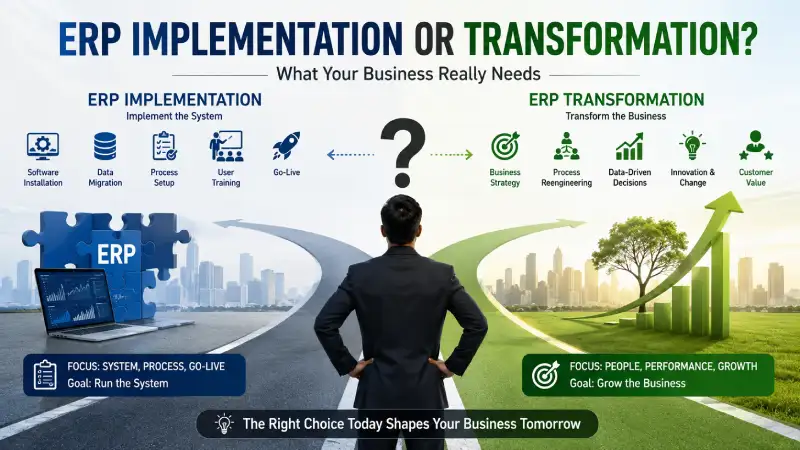
ERP Implementation vs ERP Transformation
Although these two terms are often used together, they have completely different objectives.
| ERP Implementation | ERP Transformation |
| Focuses on software deployment | Focuses on business improvement |
| Has a defined start and end date | Continuous improvement journey |
| Managed mainly by the IT team | Driven by business leadership |
| Measures project completion | Measures business performance |
| Replaces old software | Improves business processes |
| Trains users on screens | Changes the way employees work |
| Success means Go-Live | Success means measurable business results |
A simple way to remember this difference is:
Implementation asks:
“Can the software perform this task?”
Transformation asks:
“Can this business perform better because of the software?”
That single shift in thinking changes the entire purpose of an ERP project.
A Real Manufacturing Story
Let me share a situation that many manufacturing companies experience.
A company producing engineering components decided to implement an ERP system.
Before ERP, every department maintained separate Excel sheets.
The purchase department had one version of inventory.
Production maintained another.
Finance had different numbers.
Sales promised delivery dates based on assumptions.
The result?
Daily confusion.
The company implemented ERP.
Within eight months:
- Purchase Orders were automated.
- Production Orders were generated from ERP.
- Inventory became centralized.
- Finance received automatic accounting entries.
- Reports were available instantly.
Everyone believed the project was complete.
However, six months later, management discovered something surprising.
Production delays were still happening.
Inventory was still increasing.
Emergency purchases had not reduced.
Customers still complained about late deliveries.
The ERP software was functioning perfectly.
The business wasn’t.
After a detailed review, the actual issues became clear.
The company was still planning production based on assumptions instead of demand.
Bills of Materials had not been reviewed.
Safety stock levels were outdated.
Suppliers were never evaluated for delivery performance.
Departments still held independent planning meetings instead of using ERP dashboards.
The software had digitized inefficient processes.
It had not improved them.
That realization became the starting point of the company’s transformation journey.
Over the next year, they standardized planning, introduced demand forecasting, improved MRP, measured supplier performance, redesigned approval workflows, and trained department heads to make decisions using ERP dashboards.
Only then did the business begin seeing measurable improvements.
Inventory reduced.
Production planning improved.
Customer satisfaction increased.
Management finally achieved the return on investment they expected from the ERP.
The software hadn’t changed.
The way people used it had.
That is the true difference between ERP Implementation and ERP Transformation.
The Biggest Mistake Companies Make
One statement I frequently hear is:
“Our ERP implementation is complete.”
Whenever I hear this, I ask another question.
“Has your business transformation also been completed?”
Most people smile.
Because they immediately understand the difference.
ERP implementation is a project.
ERP transformation is a journey.
One has an end date.
The other never ends.
The most successful organizations continue improving their ERP environment year after year.
They automate new processes.
They introduce dashboards.
They implement AI-driven forecasting.
They simplify approvals.
They improve master data.
They continuously optimize operations.
That mindset creates long-term competitive advantage.
Is Your Organization Still Stuck at ERP Implementation?
Ask yourself these simple questions.
- Are employees still maintaining Excel sheets?
- Does management request manual reports instead of using dashboards?
- Are departments blaming each other because information doesn’t match?
- Do customer complaints continue despite ERP?
- Are inventory shortages still common?
- Are production plans changing every day?
- Are approvals still handled through emails or WhatsApp messages?
If your answer to most of these questions is Yes, your ERP implementation may be complete—but your ERP transformation has only just begun.
Why ERP Transformation Fails Even After a Successful ERP Implementation
If ERP transformation offers so many benefits, why do so many organizations struggle to achieve it?
After participating in more than 100 ERP implementation projects, I have realized that software is rarely the reason behind failure.
The biggest challenges are usually people, processes, leadership, and organizational culture.
An ERP system can automate business processes, but it cannot force people to change the way they work.
That responsibility belongs to the organization.
Let’s look at the most common reasons why ERP transformation initiatives fail.
1. Treating ERP as an IT Project Instead of a Business Project
One of the biggest mistakes organizations make is handing over the entire ERP project to the IT department.
The IT team is responsible for configuring the software, managing infrastructure, migrating data, and ensuring the system functions correctly.
But ERP is much more than technology.
It impacts every department:
- Sales
- Procurement
- Inventory
- Production
- Warehouse
- Finance
- Human Resources
- Customer Service
If department heads are not actively involved, the ERP system simply automates existing inefficiencies.
The most successful ERP projects are led by business leaders—not just the IT team.
Technology supports transformation.
Leadership drives it.
2. Employees Continue Working the Old Way
This happens in almost every organization.
Employees attend ERP training.
They learn how to enter transactions.
The system goes live.
And within a few weeks…
Excel sheets quietly return.
The purchase team maintains supplier lists in Excel.
Production planners prepare schedules outside ERP.
Warehouse staff write stock movements on paper before updating the system later.
Finance exports reports into spreadsheets before presenting them to management.
The organization has implemented ERP.
But employees haven’t changed their working habits.
Transformation only begins when ERP becomes the single source of truth for the entire organization.
3. Poor Master Data Leads to Poor Decisions
One of my favorite statements during ERP implementations is:
“ERP is only as good as the data you provide.”
Even the world’s best ERP system cannot produce accurate results if the master data is incorrect.
Examples include:
- Incorrect Bills of Materials (BOM)
- Outdated Routing
- Duplicate Products
- Incorrect Unit of Measure
- Wrong Supplier Information
- Missing Lead Times
- Incorrect Standard Costs
- Duplicate Customers
Poor master data affects everything:
- MRP planning
- Purchasing
- Inventory
- Production
- Financial reporting
Many organizations spend months selecting ERP software but only a few days cleaning their master data.
That imbalance often becomes expensive after Go-Live.
4. Management Stops Participating After Go-Live
Many organizations believe the ERP project ends after Go-Live.
In reality, that is where the real work begins.
Successful organizations continuously ask questions like:
- Why has inventory increased this month?
- Which products are generating the highest profit?
- Why did production efficiency decrease?
- Which suppliers are consistently delivering late?
- Which customers contribute the highest revenue?
When leadership regularly uses ERP dashboards to make decisions, employees naturally begin trusting the system.
When leaders ignore ERP reports, employees eventually ignore them too.
Transformation always starts from the top.
5. There is No Continuous Improvement Plan
Business never stands still.
Markets change.
Customer expectations change.
Technology changes.
Your ERP environment should evolve too.
Unfortunately, many organizations freeze their ERP environment immediately after implementation.
They avoid process improvements because:
“We don’t want to disturb the existing setup.”
That approach gradually makes the ERP less relevant.
Successful organizations continuously improve:
- Dashboards
- Approval workflows
- Reports
- Planning methods
- Manufacturing processes
- Costing methods
- Business Intelligence
- Artificial Intelligence capabilities
ERP transformation is not a destination.
It is a culture of continuous improvement.
The Human Side of ERP Transformation
One lesson I have learned over the years is that ERP projects are never really about software.
They are about people.
Technology is usually the easiest part.
Changing habits is much harder.
Imagine asking an experienced warehouse supervisor who has worked for twenty years using paper registers to suddenly trust barcode scanners and mobile devices.
Initially, it feels uncomfortable.
Some employees worry about making mistakes.
Some believe automation will replace their jobs.
Others simply prefer familiar routines.
This is completely normal.
Successful organizations don’t force change.
They explain why the change matters.
When employees understand that ERP reduces repetitive work, improves accuracy, and helps customers receive better service, resistance gradually disappears.
People support change when they understand its purpose.
How to Measure ERP Transformation Success
Many companies measure ERP success by asking:
“Did we complete the implementation on time?”
While important, this tells only a small part of the story.
Business transformation should be measured using operational improvements.
Some useful KPIs include:
Operational KPIs
- Inventory Turnover
- On-Time Delivery
- Production Efficiency
- Order Fulfilment Time
- Purchase Lead Time
- Machine Utilization
Financial KPIs
- Inventory Carrying Cost
- Gross Profit Margin
- Working Capital
- Cost of Goods Sold (COGS)
- Cash Conversion Cycle
Customer KPIs
- Customer Satisfaction
- Order Accuracy
- Delivery Performance
- Complaint Resolution Time
Employee KPIs
- User Adoption Rate
- Manual Excel Usage
- Productivity Improvement
- Training Completion
Notice that none of these KPIs measure software.
They measure business performance.
That is exactly what ERP transformation should improve.
A Five-Step Roadmap from ERP Implementation to ERP Transformation
Organizations often ask,
“Where should we begin?”
A practical roadmap looks like this.
Step 1 – Standardize Business Processes
Document every business process.
Remove unnecessary manual approvals.
Eliminate duplicate activities.
Create standard operating procedures.
Step 2 – Build High-Quality Master Data
Review:
- Product Masters
- Customer Masters
- Supplier Masters
- Bills of Materials
- Routing
- Pricing
- Warehouse Structures
Good data creates reliable decisions.
Step 3 – Improve User Adoption
Train employees continuously.
Help them understand business processes—not just ERP screens.
Encourage departments to use ERP reports instead of spreadsheets.
Step 4 – Introduce Business Intelligence
Move from static reports to interactive dashboards.
Allow managers to monitor:
- Sales
- Inventory
- Production
- Finance
- Procurement
in real time.
Step 5 – Embrace Continuous Innovation
Introduce:
- Workflow Automation
- Mobile Applications
- AI-driven Forecasting
- Predictive Analytics
- Machine Learning
- Digital Document Management
Transformation never stops.
It evolves with your business.
Lessons Learned from More Than 19 Years of ERP Consulting
Every ERP project teaches something new.
But a few lessons remain constant.
Lesson 1
Software rarely causes project failure.
Poor planning does.
Lesson 2
The best ERP system cannot compensate for poor business processes.
Automating a bad process simply allows mistakes to happen faster.
Lesson 3
Executive sponsorship is non-negotiable.
When leadership actively participates, employees take the project seriously.
Lesson 4
Data quality determines reporting quality.
Clean data is one of the most valuable assets an organization owns.
Lesson 5
ERP implementation finishes.
ERP transformation never does.
The organizations that continue improving year after year achieve the highest return on investment.
How Cyprus ERP and Onfinity ERP Help Organizations Transform Their Business
At Cyprus ERP and Onfinity ERP, we believe ERP should do much more than record transactions.
A modern ERP platform should help organizations improve the way they plan, operate, collaborate, and make decisions.
Both solutions are designed around integrated business processes, enabling every department to work from a single, reliable source of information.
Some of the transformation-focused capabilities include:
- Integrated Procurement, CRM, Sales, Inventory, Manufacturing, Finance, HR & Payroll, Fixed Assets, and Project Management.
- Advanced Material Requirements Planning (MRP) for accurate production and purchasing decisions.
- Workflow approvals that reduce manual follow-ups and improve governance.
- Real-time dashboards and Business Intelligence for faster decision-making.
- Multi-company, multi-warehouse, and multi-currency support for growing businesses.
- Batch and serial number traceability for quality-sensitive industries.
- Flexible costing methods to support different manufacturing environments.
- Document management and workflow automation to reduce paperwork.
- AI-enabled capabilities that assist organizations with forecasting, analytics, and operational insights.
More importantly, our implementation philosophy focuses on improving business processes—not simply deploying software.
Every successful ERP journey begins by understanding how an organization works today and identifying how it can work better tomorrow.
That is the foundation of sustainable business transformation.
Frequently Asked Questions (FAQs)
1. What is the difference between ERP implementation and ERP transformation?
ERP implementation focuses on installing and configuring ERP software, while ERP transformation focuses on improving business processes, productivity, and decision-making using that software.
2. Can a company implement ERP without achieving transformation?
Yes. Many organizations successfully implement ERP systems but continue working with old processes, spreadsheets, and manual decision-making. In such cases, implementation is complete, but transformation has not yet begun.
3. Why do ERP transformation projects fail?
The most common reasons include poor leadership involvement, resistance to change, poor master data, lack of user adoption, and the absence of a continuous improvement strategy.
4. How long does ERP transformation take?
Unlike implementation, transformation has no fixed end date. It is an ongoing journey of optimizing processes, adopting new technologies, and continuously improving business performance.
5. Is ERP transformation only for large enterprises?
No. Small and medium-sized businesses can benefit equally by improving efficiency, reducing manual work, and gaining better visibility into their operations.
6. What role does Artificial Intelligence play in ERP transformation?
AI helps organizations improve forecasting, automate repetitive tasks, identify trends, generate business insights, and support faster decision-making.
7. What should management measure after ERP Go-Live?
Organizations should monitor KPIs such as inventory turnover, production efficiency, on-time delivery, profitability, customer satisfaction, and user adoption rather than focusing only on system usage.
8. How can organizations ensure ERP transformation succeeds?
Strong leadership, clean master data, employee engagement, continuous training, regular process reviews, and ongoing optimization are the key success factors.
About the Author
Surya Sagar is an ERP Solution Architect with more than 19 years of experience in Enterprise Resource Planning (ERP), Digital Transformation, Manufacturing, Supply Chain Management, Material Requirements Planning (MRP), Finance, Warehouse Management, and Business Process Optimization.
Over the course of his career, he has successfully delivered more than 100 ERP implementation projects across manufacturing, pharmaceuticals, engineering, retail, distribution, trading, construction, and service industries.
His expertise extends beyond ERP implementation. He specializes in helping organizations redesign business processes, improve operational efficiency, optimize manufacturing operations, and leverage technology to achieve measurable business growth.
Through ERPPilot, Cyprus ERP, and Onfinity ERP, Surya regularly shares practical insights, implementation experiences, and industry best practices to help organizations maximize the return on their ERP investments.
Ready to Move Beyond ERP Implementation?
Implementing ERP is an important milestone—but it should never be the final destination.
The organizations that achieve the greatest success are those that continuously improve their processes, empower their people, and use ERP as a strategic platform for innovation and growth.
If your organization has already implemented an ERP system but still faces challenges such as inventory issues, production delays, manual spreadsheets, disconnected departments, or limited visibility, it may be time to focus on ERP Transformation rather than simply ERP Implementation.
Whether you are planning your first ERP project or looking to unlock more value from your existing system, the right strategy can make all the difference.
Want to discuss your ERP transformation journey?
Our ERP experts at Cyprus ERP and Onfinity ERP have helped organizations across multiple industries improve operational efficiency, streamline business processes, and build scalable digital enterprises.
Contact us today for a consultation and discover how your ERP can become more than just software—it can become the foundation for your organization’s long-term success.


