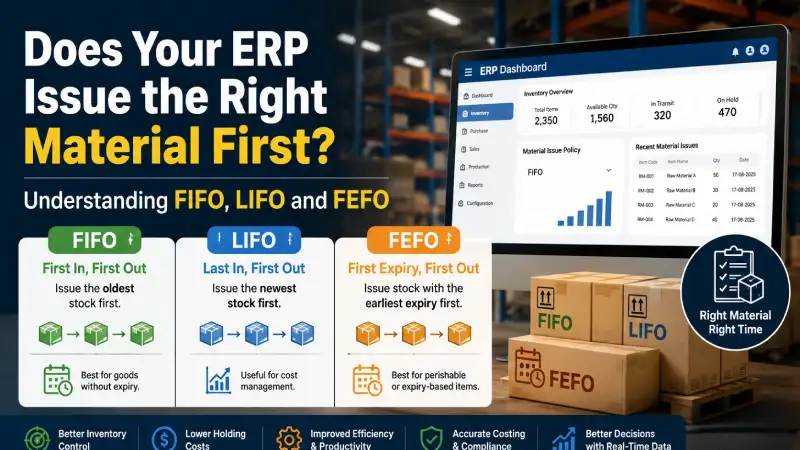
How ERP decides which inventory to issue—and why batch, expiry, warehouse and reservation rules matter
By Surya Sagar | ERP Solution Architect & ERP Implementation Expert
A warehouse manager says:
“We have enough stock, but the wrong material is being issued.”
The production manager says:
“Why did the operator use the newer batch when the older batch was still available?”
The quality team asks:
“Why are products approaching expiry still sitting in the warehouse?”
And the finance team asks:
“Why does the inventory movement not match the policy we agreed during ERP implementation?”
These may look like four different problems.
In reality, they can all come back to one important question:
How does the ERP decide which inventory should be issued when multiple quantities of the same product are available?
This is where material issue policies such as FIFO, LIFO and FEFO become important.
I have seen variations of this problem during ERP implementations. A business may have the correct stock quantity in the ERP, and the warehouse may physically have the same quantity, but the stock being issued may not follow the business rule expected by the organization.
The ERP may say there are 5,000 units available.
The warehouse may physically have 5,000 units.
But the real question is:
Which 5,000 units are available, and which ones should be used first?
That is where material issue policy becomes important.
What Is a Material Issue Policy?
A material issue policy defines which available inventory should be selected when material is issued from a warehouse.
Consider a warehouse with three batches of the same product:
| Batch | Receipt Date | Expiry Date | Quantity |
| A | 1 January | 31 December | 100 |
| B | 15 January | 30 September | 100 |
| C | 1 February | 31 October | 100 |
Now production needs 150 units.
The ERP has to decide:
Which 150 units should be issued?
There are several possible answers.
If the policy is FIFO, the oldest received stock is considered first.
If the policy is LIFO, the latest received stock is considered first.
If the policy is FEFO, the stock with the earliest expiry date is considered first.
The quantity in inventory may be exactly the same under all three policies.
But the physical stock selected for issue will be different.
That distinction is extremely important when designing an ERP process.
Material Issue Policy Is Not the Same as Inventory Costing
This is one of the most common areas of confusion during ERP implementations.
Two questions need to be separated.
Question 1: What cost should be assigned to the inventory?
This relates to the inventory costing method.
Examples include:
- Weighted Average
- Weighted Average PO
- FIFO Costing
- LIFO Costing
- Standard Cost
- Average PO
- Average Invoice
- Last PO
- Last Invoice
- Other ERP-specific costing methods
Question 2: Which physical inventory should be issued?
This relates to the material issue policy.
Examples include:
- FIFO
- LIFO
- FEFO
- Customer-specific allocation
- Other business-defined issue rules
The two concepts can be related, but they are not necessarily the same.
For example, an organization may use Weighted Average for financial inventory valuation while using FEFO to determine which batch should physically be issued from the warehouse.
This distinction is particularly important in industries where expiry dates matter.
A simple way to remember it is:
Costing answers: “What cost should be assigned?”
Material issue policy answers: “Which stock should be issued?”
A good ERP implementation should clearly define both.
If you want to understand the financial side of this topic, see our related article on inventory costing methods and their impact on COGS, gross profit and inventory valuation.
One Warehouse, Three Batches — Which Stock Should the ERP Issue?
Let’s take the same example again:
| Batch | Receipt Date | Expiry Date | Quantity |
| A | 1 January | 31 December | 100 |
| B | 15 January | 30 September | 100 |
| C | 1 February | 31 October | 100 |
The warehouse needs 150 units.
The product is the same.
The quantity is the same.
The warehouse is the same.
But the result depends on the issue policy.
FIFO
The ERP considers the oldest receipt first:
A → B
100 units from A and 50 units from B.
LIFO
The ERP considers the latest receipt first:
C → B
100 units from C and 50 units from B.
FEFO
The ERP considers the earliest expiry first:
B → C
100 units from B and 50 units from C.
The same inventory has produced three different physical issue sequences.
This simple example explains why material issue policy matters.
Why Does Material Issue Policy Matter?
If a business has only one receipt of a product, the issue policy may not appear important.
Suppose the warehouse has:
1,000 units of Product A
There is nothing complicated.
But imagine the warehouse has:
- 500 units received in January
- 300 units received in February
- 400 units received in March
- 200 units received in April
Now production requests 600 units.
Which stock should be selected?
The answer can affect:
- Inventory ageing
- Expiry management
- Product quality
- Warehouse efficiency
- Production planning
- Inventory losses
- Obsolescence
- Customer service
- Regulatory compliance
- Working capital
This is why material issue policy should be defined during the ERP blueprint stage, rather than being treated as a small configuration decision after the system is already built.
FIFO – First In, First Out
FIFO means:
First In, First Out.
The basic principle is:
The stock that entered the warehouse first should normally be issued first.
Consider:
| Receipt | Quantity | Date |
| Receipt 1 | 100 | 1 January |
| Receipt 2 | 100 | 15 January |
| Receipt 3 | 100 | 1 February |
Production requires 150 units.
Under FIFO:
- 100 units from Receipt 1 are issued first.
- 50 units from Receipt 2 are issued next.
The remaining inventory is:
- 50 units from Receipt 2
- 100 units from Receipt 3
The objective is to avoid keeping older stock in the warehouse unnecessarily.
Where Is FIFO Useful?
FIFO can be useful when the age of inventory matters.
Examples include:
- Food distribution
- General consumer products
- Raw materials with ageing concerns
- Packaging materials
- Chemicals
- Some manufacturing environments
- Products where older stock should normally be consumed first
Consider a food distributor.
The warehouse receives:
1,000 packets on 1 June
and another:
1,000 packets on 20 June
If warehouse operators continually pick from the latest receipt, the June 1 stock may remain in storage for much longer.
Eventually, the business may have ageing or obsolete inventory.
FIFO helps reduce that risk by encouraging the movement of older stock first.
A Real ERP Implementation Problem: “We Use FIFO”
One situation I have seen during ERP implementations is where the warehouse team physically follows FIFO, but the ERP does not appear to do the same.
The warehouse manager says:
“We always issue the oldest stock first.”
The implementation team configures FIFO.
Then, during testing, the ERP selects another available stock.
The immediate reaction is:
“The ERP is wrong.”
But that should not be the first conclusion.
Before changing the configuration, I would investigate:
- Was the material stored under different batches?
- Was the receipt date captured correctly?
- Was the locator correct?
- Was a batch manually selected?
- Was negative stock allowed?
- Was the stock already reserved?
- Was the receipt posted before or after the issue?
- Was the issue policy configured at the correct level?
- Was the physical warehouse process actually FIFO for this product?
This is an important lesson from ERP implementation.
A material issue policy only works correctly when the inventory data and transaction process behind it are also correct.
Simply enabling a checkbox called “FIFO” does not guarantee that the warehouse will operate according to FIFO.
LIFO – Last In, First Out
LIFO means:
Last In, First Out.
The principle is the opposite of FIFO:
The most recently received inventory is considered for issue first.
Suppose the warehouse has:
| Receipt | Quantity | Date |
| Receipt 1 | 100 | 1 January |
| Receipt 2 | 100 | 15 January |
| Receipt 3 | 100 | 1 February |
Production requires 150 units.
Under LIFO:
- 100 units from Receipt 3 are issued first.
- 50 units from Receipt 2 are issued next.
The remaining stock is:
- 100 units from Receipt 1
- 50 units from Receipt 2
Where Can LIFO Make Sense?
LIFO is not appropriate for every business.
It may be considered where the physical characteristics of the material or the warehouse operating process make the latest stock easier or more practical to issue.
For example, imagine a warehouse where newly received bulk material is placed at the front of a storage area while older material is positioned behind it. If the operating process intentionally consumes the latest material first, LIFO may be considered.
However, the business should ask:
“Why do we actually want the latest stock to be issued first?”
If there is no strong operational reason, LIFO may simply cause older stock to remain in storage for longer.
There are also separate accounting considerations when LIFO is used as a financial inventory costing method. Therefore, financial costing policy and physical warehouse issue policy should not automatically be treated as the same thing.
FEFO – First Expiry, First Out
For many industries, FIFO is not enough.
This is where FEFO becomes particularly important.
FEFO means:
First Expiry, First Out.
The basic principle is:
The inventory with the earliest expiry date should be issued first.
Notice the difference.
FIFO primarily looks at:
When was the inventory received?
FEFO primarily looks at:
When will the inventory expire?
Consider:
| Batch | Receipt Date | Expiry Date | Quantity |
| A | 1 January | 31 December | 100 |
| B | 15 January | 30 September | 100 |
| C | 1 February | 31 October | 100 |
Production requires 150 units.
Under FIFO:
A → B
because A was received first.
Under FEFO:
B → C
because B expires first.
This is a major difference.
Why FEFO Is Critical for Pharmaceuticals
Consider a pharmaceutical warehouse with two batches of the same medicine.
Batch A
Received: January
Expiry: December
Batch B
Received: February
Expiry: September
If the warehouse follows FIFO, Batch A may be issued first because it arrived earlier.
But Batch B will expire earlier.
From an expiry-management perspective, issuing Batch B first may be more appropriate.
That is why FEFO is particularly important for:
- Pharmaceuticals
- Food products
- Chemicals
- Cosmetics
- Medical products
- Other expiry-sensitive products
The objective is to reduce:
- Expired stock
- Product write-offs
- Inventory losses
- Obsolescence
- Regulatory risks
A Real-Life Expiry Problem
Imagine a distributor with 50,000 units of a pharmaceutical product.
The ERP shows:
50,000 units available.
From a quantity perspective, management is comfortable.
Then the warehouse discovers:
8,000 units will expire within the next three months.
The company now has a serious inventory problem.
The stock quantity is correct.
The ERP may not be showing an incorrect balance.
But the business does not really have 50,000 equally usable units.
A portion of the inventory has a much shorter remaining shelf life.
If the warehouse does not prioritize that stock appropriately, the company may eventually face:
- Expiry-related losses
- Write-offs
- Reduced profitability
- Regulatory concerns
- Emergency discounting
- Customer service problems
This is where FEFO becomes valuable.
A good ERP should help the business identify and prioritize inventory that needs to move first.
FEFO Is More Than a Warehouse Feature
Some businesses think:
“We need FEFO, so we just need a button that selects the earliest expiry batch.”
In practice, it is much more complicated.
FEFO requires reliable master data and transaction discipline.
The ERP needs to know:
- Product
- Batch
- Receipt date
- Expiry date
- Quantity
- Warehouse
- Locator
- Stock status
- Quality status
- Reservation status
If expiry dates are missing or incorrect, FEFO cannot reliably select the right inventory.
In fact:
FEFO is only as good as the inventory data behind it.
If the expiry date is wrong, the ERP can make the wrong decision very efficiently.
That is why master data quality is just as important as the configuration itself.
Why Material Issue Is More Complicated Than FIFO, LIFO or FEFO
At this point, it may seem that the ERP simply needs to select inventory according to FIFO, LIFO or FEFO.
In real ERP implementations, several other conditions may come into play.
Batch and Serial Control
The same product may exist across multiple batches or serial numbers.
Some batches may be:
- Approved
- Blocked
- Under inspection
- Expired
- Reserved
- Customer-specific
The issue policy must work with these conditions.
Quality Status
Suppose Batch A has the earliest expiry date, but it is under quality inspection.
Should the ERP issue it?
Not necessarily.
The system may first need to determine:
Is this inventory actually available for issue?
Only eligible inventory should then be considered by the material issue policy.
Reservations
Suppose a warehouse has 1,000 units.
But 600 units are already reserved for another customer.
The physically present quantity is 1,000.
But the quantity available for the next transaction may only be 400.
The issue policy must work within the available-to-issue quantity, not simply the physical balance.
Multiple Warehouses
Imagine the company has:
- Delhi Warehouse
- Mumbai Warehouse
- Bangalore Warehouse
The same product is available in all three.
A production order requires 1,000 units.
Which warehouse should supply the material?
This is no longer only a FIFO, LIFO or FEFO question.
The ERP may first need to determine:
- Which warehouse is allowed?
- Which warehouse is linked to the production unit?
- Is stock transferable?
- Is there a preferred warehouse?
- Is the stock reserved?
- What is the transfer lead time?
- Is the inventory available for issue?
Only after determining eligible inventory can the system apply the appropriate issue policy.
Negative Stock
Negative stock can create another complication.
Suppose the system allows a warehouse to issue 100 units before the receipt of those units has been recorded.
Later, the receipt is posted.
Now the ERP needs to reconcile the inventory movement and determine how the stock layer, batch or cost should be handled.
If negative inventory is allowed without appropriate controls, FIFO, LIFO or FEFO behavior can become difficult to understand.
Therefore, the business should explicitly define:
Can inventory be issued before it is physically received?
If yes, what should happen?
If no, how will the ERP prevent it?
These are business-policy questions, not merely technical questions.
Material Issue Policy in Manufacturing
Material issue policy becomes even more important in manufacturing.
Consider a production order requiring:
500 kg of Raw Material A
The warehouse has:
| Batch | Quantity | Expiry |
| RM-A01 | 200 kg | December 2026 |
| RM-A02 | 300 kg | October 2026 |
| RM-A03 | 400 kg | November 2026 |
If the business uses FEFO:
RM-A02 should be considered first because it expires earliest.
Then:
RM-A03
Then:
RM-A01
This can be particularly useful when raw materials have limited shelf life.
But manufacturing can introduce additional restrictions.
For example:
- Certain batches may be approved only for specific products.
- Some batches may be under quality inspection.
- Some may be reserved for another production order.
- Some materials may have customer-specific requirements.
- Some materials may need a minimum remaining shelf life.
Therefore, material issue policy must work together with the production, inventory and quality processes.
A Common ERP Implementation Mistake
One of the common mistakes I have seen is defining the material issue policy based only on an initial requirement discussion.
For example, the customer says:
“We use FIFO.”
The implementation team configures FIFO.
Then, during UAT, the warehouse team says:
“Actually, we use FEFO for pharmaceutical products.”
Another team says:
“Some products are issued based on customer allocation.”
Production says:
“Some batches cannot be used for certain products.”
Now the original requirement is no longer sufficient.
This is why I recommend asking a more useful question:
“How do you decide which physical stock to issue for each category of material?”
That question usually produces a much better ERP requirement than simply asking:
“Do you use FIFO?”
Material Issue Policy Should Be Defined Product-Wise Where Necessary
Not every product in an organization necessarily needs the same issue policy.
For example:
| Product Category | Typical Consideration |
| Perishable Products | FEFO is often considered |
| Pharmaceutical Products | FEFO is often important |
| General Raw Materials | FIFO may be appropriate |
| Non-expiring Bulk Material | FIFO or business-defined policy |
| Special Customer Stock | Allocation-based issue |
| Other Operational Materials | Business-defined policy |
These are examples, not universal rules.
The actual policy should be based on the organization’s:
- Product characteristics
- Warehouse process
- Customer requirements
- Quality requirements
- Regulatory environment
- Shelf-life requirements
- Manufacturing process
A single global rule may not be appropriate for every product category.
Material Issue Policy and ERP Automation
The real benefit of ERP comes when the system can help the warehouse consistently apply the defined policy.
Without an ERP, a warehouse operator may need to:
- Open a stock report.
- Check available quantities.
- Check batches.
- Check expiry dates.
- Check reservations.
- Check quality status.
- Decide which stock to pick.
- Enter the selected batch manually.
Every additional manual step creates room for error.
With a properly designed ERP process, much of this logic can be system-driven.
The system can suggest or allocate eligible inventory according to the configured business policy.
But automation should not remove control.
The ERP should still provide visibility into:
- Which batch was selected
- Why it was selected
- Quantity issued
- Remaining quantity
- Expiry date
- Warehouse and locator
- User who performed the transaction
This creates traceability and makes the transaction easier to investigate later.
What Should Be Tested During ERP UAT?
A material issue policy should not be considered successfully implemented simply because one test transaction works.
It should be tested using realistic warehouse and production scenarios.
Test 1 – Multiple Receipts
Receive the same product three times.
Verify which stock is selected under FIFO.
Test 2 – Reverse Receipt Sequence
Receive newer stock after older stock.
Verify LIFO behavior where LIFO is required.
Test 3 – Different Expiry Dates
Create multiple batches with different expiry dates.
Verify FEFO selection.
Test 4 – Partial Issue
If 500 units are required but the selected batch contains only 300 units, verify that the ERP selects the next eligible inventory correctly.
Test 5 – Expired Stock
Create an expired batch.
Verify whether the ERP prevents the issue or handles it according to the defined business rule.
Test 6 – Quality Hold
Place a batch under quality inspection.
Verify that the issue policy does not incorrectly select unavailable stock.
Test 7 – Reserved Stock
Reserve part of the inventory for another order.
Verify that the issue process considers the available quantity correctly.
Test 8 – Multiple Warehouses
Keep stock in different warehouses.
Verify warehouse selection and the subsequent material issue policy.
Test 9 – Manufacturing Issue
Create a production order and issue components.
Verify which batch is selected and whether the result follows the defined policy.
Test 10 – Manual Override
If the business allows users to select another batch manually, test:
- Who can override?
- Is a reason required?
- Is the override recorded?
- Is the transaction traceable?
- Can unauthorized users bypass the policy?
These tests are much more valuable than simply checking whether a material issue transaction can be completed.
What Should the ERP Blueprint Define?
If material issue policy is important to your business, a requirement such as:
“Material Issue Policy = FIFO”
is probably not detailed enough.
Before configuring the ERP, I recommend documenting at least the following:
- Which products are batch controlled?
- Which products are serial controlled?
- Which products have expiry dates?
- Which products follow FIFO?
- Which products follow FEFO?
- Are there products requiring LIFO?
- Can users manually override the suggested batch?
- Can expired stock be issued?
- Can quality-hold stock be issued?
- How should reserved stock be handled?
- How should multiple warehouses be considered?
- How should stock transfers affect the issue sequence?
- Should the same policy apply to sales and production?
- What happens when the preferred batch does not have sufficient quantity?
- How should exceptions be authorized and recorded?
These questions turn a simple statement such as “We use FIFO” into a meaningful ERP specification.
And this is exactly where an experienced ERP implementation team can add value.
Which Policy Should You Choose?
There is no universal answer.
The right policy depends on what the business is trying to achieve.
Choose FIFO when inventory age matters
If the business wants older received inventory to be consumed before newer inventory, FIFO may be appropriate.
Consider LIFO when there is a specific operational reason
If the physical warehouse process genuinely requires newer inventory to be issued first, LIFO may be considered, subject to the organization’s operational and accounting policies.
Choose FEFO when expiry matters
If the product has a shelf life and expiry management is important, FEFO can be particularly useful.
This is common in:
- Pharmaceuticals
- Food
- Chemicals
- Cosmetics
- Medical products
But there is one principle I strongly recommend:
The policy should reflect the physical reality of the warehouse.
Don’t configure FEFO because it sounds more advanced.
Don’t configure FIFO simply because it is common.
Don’t configure LIFO simply because the ERP supports it.
First understand:
How does the warehouse actually operate?
Then configure the ERP accordingly.
The ERP Should Follow the Business Rule — Not the Other Way Around
This is one of the most important lessons I have learned from ERP implementations.
When a company purchases an ERP, there is sometimes a tendency to ask:
“What does the system support?”
I prefer to start with:
“What does the business actually need?”
Then we determine how the ERP should support it.
For material issue, this means understanding the real warehouse process.
If the warehouse team physically rotates stock based on expiry dates, the ERP should support FEFO.
If the warehouse rotates stock based on receipt sequence, FIFO may be appropriate.
If specific customer batches are allocated, the system needs to consider allocation rules.
The ERP should become a tool for consistently enforcing the business process—not a reason for changing a valid business process simply because the software has been configured differently.
This is one of the fundamental principles I follow while working on ERP blueprinting and implementation.
How Cyprus ERP and Onfinity ERP Handle Material Issue Policies
In Cyprus ERP and Onfinity ERP, inventory management is not treated as simply maintaining a quantity balance.
A complete inventory process can involve:
Product Category
↓
Product
↓
Warehouse
↓
Locator
↓
Batch / Serial
↓
Receipt
↓
Available Quantity
↓
Material Issue Policy
↓
Issue / Consumption
↓
Inventory Traceability
This becomes particularly important for manufacturing organizations, distributors and businesses handling batch-controlled, serial-controlled or expiry-sensitive inventory.
For example, when material is required for production, the ERP process should not treat every available quantity as interchangeable.
The system may need to consider:
- Warehouse
- Locator
- Batch
- Serial number
- Receipt sequence
- Expiry date
- Quality status
- Reservations
- Available quantity
- Production requirements
- Sales requirements
The objective is not simply to tell the warehouse:
“You have 10,000 units.”
The objective is to help answer:
“Which 10,000 units are actually available, and which ones should be issued first?”
That is where an integrated ERP becomes valuable.
The larger transaction flow can connect:
Purchasing → Inventory → Warehouse → Material Issue → Production → Sales → Finance
This means the material issue decision is not an isolated warehouse activity. It can become part of the complete business transaction flow.
A Final Practical Example
Let’s return to our warehouse.
It has:
300 units of the same product.
But the inventory is spread across three batches.
One batch is old.
One batch is new.
One batch expires soon.
The warehouse needs 150 units.
If the business uses FIFO, the oldest receipt may be selected.
If it uses LIFO, the newest receipt may be selected.
If it uses FEFO, the batch with the earliest expiry may be selected.
There is no universal answer.
The correct answer comes from the business policy.
And that is the real purpose of an ERP.
Not to make the decision for the business without understanding the process.
But to:
Consistently apply the business decision every time a transaction is processed.
Is Your ERP Issuing the Right Stock?
If your organization is facing questions such as:
- Why is the ERP selecting the wrong batch?
- Why isn’t FIFO working as expected?
- Should we use FIFO or FEFO?
- How should expiry-based inventory be handled?
- Why is production consuming a different batch than expected?
- How should material issue work across multiple warehouses?
- Why is the system selecting reserved or unavailable inventory?
- Is our ERP blueprint detailed enough to handle these rules?
These are not simply warehouse questions.
They are ERP design questions.
Material issue policy touches inventory, warehouse, production, quality, sales and sometimes regulatory requirements.
This is why it should be addressed during ERP blueprinting, configuration, testing and UAT—not discovered after go-live.
If your current ERP is not issuing the inventory you expect, the first step should not necessarily be changing the configuration.
The first step should be understanding:
What is the business rule?
What inventory is actually eligible?
What data is driving the decision?
What policy has been configured?
And does the ERP apply that policy consistently?
That is where experienced ERP implementation makes a difference.
Frequently Asked Questions
What is a material issue policy?
A material issue policy defines which available inventory should be selected when material is issued from a warehouse.
Is FIFO the same as FIFO costing?
Not necessarily. FIFO can be used as a physical material issue policy, while FIFO costing is a financial inventory valuation method. These should be defined separately during ERP implementation.
What is the difference between FIFO and FEFO?
FIFO selects stock based primarily on the sequence in which it was received. FEFO selects stock primarily based on expiry date.
Is FEFO better than FIFO?
Not always. FEFO is particularly useful for expiry-sensitive products. For products without expiry concerns, FIFO may be sufficient.
Why is FEFO important in pharmaceuticals?
A product received later may expire earlier than an older batch. FEFO helps prioritize the batch with the earliest expiry date and can reduce expiry-related inventory losses.
Can an ERP use Weighted Average costing and FEFO issue policy together?
Yes. They address different questions. Weighted Average determines the financial inventory cost, while FEFO determines which physical stock should be issued.
Can users override FIFO or FEFO?
This depends on the ERP design and business policy. If overrides are allowed, the organization should consider authorization, reason capture and transaction traceability.
What happens if the selected batch does not have enough stock?
The ERP should normally continue considering the next eligible inventory according to the configured rules, subject to reservations, quality status, warehouse restrictions and other business controls.
Should every product use the same material issue policy?
Not necessarily. Different product categories may require different policies based on expiry, shelf life, warehouse practices, customer requirements and business processes.
About the Author
Surya Sagar is an ERP Solution Architect, ERP implementation expert and founder of BRS Infotek.
With more than 19 years of ERP experience and 100+ ERP implementations, his practical experience covers:
Sales | Procurement | Inventory | MRP | Manufacturing | WMS | Finance | Costing | ERP Transformation
His approach to ERP implementation is based on understanding the real business process first and then designing the ERP around that process.
During ERP implementations, he has worked closely with finance, warehouse, procurement, production and management teams to translate operational requirements into practical ERP processes.
His experience includes designing inventory and manufacturing processes where seemingly simple requirements—such as “issue the oldest stock first” or “use the batch that expires first”—need to be converted into clear system rules, master data requirements and UAT scenarios.
He is also associated with Cyprus ERP and Onfinity ERP, applying this practical ERP experience to integrated business solutions.
About Cyprus ERP and Onfinity ERP
Cyprus ERP and Onfinity ERP provide integrated ERP capabilities covering areas such as:
Sales | Procurement | Inventory | MRP | Manufacturing | WMS | Finance | CRM | Fixed Assets | Business Intelligence
For organizations managing batch-controlled, serial-controlled or expiry-sensitive inventory, an ERP should provide more than a simple stock balance.
It should connect:
Purchasing → Inventory → Warehouse → Material Issue → Production → Sales → Finance
This integrated approach helps businesses maintain better inventory visibility, traceability and control.
If your organization is reviewing its inventory process, material issue policy or ERP blueprint, the right questions are not only:
“Does the ERP support FIFO, LIFO or FEFO?”
The more important questions are:
“Which policy does our business actually need?”
and:
“Can our ERP apply that policy correctly across inventory, warehouse, production and sales?”
Explore Cyprus ERP and Onfinity ERP, or connect with an ERP expert to discuss your inventory and warehouse requirements.
Written by Surya Sagar
ERP Solution Architect | Founder – BRS Infotek


