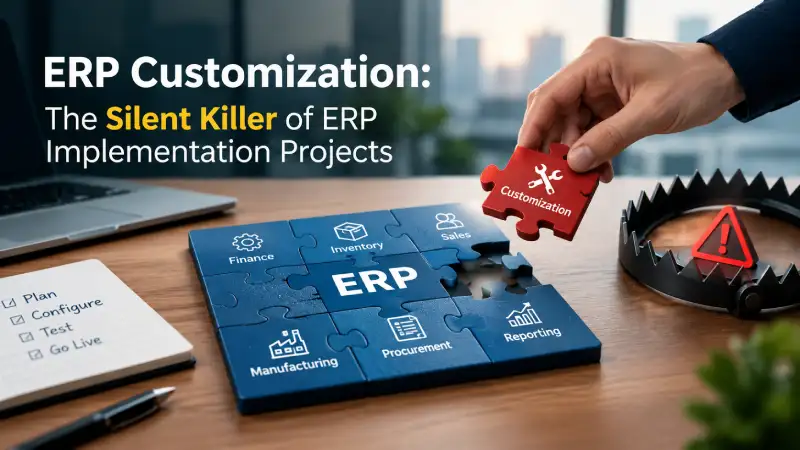
The ERP demo went well.
The management team liked the system. The functional features looked impressive. The implementation partner explained the implementation plan, the customer agreed to follow the standard ERP processes, and everyone was expecting the project to go live within the planned time and budget.
Then implementation started.
A few weeks later, the first request came:
“Can you add one more field?”
Then another:
“Can you change the approval process?”
Then:
“Our production process is different. We need the ERP to work this way.”
And finally:
“This report is critical for our management.”
None of these requests looked particularly dangerous.
But one customization became five. Five became fifteen. Fifteen became a significant development backlog.
The project that was supposed to be a standard ERP implementation slowly started becoming a software development project.
This is a situation I have seen repeatedly during ERP implementations.
And there is an important point I want to make at the beginning:
ERP customization is not the enemy. Uncontrolled customization is.
A business may have a genuine requirement that the standard ERP cannot address. Customization may sometimes be necessary because of regulatory requirements, industry-specific processes, integrations or genuine competitive needs.
The problem begins when every difference between the customer’s existing way of working and the ERP’s standard process is treated as a software gap.
That is when customization can quietly become one of the biggest causes of ERP implementation delays, additional cost, testing problems and user frustration.
The Real Problem Starts After ERP Selection
During an ERP demonstration, the customer usually asks:
“Can this ERP do this?”
The vendor demonstrates the functionality, and the customer gets an understanding of the product.
But after the ERP is selected, the question often changes to:
“Can the ERP do exactly what we are doing today?”
That is a completely different question.
During the demo, a standard sales process may look perfectly suitable.
During implementation, the sales team starts using real business scenarios and discovers differences in:
- Pricing
- Approvals
- Customer-specific processes
- Dispatch
- Returns
- Credit control
- Reporting
- Documentation
The same thing happens in procurement, inventory, manufacturing and finance.
The customer then starts asking for changes.
This is why ERP selection should not be based only on a feature demonstration. Requirements need to be understood, business processes need to be mapped, and the fit between the customer’s needs and the ERP’s standard capabilities needs to be evaluated before the implementation scope is finalized.
A standard-first approach, documented scope and disciplined change control are widely recognized as important ERP implementation practices.
Configuration and Customization Are Not the Same
One of the first things I explain to customers is that configuration and customization are different.
Modern ERP systems normally provide many ways to adapt the system without changing the underlying software.
These may include:
- Master data
- Document types
- Workflows
- Approval rules
- Roles and permissions
- Accounting configuration
- Business rules
- Reports
- Dashboards
- Validations
- Configurable fields
Suppose a company wants all purchase orders above ₹10 lakh to go through an additional approval.
If the ERP already provides an approval workflow that can be configured for this requirement, there may be no need for custom programming.
That is configuration.
Now suppose the customer wants an entirely new purchasing process involving new business objects, new calculations, new screens and new accounting logic.
That is much closer to customization or custom development.
This distinction matters because the first question should always be:
Can we achieve the business requirement using the ERP’s existing capabilities?
Only after that question has been answered should custom development be considered.
How a Small Customization Becomes a Big Problem
Most customization problems do not begin with a major development request.
They begin with something that sounds very small.
“It is only one field.”
The implementation consultant adds the field.
Then someone says:
“Can this field be mandatory only for certain products?”
Then:
“Can it be automatically populated?”
Then:
“Can we add an approval based on this field?”
Then:
“Can this information appear on the invoice?”
Now the original request for one field has become:
Field → Validation → Business Rule → Workflow → Document Change → Testing
This is how ERP scope grows.
And an ERP is an interconnected system.
For example:
Purchase Requisition → Purchase Order → Receipt → Invoice → Inventory → Accounting → Reporting
A change to one part of the process can affect several downstream transactions.
That is why a customization should never be evaluated only from the screen where the request originated.
The important question is:
What happens to the rest of the ERP after we introduce this change?
A Real-Life ERP Implementation Situation
Let me describe a situation that will be familiar to many companies implementing an ERP.
A manufacturing company selected an ERP after several product demonstrations.
During the sales discussion, the customer and implementation partner agreed that the initial phase would follow standard ERP functionality. Custom development was not included in the agreed implementation scope.
The project started.
The team configured procurement, sales, inventory, finance and fixed assets.
Initially, everything looked fine.
Then users started working with actual business transactions.
The purchase department said:
“We need one additional approval before the purchase order is released.”
The production department said:
“Our production process is different. We need additional information on the production order.”
Finance said:
“This invoice needs to behave differently for a particular business case.”
Management said:
“We need another report.”
None of these requests were unreasonable.
That is what makes the situation difficult.
Every request can be justified from the customer’s perspective.
But the implementation partner has another responsibility: delivering the agreed project within the approved scope, budget and timeline.
If the partner accepts every request without analyzing the impact, the project timeline begins to move.
If the partner says:
“This is outside the agreed scope and will require additional customization charges,”
the customer may respond:
“But this is critical for our business. Why should we pay extra?”
This is where the relationship between the customer and implementation partner can become difficult.
The customer believes the ERP should support the business.
The implementation partner believes additional development was not part of the original agreement.
In many cases, both sides have a valid point.
The solution is not to argue about who is right.
The solution is to have a proper change-control process.
“This Customization Is Critical for Us”
This is one of the most common statements heard during ERP implementation.
“This customization is critical for us.”
As an ERP consultant, I understand why users say this.
If a process is important to their daily operation, it genuinely feels critical.
But I always believe there is another question worth asking:
Critical for what?
Is it:
- A legal requirement?
- A statutory requirement?
- A customer contractual requirement?
- An industry requirement?
- An internal control?
- A genuine operational requirement?
- A management preference?
- User convenience?
- A legacy process?
- Something users are simply accustomed to?
These requirements should not automatically be treated in the same way.
For example, if a statutory requirement is mandatory, it obviously deserves serious consideration.
But if someone says:
“We have always printed this information on this report.”
that alone does not mean the ERP must be customized.
The implementation team needs to understand why the information is required and what business decision depends on it.
That is where experienced ERP consulting becomes important.
The “We Have Always Done It This Way” Problem
One of the biggest challenges in ERP implementation is legacy thinking.
A company may have used the same process for 10 or 15 years.
When the new ERP proposes a different process, users may immediately say:
“No, we cannot work like this.”
But there is an important question:
Is the existing process actually better, or is it simply familiar?
ERP implementation is not only a software installation exercise.
It is an opportunity to review how the organization works.
If every old process is recreated exactly inside the new ERP, the company may simply be paying to reproduce its existing inefficiencies.
This is why an experienced ERP consultant should ask two questions:
“What do you want the ERP to do?”
and then:
“Why do you need it to work this way?”
The second question often reveals the real requirement.
The ERP Customization Domino Effect
Consider a manufacturing example.
The customer asks for a customized production order.
The production order needs three additional fields.
Those fields are then used during production execution.
Production execution affects inventory consumption.
Inventory consumption affects costing.
Costing affects accounting.
Accounting affects financial reporting.
Suddenly, the original request:
“We need three additional fields.”
has touched several functional areas.
This is the ERP customization domino effect.
A good implementation consultant therefore does not ask only:
“Can we develop this?”
The consultant should also ask:
“What else will this change?”
That question can uncover:
- Database impact
- Workflow impact
- Accounting impact
- Reporting impact
- Integration impact
- Security impact
- Testing impact
- Training impact
- Upgrade impact
Technically, many things can be developed.
The real question is whether they should be developed.
When ERP Implementation Becomes a Software Development Project
An ERP implementation should primarily be about:
Business Process + ERP Configuration + Data + Testing + Training + Change Management
But excessive customization changes the project equation.
It becomes:
Requirement → Design → Programming → Unit Testing → Integration Testing → UAT → Bug Fixing → Regression Testing → Documentation → Training → Deployment
At that point, the implementation needs more developers, more functional consultants, more testing and more project management.
A three-month implementation plan may no longer be realistic if significant development is introduced halfway through the project.
Current ERP implementation guidance similarly identifies uncontrolled scope expansion as a source of increased cost, schedule pressure and implementation risk.
The Hidden Cost of ERP Customization
Customers often look only at the development charge.
Suppose a customization costs ₹1,00,000.
The immediate reaction may be:
“We are paying ₹1 lakh for this customization.”
But that is not the complete cost.
The customization may require:
Requirement Analysis
↓
Solution Design
↓
Development
↓
Testing
↓
User Acceptance Testing
↓
Bug Fixing
↓
Regression Testing
↓
Documentation
↓
Training
↓
Deployment
↓
Future Maintenance
There is also an opportunity cost.
If the implementation team spends two weeks developing and testing one customization, those two weeks may delay:
- Data migration
- UAT
- User training
- Other module configurations
- Integration testing
- Go-live preparation
There may also be a future maintenance cost whenever the ERP evolves.
This is why customization should be evaluated using total project and lifecycle impact, not just the developer’s effort.
Long-term ERP guidance increasingly recommends evaluating customization through total cost, risk, maintenance and future-change considerations rather than treating development effort as the only cost.
Why Customization During UAT Can Be Dangerous
UAT is supposed to confirm whether the ERP meets the agreed business requirements.
But in many projects, UAT becomes a new requirements workshop.
A user performs a transaction and says:
“We need one more change.”
Another says:
“This screen should work differently.”
Another says:
“We need another report.”
The project goes back to development.
Then testing starts again.
The cycle becomes:
UAT → Change Request → Development → Testing → UAT → New Change Request
If this continues without control, the project can remain in testing for a very long time.
This does not mean that UAT findings should be ignored.
It means every finding should be classified.
Is it:
- A defect?
- A missed requirement?
- A new requirement?
- A user preference?
- A training issue?
- A configuration issue?
- A genuine customization?
That classification can make a huge difference.
Customization Is Not Always Bad
It is important to be clear about this.
I am not suggesting that companies should never customize an ERP.
That would be unrealistic.
There are situations where customization is completely justified.
1. Regulatory Requirements
A statutory or tax requirement may require functionality that the standard ERP does not provide.
2. Industry-Specific Processes
Certain manufacturing, pharmaceutical, construction, service or other specialized industries may have processes that genuinely require additional functionality.
3. Competitive Differentiation
A business may have a process that creates a genuine competitive advantage.
4. Integration Requirements
The ERP may need to exchange information with machines, marketplaces, banking systems, external applications or other business platforms.
5. Genuine Product Gaps
A business may have a legitimate requirement that cannot reasonably be handled through configuration or standard functionality.
In these cases, customization may be the right answer.
The objective is not:
Zero customization.
The objective is:
Controlled, justified and maintainable customization.
A Simple ERP Customization Decision Framework
Whenever a customization request is raised, I recommend asking five questions.
1. Is the requirement genuinely necessary?
What happens if we do not implement it?
2. Can standard functionality handle it?
Check configuration, workflows, reports, roles, validations and existing business processes before considering development.
3. Can the business process be changed?
Sometimes changing the process is easier, cheaper and more sustainable than changing the software.
4. What is the total impact?
Evaluate:
- Cost
- Timeline
- Testing
- Training
- Support
- Upgrades
- Integration
- Accounting
- Reporting
5. Does it really need to be delivered before go-live?
Not every requirement needs to be part of the initial implementation.
A simple prioritization model can be:
Must Have → Should Have → Could Have → Future Enhancement
This keeps the first implementation focused.
Should You Customize Your ERP? Use This Simple Matrix
| Requirement | First Question to Ask |
| Legal requirement | Is customization/configuration mandatory? |
| Statutory reporting | Can standard functionality meet the requirement? |
| Industry-specific process | Is it genuinely different or simply a legacy process? |
| Workflow change | Can the existing workflow be configured? |
| Additional field | Does the platform already provide extensibility? |
| New report | Can the reporting capability provide it? |
| User preference | Does it create measurable business value? |
| Legacy process | Why does the business need to continue it? |
| Convenience | Can it move to a future phase? |
| Competitive advantage | Does it provide genuine differentiation? |
The question should never simply be:
“Can the ERP do it?”
The better question is:
“Should we change the ERP to do it?”
That small change in thinking can save a project from a lot of unnecessary complexity.
The Importance of a Formal Change Request Process
Every ERP implementation should have a formal mechanism for handling new requirements.
When a request comes in, document:
Requirement
What exactly does the customer want?
Business Reason
Why is it required?
Current ERP Capability
Can standard functionality handle it?
Proposed Solution
What needs to change?
Effort
How much work is required?
Cost
What is the additional commercial impact?
Timeline
How many days will it add?
Dependencies
Which modules, reports, integrations or processes are affected?
Testing Impact
What needs to be retested?
Approval
Who has approved the change?
This creates transparency.
The customer understands what they are requesting.
The implementation partner understands what they are committing to.
Both sides understand the consequences.
A formal process that evaluates criticality, cost, schedule, risk and the option to defer lower-priority requirements is a recognized way of controlling ERP scope.
What Should Be Defined Before Signing the ERP Contract?
Many customization disputes can be prevented before implementation even starts.
The implementation agreement should clearly define:
In-Scope Functionality
What will be implemented?
Out-of-Scope Functionality
What is explicitly excluded?
Configuration
What configuration activities are included?
Customization
How will custom development be handled?
Reports
Which reports are included?
Integrations
Which integrations are included?
Data Migration
What data will be migrated?
UAT
What does UAT cover, and how will new requirements discovered during UAT be handled?
Change Requests
How will additional requirements be evaluated commercially and technically?
Go-Live Criteria
What must be completed before go-live?
A documented scope baseline gives both the customer and implementation partner a common reference point when new requirements appear.
What I Have Learned From Real ERP Implementations
After working on ERP implementations across different industries and business processes, I have learned an important lesson:
Most ERP projects do not get delayed because someone cannot write the required code.
They get delayed because decisions keep changing.
The pattern is often:
Requirement discussion
→ Customer asks for a change
→ Consultant analyzes it
→ Customer asks for another change
→ Development starts
→ Another department identifies a dependency
→ Development changes
→ UAT starts
→ Users request additional modifications
→ Existing functionality is retested
→ Go-live moves
This is not always a technical problem.
Very often, it is a project governance problem.
The more departments involved in ERP, the more important governance becomes.
ERP connects finance, procurement, sales, inventory, manufacturing, projects, HR and management reporting. A change in one area can affect another.
That is why ERP implementation requires discipline.
Customers Are Not the Enemy Either
There is another lesson I have learned.
Customers generally do not request customization because they want to make the project difficult.
They ask because they are responsible for running the business.
When a production manager says:
“We cannot use this process.”
there is probably a reason.
When finance says:
“We need this accounting treatment.”
there may be a financial or statutory reason.
When sales says:
“We need this information on the invoice.”
there may be a customer requirement.
The consultant’s job is therefore not to reject the request immediately.
The consultant’s job is to understand the reason behind it.
Once the reason is understood, there are usually several possible solutions:
- Use standard ERP functionality.
- Configure the ERP.
- Improve or change the business process.
- Customize the ERP.
- Defer the requirement to a future phase.
The best solution is the one that satisfies the business need while keeping the ERP maintainable and the implementation under control.
If Your ERP Project Is Already Facing Customization Problems
If your implementation is already experiencing a growing customization list, don’t panic.
Start with five practical steps.
Step 1: Stop treating every request as a development task
Create a customization and change-request register.
Step 2: Classify every request
Mark each requirement as:
Must Have / Important / Useful / Future
Step 3: Recheck standard functionality
Ask the functional consultant and product team whether configuration or existing functionality can solve the requirement.
Step 4: Calculate the complete impact
Do not look only at development cost.
Consider:
Cost + Timeline + Testing + Training + Maintenance + Upgrade Impact
Step 5: Protect the go-live scope
If a requirement is valuable but not essential for go-live, move it to a post-go-live enhancement phase.
This is not rejecting the customer’s requirement.
It is protecting the implementation.
Modern ERP implementation guidance similarly recommends validating requirements, evaluating the impact of new features and moving legitimate lower-priority requirements into future phases rather than allowing every request to disrupt the current implementation.
Can an ERP Be Flexible Without Becoming Heavily Customized?
This is where the architecture of the ERP platform becomes important.
A modern ERP should provide a strong standard business foundation while also giving organizations enough flexibility to address genuine business requirements.
The objective should not be to customize the core application every time the customer needs something different.
Instead, the platform should provide mechanisms for configuration and controlled extension.
This is particularly important for organizations that expect the ERP to evolve over many years.
How Cyprus ERP and Onfinity ERP Approach This Challenge
The philosophy behind Cyprus ERP and Onfinity ERP is based on providing a broad standard ERP foundation while allowing organizations to configure and extend the system where genuine business requirements exist.
This is an important distinction.
An organization may need:
- Additional fields
- Dynamic validations
- Role-based behavior
- Organization-specific access
- Workflow approvals
- Business rules
- Additional reports
- Industry-specific processes
The first question should be whether these requirements can be addressed through the platform’s existing capabilities.
Only after that should traditional custom development become the preferred solution.
For Cyprus ERP in particular, the model-driven architecture provides an important foundation for this approach. Instead of treating every change as a programming exercise, the platform can provide controlled mechanisms to extend existing ERP structures and define additional behaviour.
This can include areas such as adding fields, controlling field behaviour, applying validations and configuring business rules.
The underlying philosophy is simple:
Flexibility does not always have to mean custom programming.
That is an important principle when designing an ERP that needs to serve different industries and organizations without turning every implementation into a separate software-development project.
The Right ERP Customization Philosophy
After years of ERP implementation work, I believe the right philosophy can be summarized in five points:
1. Standardize where possible
Use the ERP’s standard processes wherever they provide a reasonable business fit.
2. Configure where practical
Use the platform’s configuration capabilities before developing new functionality.
3. Challenge legacy processes
Do not automatically reproduce something simply because the organization has always done it that way.
4. Customize where there is genuine value
If the requirement is important and cannot reasonably be handled through standard functionality or configuration, customization may be justified.
5. Control every customization
Document its purpose, cost, impact, testing requirement and long-term maintenance implications.
This creates a healthier relationship between the ERP product and the business.
Final Thoughts
ERP customization is not the enemy.
Uncontrolled customization is.
A successful ERP implementation needs a balance between the ERP’s standard capabilities and the customer’s genuine business requirements.
The customer should not be forced to change every business process simply because the ERP cannot support it.
At the same time, the ERP should not be customized every time a user says:
“This is how we have always done it.”
The right approach lies somewhere in between.
The next time someone asks:
“Can we customize the ERP?”
don’t immediately answer yes or no.
Ask:
Is it necessary?
Can standard functionality handle it?
Can configuration solve it?
Can the business process be improved instead?
What will it cost?
How will it affect the implementation timeline?
What other processes will it affect?
Will we still need this customization five years from now?
These questions can prevent a small request from becoming a major implementation problem.
An ERP project should ultimately deliver business value, not the largest possible number of customized screens.
The goal should be simple:
Implement the ERP successfully, improve the business process, customize where there is genuine value, and avoid turning an ERP implementation into an endless software development project.
That is how the customer and implementation partner can finish the project with an ERP system they can support, use and grow with for many years.
Looking for an ERP That Balances Standardization and Flexibility?
If your organization is evaluating an ERP, don’t ask only how many features the system has.
Ask a more important question:
How easily can the ERP adapt to genuine business requirements without turning every requirement into a custom development project?
Cyprus ERP is designed as a flexible ERP platform that combines standard ERP functionality with configurable and model-driven capabilities.
It provides a foundation for business processes including Procurement, Sales, Inventory, MRP, Manufacturing, Finance, Costing and other core ERP operations, while providing flexibility for organizations that need to extend the system.
If you are evaluating ERP software or planning an ERP implementation, understanding this balance between standard functionality, configuration, business process improvement and customization can make a significant difference to the success of the project.
Explore Cyprus ERP and evaluate whether its approach fits your organization’s ERP requirements.
About the Author
Surya Sagar is an ERP Solution Architect and implementation professional with more than 19+ years of experience in ERP consulting and implementation. He has worked on more than 100 ERP projects across different industries, with hands-on experience in Procurement, Sales, Inventory, MRP, Manufacturing, Finance, Costing and Project Management.
His experience comes not only from designing ERP solutions but also from dealing with the practical challenges that occur during real implementations—requirements, fit-gap analysis, customization decisions, UAT, data migration, costing, user adoption and go-live.
Surya is also associated with Cyprus ERP and Onfinity ERP, working on ERP product architecture, implementation methodology and industry-specific business solutions.
His approach to ERP implementation is simple:Use standard functionality wherever it makes business sense, configure wherever possible, customize where there is genuine business value, and always understand the long-term impact of a customization before buildi


