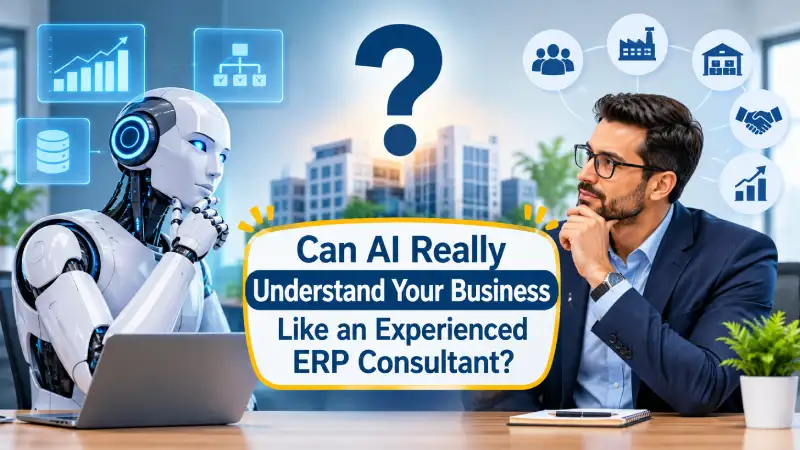
Artificial Intelligence is becoming part of almost every business conversation. From preparing reports and writing emails to developing applications and analyzing data, AI is helping people complete tasks that previously required considerable time and effort.
ERP consulting is no exception.
Today, business owners can ask AI to prepare a procurement process, design a Bill of Materials (BOM), explain an MRP cycle, suggest inventory controls, or even create an ERP implementation plan.
The answers often look professional. The process diagrams appear correct, the terminology is familiar, and the recommendations may sound convincing.
But there is one important question:
Can AI really understand how your business operates, the challenges your employees face, and the decisions you need to make, just like an experienced ERP consultant?
Consider a manufacturing company that wants to implement an ERP system. The management explains that it purchases raw materials, manufactures products, maintains inventory, and sells finished goods.
AI can quickly prepare a standard manufacturing process based on this information.
But what if the company manufactures semi-finished goods in one factory and uses them to manufacture finished goods in another? What if the second factory also receives materials from external vendors? What if the company maintains different warehouses for quality inspection, production, rejected materials, and finished goods?
The process is no longer as simple as it first appeared.
Imagine that you are the owner of this company. You have explained your requirements to AI and received a complete manufacturing process within minutes. Everything looks correct. But when your team starts using the system, you discover that material availability is calculated incorrectly, production orders are being generated for the wrong unit, and the finished goods delivery schedule is affected.
Who will identify whether the problem is in the BOM, routing, warehouse configuration, or MRP logic?
This is where understanding the actual business becomes more important than simply generating a process document.
An experienced ERP consultant will ask additional questions, understand the actual business operations, identify dependencies, and then recommend a suitable process.
AI can assist in this work, but understanding the complete business context is a different challenge.
In this article, we will explore what AI can do in ERP consulting, where it may fall short, and why experienced business and ERP knowledge remains important for successful ERP implementation.
1. AI Can Give You an ERP Process, But Does It Understand Your Business?
Let’s start with a simple example.
Suppose a business owner asks AI:
“Prepare a procurement process for a manufacturing company.”
AI can generate a standard procurement flow:
- Purchase requisition.
- Request for quotation.
- Vendor selection.
- Purchase order.
- Goods receipt.
- Quality inspection.
- Supplier invoice.
- Payment.
This is a reasonable standard process.
Now consider the actual business.
The company purchases raw materials, semi-finished goods, and finished goods. Some materials are received directly into the main warehouse, while others must first go through quality inspection. Certain materials are purchased for a specific production order. Some vendors also perform job work using materials supplied by the company.
The company may also have different approval levels depending on the purchase value, product category, or department.
Suddenly, the procurement process requires more detailed decisions.
For example:
- Should the purchase requisition be generated manually or through MRP?
- Should the purchase order be created directly from the requisition?
- Does the material require quality inspection?
- Should rejected material be returned to the vendor?
- How should materials sent for job work be tracked?
- How will the supplier invoice be matched with the purchase order and goods receipt?
- How will the purchase transaction affect inventory and accounting?
AI can suggest answers to these questions when given sufficient information.
However, the challenge is that business owners do not always know which details they need to provide.
An experienced ERP consultant does not simply wait for the customer to explain every requirement. The consultant asks questions based on implementation experience, identifies missing information, and explores situations that may not have been considered by the business.
The difference is not just in providing an answer. It is in knowing which questions must be asked before arriving at the answer.
2. Understanding a Business Requires More Than Understanding Its Process
Every business has its own way of operating.
Two manufacturing companies may produce similar products, but their business processes can be completely different.
One company may manufacture products based on customer orders, while another manufactures products based on forecasts and maintains finished goods inventory.
One may purchase raw materials from domestic suppliers, while another imports materials and needs to manage customs duties, freight, insurance, and landed costs.
One company may manufacture everything in-house, while another outsources certain production activities to job workers.
A standard ERP process may provide a starting point, but it must be evaluated against the actual business requirements.
Consider a company that manufactures industrial equipment.
Its operations may include:
- Procurement of raw materials.
- Cutting and fabrication.
- Welding and assembly.
- Surface treatment.
- Quality inspection.
- Finished goods packing.
- Dispatch to customers.
During an ERP discussion, management may explain that all these activities are part of manufacturing.
But an ERP consultant will explore additional details:
- Are all operations performed in the same factory?
- Is material issued at the beginning of production or at each operation?
- Are partially completed products transferred between work centres?
- Is production completed in one shift or multiple shifts?
- Are rejected materials reworked or scrapped?
- Is labour cost recorded against each operation?
- How is machine capacity considered during production planning?
These questions help determine how the manufacturing process should be configured.
Consider another example: Vendor Job Work
A company sends raw materials to an outside vendor for processing. The vendor performs the operation and returns semi-finished goods.
At first, management may describe this as a simple purchase from a vendor.
But the actual ERP requirement is much more detailed.
The system may need to track:
- Quantity of material sent to the vendor.
- Stock available at the vendor’s location.
- Material consumed during processing.
- Semi-finished goods received from the vendor.
- Rejected quantities and material loss.
- Outstanding quantity with the vendor.
- Vendor processing charges.
- Actual job-work cost.
Suppose the company sends 1,000 units of raw material to a vendor. The vendor returns 950 units of processed material, while 30 units are rejected and 20 units remain pending.
The company must know where all 1,000 units are accounted for.
If the ERP only records the purchase of processed goods, it may not provide the required visibility of the original material sent to the vendor.
This is why job work may require a different process from normal procurement.
An experienced ERP consultant will ask how materials are transferred, how consumption is recorded, how receipts are accepted, and how vendor charges are calculated.
AI can help prepare a job-work process, but the recommendation must be validated against the company’s actual operations.
AI can help prepare a manufacturing workflow, but the quality of the recommendation depends on the information available and how well the actual business situation is represented.
An experienced ERP consultant brings another advantage: the ability to recognize patterns from different industries and implementation scenarios.
They may have seen similar problems in other businesses and can use that experience to identify risks before they become implementation issues.
3. Real-Life ERP Perspective: Three Manufacturing Units, One Business
Let’s consider a manufacturing company operating three production units under a single legal entity.
- Unit 1 manufactures semi-finished goods.
- Unit 2 manufactures finished goods.
- Unit 3 also manufactures selected semi-finished goods.
The finished goods manufactured in Unit 2 require materials supplied by Units 1 and 3.
At first, the requirement appears straightforward. Management wants to use one ERP system to manage all three units.
AI may suggest a standard multi-warehouse ERP structure with separate warehouses for each production unit.
That is a useful starting point.
However, when the actual MRP process is discussed, additional questions arise.
Suppose the company receives an order to manufacture 3,000 finished goods.
The system must determine:
- Which raw materials are required?
- Which semi-finished goods must be manufactured?
- How much stock is available in each unit?
- Which unit should manufacture the required semi-finished goods?
- How much material needs to be transferred?
- What existing purchase or production orders are already open?
- When must each item be available to meet the customer’s delivery date?
There is another important consideration.
If Unit 1 manufactures semi-finished goods for Unit 2, the ERP must understand the relationship between the production plan, manufacturing warehouse, BOM, and routing.
A routing defined for one production unit may not automatically be suitable for another unit.
If the system validates routing based on the selected warehouse or production organization, the configuration must reflect the actual manufacturing arrangement.
This is not simply a matter of creating three warehouses.
The consultant must understand the production structure, planning responsibilities, material movement, and costing requirements.
There is also a financial impact.
If semi-finished goods are manufactured in Unit 1 and consumed in Unit 2, their cost must be correctly captured and reflected in the finished goods cost.
If the material transfer, production consumption, or costing process is incorrectly configured, the company may end up with incorrect inventory valuation and product profitability reports.
Therefore, the ERP design must consider not only material movement but also the financial impact of each transaction.
An experienced ERP consultant will explore these details before finalizing the MRP design.
AI can assist in documenting the scenario, preparing process diagrams, and suggesting possible configurations. But it should not be assumed that a generic answer will automatically fit the company’s actual production environment.
This is where practical implementation experience makes a difference.
4. AI May Understand the Words, But Does It Understand the Business Impact?
One of the biggest challenges in ERP implementation is that a single transaction can affect several departments.
Consider a simple purchase receipt.
The warehouse team sees it as an activity to receive material.
The procurement team sees it as fulfillment of a purchase order.
The quality team may need to inspect the material.
The finance team needs the receipt information for supplier invoice matching and accounting.
The inventory team needs the stock quantity and valuation to be updated correctly.
All these departments are looking at the same transaction from different perspectives.
Now imagine that a user cancels the goods receipt after the material has already been inspected.
What should happen?
Should the quality inspection result be reversed? Should the stock quantity be reduced? What happens if some of the material has already been issued to production? Should the system allow cancellation, or should it require a return transaction?
These are business decisions that must be understood before defining the system behaviour.
A technically correct solution can still be operationally wrong if it does not follow the company’s actual process.
In ERP consulting, understanding the impact of a transaction across different modules is extremely important.
AI can explain how a goods receipt generally works, but the consultant must validate how that process should work in the specific business environment.
5. Where AI Can Be Extremely Useful in ERP Consulting
It would be incorrect to say that AI cannot understand business processes or contribute to ERP implementation.
AI has become a useful assistant for ERP consultants, business analysts, developers, and project teams.
When used properly, it can save time and improve the quality of documentation and analysis.
Here are some areas where AI can make a meaningful difference.
A. Preparing Process Documentation
An ERP consultant can provide the business requirements to AI and ask it to prepare a structured process document.
For example, a discussion about purchase requisitions, purchase orders, goods receipts, quality inspection, and supplier invoices can be converted into a process description.
The consultant can then review the document, correct gaps, and ensure that it reflects the agreed business process.
B. Analyzing Business Requirements
AI can help organize a large number of requirements into functional areas.
For example, manufacturing requirements can be grouped into:
- BOM management.
- Routing.
- Production planning.
- Material issue.
- Production execution.
- Quality inspection.
- Finished goods receipt.
- Production costing.
This makes requirement analysis easier and helps identify areas that need further discussion.
C. Generating Test Cases
Testing is an important part of ERP implementation.
AI can help prepare test cases for procurement, sales, inventory, manufacturing, and finance.
For example, it can generate scenarios for:
- Partial goods receipt.
- Purchase order cancellation.
- Material return.
- Stock transfer.
- Production material shortage.
- Finished goods rejection.
- Customer sales return.
The ERP consultant and testing team must still validate whether the test cases cover the actual business rules.
D. Preparing SQL Queries and Reports
ERP projects frequently require reports that combine information from multiple database tables.
AI can help developers prepare SQL queries, identify possible joins, explain database structures, and improve query performance.
For example, a manufacturing company may need a report showing raw material consumption against production orders.
AI can help draft the query, while the developer and ERP consultant validate the calculations, transaction filters, and business rules.
E. Supporting Developers
AI can assist with code generation, debugging, API development, database queries, and technical documentation.
This can reduce repetitive development work and allow technical teams to focus more on complex requirements.
F. Explaining ERP Concepts to Business Users
Not every employee understands ERP terminology.
AI can explain concepts such as MRP, BOM, routing, inventory valuation, WIP, and landed cost in simple language.
This can be useful during employee training and knowledge sharing.
The most effective approach is to use AI to improve productivity while keeping experienced people responsible for business decisions and validation.
6. Five Areas Where an Experienced ERP Consultant Still Makes a Difference
AI can process large amounts of information, but successful ERP implementation also requires judgement, experience, and an understanding of how businesses operate.
There are several areas where an experienced consultant plays an important role.
A. Identifying Requirements That the Customer Has Not Mentioned
During ERP discussions, customers generally explain the problems they currently face.
However, they may not mention every exception or future requirement.
For example, a customer may say that they need inventory management across multiple warehouses.
An experienced consultant will ask:
- Are materials allowed to move between warehouses without approval?
- Do you maintain separate locations for rejected and quality-inspection stock?
- Should safety stock be excluded from available inventory?
- Are materials reserved for specific sales or production orders?
- Do you track batch numbers and serial numbers?
- Do you need warehouse-wise inventory valuation?
These questions help uncover requirements that may otherwise appear much later during implementation.
B. Understanding the Difference Between Standard and Custom Processes
Not every customer requirement needs customization.
Sometimes the existing ERP already supports the required process, but the customer is unfamiliar with the available functionality.
For example, a company may request a custom application to manage purchase approvals.
An ERP consultant may identify that the existing workflow and approval configuration can handle the requirement.
This avoids unnecessary development and reduces future maintenance.
On the other hand, some businesses genuinely have unique requirements that cannot be addressed through standard configuration.
The consultant must identify the difference and recommend the appropriate approach.
C. Understanding the Accounting Impact
This is particularly important in manufacturing and inventory management.
Consider a production process:
- Raw materials are issued to production.
- The material cost is transferred to work-in-progress.
- Finished goods are received into inventory.
- Finished goods are delivered to customers.
- The cost of goods sold is recognized.
The ERP must maintain the correct relationship between inventory transactions and financial accounting.
A change in material costing, production execution, or finished goods receipt may affect financial results.
An experienced ERP consultant understands that operational transactions and accounting entries cannot be designed independently.
AI can explain accounting concepts and generate possible journal entries, but the actual treatment must be checked against the company’s accounting policies and applicable requirements.
D. Balancing Business Requirements with ERP Best Practices
Customers sometimes request a process because it is how they have always worked.
However, their existing process may involve unnecessary approvals, manual entries, duplicate data, or avoidable delays.
An ERP consultant should not simply reproduce every existing activity.
Instead, the consultant should understand why the process exists and determine whether it can be simplified.
For example, a company may maintain separate Excel files for purchase requirements, vendor quotations, purchase orders, and pending receipts.
An ERP implementation may bring these activities into one connected process.
The objective is not just to move existing manual work into software. It is to improve the way the business operates.
E. Managing Change During Implementation
ERP implementation involves people, not just technology.
Employees may be comfortable with their existing Excel sheets and manual procedures.
They may resist using a new system, particularly when it introduces additional controls or changes their responsibilities.
An experienced consultant helps explain why the process is changing, conducts training, identifies adoption problems, and works with management to resolve them.
AI can prepare training materials, but managing people and organizational change requires communication and practical involvement.
7. Real-Life Example: Why the Same Manufacturing Process Does Not Work for Every Company
Consider two companies manufacturing similar industrial products.
Both purchase raw materials, maintain BOMs, manufacture finished goods, and sell to customers.
At first glance, their ERP requirements appear almost identical.
However, Company A manufactures products only against confirmed customer orders.
Company B manufactures products based on monthly forecasts and maintains finished goods inventory.
The difference affects several ERP processes.
For Company A:
- Production orders may be linked to customer demand.
- Material requirements are calculated based on confirmed orders.
- Finished goods may be produced according to specific delivery dates.
- Production priorities may change based on customer commitments.
For Company B:
- Production planning may be based on forecast demand.
- Finished goods inventory must be considered before generating new production orders.
- Safety stock and reorder levels may influence planning.
- Production schedules may be prepared in advance.
If both companies are given exactly the same ERP process without understanding these differences, one of them may end up with a system that does not support its actual business operations.
An experienced ERP consultant will identify the difference during requirement discussions and design the appropriate planning approach.
AI can compare the two scenarios and suggest possible solutions. But the quality of the final design depends on the accuracy of the business information and the validation of the proposed process.
This is why ERP implementation should begin with understanding the business, not simply selecting modules and configuring screens.
8. Can AI Replace an ERP Consultant?
This is a question many businesses are beginning to ask.
The answer depends on what they expect an ERP consultant to do.
If the requirement is to explain a standard procurement process, prepare a sample BOM, generate test cases, or draft an ERP implementation checklist, AI can provide considerable assistance.
However, an ERP consultant’s responsibility goes beyond preparing documents.
The consultant must:
- Understand the customer’s business model.
- Study existing operational processes.
- Identify missing requirements.
- Recommend suitable ERP functionality.
- Evaluate customization requirements.
- Understand integration between departments.
- Support data migration and validation.
- Coordinate testing and user acceptance.
- Help resolve implementation issues.
- Support the business during go-live.
These activities involve continuous discussions, decisions, validation, and practical problem-solving.
The difference becomes clearer when we compare their roles:
| ERP activity | How AI helps | What the ERP consultant contributes |
| Requirement gathering | Organizes the information provided | Identifies missing business requirements |
| Process design | Suggests standard workflows | Validates workflows against actual operations |
| MRP | Explains planning concepts | Evaluates BOM, routing, capacity, and warehouse dependencies |
| Accounting | Suggests possible accounting treatments | Validates the treatment against business and accounting policies |
| Customization | Helps generate code | Decides whether customization is actually necessary |
| Testing | Generates test scenarios | Validates business rules and transaction outcomes |
| Go-live | Prepares checklists and documentation | Handles practical issues, adoption, and business coordination |
AI can assist throughout this journey, but it should not be treated as the sole authority for business process design or implementation decisions.
A useful way to look at it is:
AI can help an ERP consultant work faster, but experience helps the consultant make better decisions.
The future of ERP consulting is likely to involve people and AI working together rather than one completely replacing the other.
9. What Should Businesses Expect from an ERP Consultant in the AI Era?
Businesses should not reject AI. They should expect their ERP implementation partners to use modern tools wherever they genuinely improve the project.
At the same time, businesses should evaluate the consultant’s practical experience and ability to understand their operations.
Before selecting an ERP implementation partner, consider these questions:
- Industry experience: Has the consultant worked with businesses that have similar operational requirements?
- Process understanding: Can the consultant explain the complete process from the initial transaction to its impact on inventory and finance?
- Practical problem-solving: Can they identify possible issues before the system goes live?
- Standard ERP knowledge: Do they understand the ERP’s standard functionality, or do they recommend customization for every requirement?
- Manufacturing and costing knowledge: Can they explain BOM, routing, MRP, material consumption, WIP, and product costing?
- Implementation methodology: Do they follow a structured approach for requirement gathering, blueprinting, configuration, testing, training, and go-live?
- Long-term support: Can they provide ongoing functional and technical assistance after implementation?
An ERP implementation partner should be capable of discussing both business operations and the technology used to manage them.
The objective should be to find a partner who understands your business and can guide you towards a practical ERP solution.
10. The Future of ERP Consulting: Experienced People Working with AI
AI will continue to improve.
It will become more useful in analyzing business data, preparing reports, assisting developers, documenting processes, and supporting ERP users.
Businesses should take advantage of these capabilities.
However, ERP implementation will continue to require people who understand how business decisions affect daily operations.
For example, AI may help identify a shortage of raw materials based on demand and inventory information.
But the business still needs to decide whether to purchase the material, transfer it from another warehouse, manufacture it internally, or outsource the activity.
Similarly, AI may identify that production costs have increased.
But understanding whether the increase is due to raw material prices, machine utilization, production efficiency, wastage, or incorrect transaction recording requires proper business analysis.
The best results will come when AI provides information and assistance while experienced professionals validate the situation and guide the decisions.
ERP is not just about automating transactions. It is about helping businesses manage resources, control costs, improve operations, and make better decisions.
11. Final Thoughts: AI Can Assist Your Business, But Experience Helps Understand It
AI has become an important tool for businesses and ERP professionals.
It can prepare documents, analyse information, generate code, suggest processes, and improve productivity. There is no reason to ignore these benefits.
But a business is more than a collection of transactions.
Every organization has its own processes, people, responsibilities, exceptions, and operational challenges.
An ERP implementation must bring these activities together in a way that supports the company’s actual requirements.
A generic process may look correct on paper, but it may not work in the real business environment.
An experienced ERP consultant brings practical knowledge, asks the right questions, understands the impact of decisions across departments, and helps the company avoid unnecessary complexity.
AI can provide suggestions, but those suggestions must be evaluated against real business conditions.
The real value of an ERP consultant is not simply knowing how an ERP system works. It is understanding how your business should work with that ERP system.
The future is not about choosing between AI and experienced ERP consultants. It is about using AI intelligently while retaining the business knowledge and experience needed to make the right decisions.
How Can Cyprus ERP and Onfinity ERP Help?
Understanding business processes is only the first step. The next step is selecting an ERP platform that can support those processes without unnecessary customization.
A good ERP solution should provide standard functionality, allow flexibility where required, and have a reliable implementation and support structure.
At BRS Infotek, we believe that successful ERP implementation begins with understanding business processes and selecting the right ERP approach.
Our focus is on helping businesses connect their operations through integrated ERP solutions rather than managing different departments through disconnected applications.
Cyprus ERP – Open-Source ERP Without Software Licence Fees
Cyprus ERP is based on the open-source ADempiere platform and provides an integrated foundation for managing business operations.
It supports business areas such as:
- Procurement and vendor management.
- Sales and customer management.
- Inventory and warehouse management.
- Material Requirements Planning (MRP).
- Manufacturing.
- Financial management.
- Fixed asset management.
Cyprus ERP does not have a software licence fee. Businesses can invest in implementation, configuration, customization, training, and ongoing support according to their requirements.
With an established ERP foundation, businesses can focus on configuring and improving their processes rather than developing every standard business function from scratch.
Explore Cyprus ERP: https://www.cypruserp.com
Onfinity ERP – An AI-Enabled ERP Solution
Onfinity ERP is an AI-enabled ERP platform based on Vienna Advantage technology.
It provides an integrated environment for managing business processes across different departments.
Businesses looking for an ERP platform that combines established enterprise processes with AI-enabled capabilities can explore Onfinity ERP.
Explore BRS Infotek: https://www.brsinfotek.com
Looking for the Right ERP Solution for Your Business?
Every business has different requirements. Before selecting an ERP, it is important to understand your existing processes, identify operational challenges, and evaluate how an ERP system can support your future growth.
At BRS Infotek, we help businesses evaluate their ERP requirements and implement solutions aligned with their operational needs.
If you are planning an ERP implementation or looking to improve your existing business processes, connect with our team at https://www.brsinfotek.com.
About the Author
Surya Sagar is the Founder and ERP Solution Architect at BRS Infotek, with more than 19+ years of experience in ERP consulting, implementation, and business process automation.
He has worked on more than 100 ERP implementations across different industries and has practical experience in procurement, sales, inventory management, MRP, manufacturing, warehouse management, financial management, and product costing.
Through his ERP consulting and implementation experience, he helps businesses understand how technology can improve operational efficiency, strengthen process control, and support business growth.
Read more ERP insights at https://erppilot.com.


