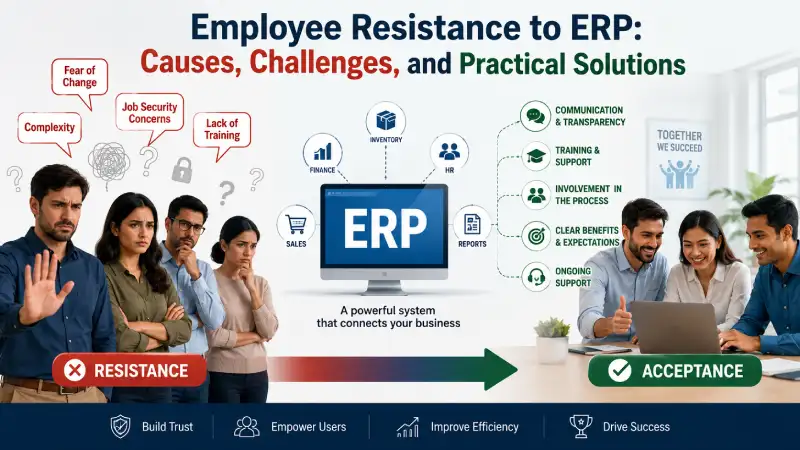
Imagine this situation.
The company’s management has finally approved a new ERP system after months of discussions. The project team is excited. Department heads are optimistic. The implementation partner has prepared a detailed project plan. Everyone is talking about how the ERP will improve productivity, reduce manual work, and help the business grow.
But something completely different is happening on the office floor.
The purchase executive quietly tells his colleague,
“Now everything will become automatic. I wonder if they’ll still need us.”
An accounts executive whispers,
“I’ve been doing this work for fifteen years. What if I can’t learn this new system?”
A warehouse supervisor worries,
“Every movement will be recorded. Management will know every mistake I make.”
The HR manager notices that employees are attending training sessions, but very few are asking questions. Instead of excitement, there is uncertainty. Instead of confidence, there is hesitation.
If you have ever implemented an ERP system, this scene probably sounds familiar.
After working on ERP implementation projects for more than 19+ years across manufacturing, trading, retail, pharmaceuticals, construction, distribution, engineering, and service industries, I have realized one important truth:
ERP projects rarely struggle because of technology. They struggle because people are afraid of change.
Ironically, the very software designed to make employees’ lives easier is often viewed as a threat.
Employees worry about losing their jobs.
Managers worry about losing control.
Departments worry about changing their routines.
Even experienced professionals become nervous when asked to work differently.
The reality is that employee resistance is one of the biggest challenges in any ERP implementation. Companies invest lakhs—or even crores—on ERP software, consultants, hardware, and training, yet many projects experience delays simply because people are not mentally prepared for the change.
The encouraging news is that employee resistance is completely natural—and more importantly, it can be overcome.
In this article, we’ll explore why employees fear ERP systems, understand the psychology behind that resistance, share real-life implementation experiences, and discuss how organizations can transform skeptical users into confident ERP champions.
A Morning I’ll Never Forget
Several years ago, I visited a manufacturing company for the first ERP training session.
The conference room was fully prepared. A projector displayed the ERP login screen. Training manuals were neatly arranged on every desk. Senior management welcomed everyone and spoke enthusiastically about the future.
On paper, everything looked perfect.
Yet as I looked around the room, something felt different.
Some employees avoided eye contact.
A few sat with folded arms.
Others appeared more worried than curious.
During the tea break, one warehouse executive quietly approached me and asked,
“Sir, after ERP goes live… will the company still need people like us?”
That single question explained more than any project status report ever could.
The software wasn’t frightening them.
The unknown future was.
At that moment, I realized that successful ERP implementation is not only about configuring software or migrating data. It is equally about understanding people.
Why Employees Resist ERP Systems
Many organizations believe employees resist ERP because they dislike technology.
In reality, that is rarely the case.
Most employees use smartphones every day.
They shop online.
They use digital banking.
They book tickets through mobile apps.
Technology itself isn’t the problem.
The real issue is uncertainty.
ERP changes the way people have worked for years—sometimes decades.
It changes:
- Daily responsibilities
- Approval processes
- Data entry methods
- Communication between departments
- Reporting structures
- Performance visibility
- Accountability
For management, these changes represent progress.
For employees, they often represent risk.
Human beings naturally seek stability. When familiar routines disappear, uncertainty takes their place.
That uncertainty gradually becomes resistance.
Resistance Doesn’t Mean Employees Are Against ERP
One of the biggest mistakes organizations make is assuming resistant employees are negative or unwilling to cooperate.
In my experience, that assumption is usually wrong.
Most employees are hardworking professionals who simply want reassurance.
They don’t resist ERP because they dislike improvement.
They resist because they have questions nobody has answered.
Questions such as:
- Will my experience still matter?
- What if I make mistakes?
- What if younger employees learn faster?
- Will ERP increase my workload?
- What happens if I press the wrong button?
- Will management blame me for every error?
These concerns are perfectly normal.
Unfortunately, many companies never discuss them openly.
As a result, fear continues to grow in silence.
The Five Emotional Stages Employees Experience During ERP Implementation
Just as businesses follow phases during ERP implementation, employees also go through emotional stages.
Understanding these stages helps management respond with empathy instead of frustration.
Stage 1 – Denial
The first reaction is often simple.
“We’ve been working this way for years.”
“Why change something that already works?”
Employees assume the ERP project will either be delayed or cancelled.
Many continue using their existing methods without paying much attention to the project.
Stage 2 – Fear
As training sessions begin, reality starts sinking in.
Employees begin asking themselves difficult questions.
“Will I be able to learn this?”
“What if I fail?”
“Will automation replace my role?”
This is usually the most sensitive stage of the entire project.
Without proper communication, resistance becomes stronger.
Stage 3 – Resistance
Fear gradually transforms into action.
Some employees avoid training.
Some continue maintaining Excel files.
Others delay testing.
Some simply stop asking questions altogether.
This is often misunderstood as laziness.
In reality, it is uncertainty.
Stage 4 – Acceptance
Once employees successfully complete a few transactions, something changes.
Their confidence slowly improves.
They realize the ERP system isn’t their enemy.
It is simply another way of working.
Stage 5 – Ownership
This is every implementation team’s dream.
The same employees who once opposed ERP begin saying,
“Can we automate this process too?”
“Can we create another dashboard?”
“Can we integrate this with barcode scanning?”
The project has now become theirs.
This transformation is one of the most satisfying moments in any ERP implementation.
Fear #1: “Will ERP Take Away My Job?”
This is by far the most common fear.
Employees rarely express it openly.
Instead, they discuss it quietly among themselves.
Consider a purchase department where five employees manually prepare purchase orders using Excel.
After ERP implementation:
- Purchase requisitions are generated automatically.
- Approval workflows become digital.
- Vendors receive email notifications.
- Reports are available instantly.
- Procurement history becomes searchable.
To management, these are efficiency improvements.
To employees, they can appear as signs that fewer people will be needed.
The immediate thought becomes:
“If ERP can do all this work, why would the company still need me?”
In reality, ERP removes repetitive tasks—not valuable employees.
Instead of spending hours creating reports, employees can focus on supplier negotiations, strategic purchasing, and process improvement.
Unfortunately, unless management communicates this clearly, fear spreads quickly.
Real-Life Experience: The Barcode Project That Almost Failed
During one manufacturing ERP implementation, we planned to introduce barcode scanning in the warehouse.
Technically, everything was ready.
The hardware worked perfectly.
The ERP integration was complete.
Yet every pilot test seemed to fail.
Management initially believed the scanners were faulty.
After speaking privately with the warehouse team, we discovered the real reason.
The operators believed barcode scanning would reduce the need for warehouse staff and eventually result in layoffs.
No one had explained the actual objective.
The company’s goal wasn’t to reduce manpower.
It was to reduce paperwork, eliminate manual errors, improve inventory accuracy, and speed up dispatch operations.
Once management openly addressed these concerns and assured employees that the ERP was meant to support them—not replace them—the same warehouse team became enthusiastic supporters of the project.
Sometimes, resistance disappears the moment communication begins.
Fear #2: “I’m Not Good with Computers”
Not every employee is comfortable using software.
Many experienced professionals built successful careers long before ERP systems became common.
Some have spent years working with paper documents.
Others rely heavily on Excel.
Factory supervisors often spend most of their time on the shop floor rather than at a computer.
Now they are expected to:
- Log into the ERP every morning.
- Enter transactions accurately.
- Approve documents online.
- Generate reports.
- Correct errors independently.
For younger employees, these tasks may seem routine.
For others, they can feel overwhelming.
One production supervisor once told me,
“Sir, I understand manufacturing much better than computers. I’m afraid I’ll make mistakes every day.”
His concern wasn’t about learning.
It was about embarrassment.
Nobody likes feeling like a beginner after being an expert for twenty years.
Organizations that understand this psychological challenge create supportive training environments rather than expecting instant perfection.
Fear #3: “Management Will Monitor Everything I Do”
ERP systems bring transparency.
Every transaction records:
- User name
- Date and time
- Approval history
- Modification history
- Document status
For management, this creates accountability.
For some employees, it feels like constant monitoring.
Thoughts such as these become common:
“Now every delay will be visible.”
“Every correction will be questioned.”
“Management will know every mistake.”
The ERP system itself isn’t creating fear.
The lack of communication is.
Employees need to understand that transparency protects everyone. It reduces misunderstandings, prevents duplicate work, and ensures decisions are based on facts rather than assumptions.
When explained properly, transparency becomes a strength instead of a threat.
Fear #4: “Will My Experience Become Useless?”
One of the most emotional concerns during ERP implementation is something many managers never notice.
Imagine an inventory manager who has spent twenty years in the company.
He knows every rack location without looking at a report.
He remembers supplier phone numbers without checking contacts.
He can identify slow-moving inventory just by walking through the warehouse.
People respect him because of his knowledge.
Then ERP arrives.
Now every transaction must be recorded in the system.
Inventory reports are available to everyone.
Management no longer needs to ask him for every stock position because the ERP provides real-time information.
At first, he may feel that his years of experience no longer matter.
He begins thinking,
“Now the software knows everything.”
But that isn’t true.
ERP stores information.
Experience converts that information into good business decisions.
No ERP can replace an experienced professional who understands customers, suppliers, production challenges, and business realities.
In fact, ERP makes experienced employees even more valuable because they now have reliable data to support their decisions.
Fear #5: “I Don’t Have Time to Learn ERP”
Learning something new always requires time.
Unfortunately, ERP training usually happens while employees are already busy with their daily work.
Think about a finance executive during month-end closing.
Or a purchase manager handling urgent vendor deliveries.
Or a production supervisor trying to complete customer orders.
Now imagine asking them to attend four hours of ERP training every day.
The natural reaction is:
“I don’t have time.”
“I’ll learn it later.”
“Right now my work is more important.”
The problem is that “later” often becomes “never.”
Organizations should remember that ERP training is not an interruption to work.
It is part of the work.
The companies that schedule proper training sessions, practical workshops, and continuous support always experience smoother ERP adoption than those that simply distribute user manuals.
Why Employees Continue Using Excel Even After ERP Goes Live
Almost every ERP consultant has seen this situation.
The ERP system is live.
Transactions are entered into ERP.
Reports are available.
Yet employees continue maintaining separate Excel sheets.
Why?
Because Excel feels familiar.
Employees know every formula.
They understand every worksheet.
They can modify data whenever they want.
ERP, on the other hand, follows structured business processes.
It validates entries.
It prevents duplicate records.
It requires approvals.
Initially, these controls feel restrictive.
But those very controls are what improve business accuracy.
Real-Life Experience: The Company That Trusted Excel More Than ERP
One organization invited us for a post go-live review almost one year after ERP implementation.
Management complained that employees were still preparing reports manually.
During our visit we discovered something surprising.
Every department maintained its own Excel files.
Sales had Excel.
Purchase had Excel.
Inventory had Excel.
Finance had Excel.
When I asked one department head why they still preferred Excel, his answer was honest.
“We trust our Excel sheets because we know how they work.”
After investigating further, we found that the ERP system wasn’t the issue.
The users had only been trained to enter transactions.
Nobody had shown them how to generate meaningful reports, analyze business information, or use dashboards.
Within a few weeks of focused training, employees gradually stopped using their Excel sheets because they realized the ERP reports were faster, more accurate, and available in real time.
The lesson was simple.
People don’t resist software.
They resist uncertainty.
The Hidden Fear Nobody Talks About
There is another fear that employees rarely discuss openly.
Accountability.
Before ERP implementation:
- Missing inventory could be blamed on manual records.
- Delayed approvals were difficult to identify.
- Incorrect calculations often remained unnoticed.
- Departments could easily blame each other.
After ERP implementation, every activity has a digital trail.
Management can immediately identify:
- Who created the transaction.
- Who approved it.
- Who modified it.
- When the activity happened.
- Where delays occurred.
Some employees feel uncomfortable because they believe ERP is watching them.
In reality, ERP is protecting everyone.
Clear accountability reduces misunderstandings, improves collaboration, and ensures decisions are based on facts instead of assumptions.
Why Senior Employees Often Resist More Than Junior Employees
Many organizations assume younger employees will resist technology.
Surprisingly, that is rarely the case.
Younger employees usually adapt quickly because they are already familiar with digital applications.
Resistance often comes from experienced professionals.
Why?
Because they have spent years mastering existing processes.
Their shortcuts disappear.
Manual calculations become automated.
Knowledge that was once available only to them becomes accessible throughout the organization.
This can feel like losing influence.
Management should never ignore these emotions.
Instead, experienced employees should be treated as mentors during ERP implementation.
When they become project champions, the entire organization follows.
The Real Cost of Employee Resistance
Many companies focus only on ERP implementation costs.
Very few calculate the cost of resistance.
Employee resistance can result in:
- Delayed implementation
- Poor master data quality
- Incorrect transactions
- Increased consulting costs
- Extended project timelines
- Multiple go-live postponements
- Duplicate work in Excel
- Lower employee confidence
- Reduced return on ERP investment
Ironically, these hidden costs often exceed the cost of the ERP software itself.
The Turning Point: When Employees Start Loving ERP
Every successful ERP implementation reaches a beautiful moment.
The first purchase order is approved without paperwork.
The first inventory audit matches perfectly.
The finance team closes the month faster than ever before.
Production managers receive real-time reports instead of waiting until the next day.
Managers begin making decisions using live dashboards.
Employees no longer search through paper files.
Approvals happen from mobile devices.
Customers receive faster responses.
Gradually something changes.
The same employees who once resisted ERP begin requesting new features.
They ask for automation.
Barcode integration.
Mobile applications.
Workflow approvals.
Business intelligence dashboards.
The ERP system is no longer viewed as management’s project.
It becomes the organization’s way of working.
As an ERP consultant, this is always the most satisfying phase of an implementation.
How Organizations Can Reduce Employee Resistance
Employee resistance cannot be eliminated overnight.
However, it can be reduced significantly through proper planning.
Here are some proven approaches based on real implementation experience.
1. Communicate Early
Employees should never hear about ERP through office rumours.
Management should clearly explain:
- Why ERP is being implemented.
- What business problems it will solve.
- How employees will benefit.
- What changes employees can expect.
Transparency builds trust.
2. Involve Employees During Implementation
Employees understand daily operations better than anyone.
Ask for their suggestions.
Include them in workshops.
Allow them to validate business processes.
People support what they help create.
3. Invest in Practical Training
Training should focus on daily work rather than software menus.
Employees learn faster when they perform real business transactions using actual business scenarios.
Confidence grows through practice.
4. Celebrate Small Successes
Recognize employees who successfully adopt ERP.
Appreciation motivates others.
Small victories gradually create organization-wide confidence.
5. Provide Continuous Support
Go-live is not the end of the project.
It is the beginning.
Users need support during the first few months.
Quick issue resolution builds trust in the new system.
A Lesson Every Business Owner Should Remember
If employees resist ERP, don’t immediately assume they dislike technology.
Ask a different question.
What are they afraid of?
Sometimes they fear losing their jobs.
Sometimes they fear looking inexperienced.
Sometimes they simply fear making mistakes.
When organizations understand these emotions, ERP implementation becomes much smoother.
Technology succeeds only when people are ready to use it.
How Cyprus ERP Helps Organizations Improve User Adoption
Implementing ERP successfully requires more than software features.
It requires a solution that employees can understand and use comfortably.
Cyprus ERP has been designed with usability in mind. The interface is clean, business processes follow practical workflows, and organizations can gradually introduce modules based on their readiness instead of forcing drastic changes all at once.
Key advantages include:
- Easy-to-understand user interface
- Standardized business processes
- Role-based access control
- Workflow approvals
- Real-time dashboards
- Manufacturing, Procurement, Sales, CRM, Inventory, Finance, HR, and many other integrated modules
- Flexible customization based on business requirements
- No software license cost, making ERP adoption affordable for growing businesses
When employees find the software simple and relevant to their daily work, resistance naturally decreases.
Onfinity ERP: Combining ERP with Artificial Intelligence
Modern businesses expect more than traditional ERP software.
They want intelligent systems that assist users in making faster and better decisions.
Onfinity ERP is designed with this vision.
In addition to comprehensive ERP capabilities, it incorporates Artificial Intelligence to improve decision-making, automate repetitive tasks, provide business insights, and enhance operational efficiency.
Instead of replacing employees, AI becomes a powerful assistant that allows teams to focus on strategic work while the system handles routine activities.
Organizations that embrace AI-enabled ERP today are preparing themselves for the future of digital business.
Final Thoughts
Every ERP implementation is ultimately a journey of people, not just technology.
The software can be installed in weeks.
Data can be migrated in days.
Servers can be configured within hours.
But building employee confidence takes time.
Companies that invest equally in communication, training, leadership, and change management consistently achieve better ERP outcomes.
Remember this simple truth:
People don’t resist ERP.
They resist uncertainty.
When organizations replace fear with understanding, resistance with communication, and confusion with proper training, ERP becomes one of the most valuable investments a business can make.
Successful ERP implementation is not measured by the day the software goes live.
It is measured by the day employees confidently say,
“I can’t imagine working without ERP anymore.”
That is the real definition of ERP success.
About the Author
Surya Sagar is an ERP Solution Architect, ERP Consultant, and Founder of BRS Infotek, with more than 19+ years of experience in ERP consulting and digital transformation.
Throughout his career, he has successfully participated in and led 100+ ERP implementation projects across industries including manufacturing, pharmaceuticals, engineering, retail, trading, construction, distribution, and services.
He is the creator of Cyprus ERP, an open and cost-effective ERP solution, and has played a key role in designing AI-driven business solutions through Onfinity ERP.
His areas of expertise include Manufacturing, MRP, Supply Chain Management, Procurement, Inventory Management, CRM, Sales, Finance, Project Management, Warehouse Management, and ERP implementation strategy.
Through his articles and practical implementation experiences, Surya aims to help businesses understand ERP beyond software—focusing on people, processes, and sustainable business growth.


