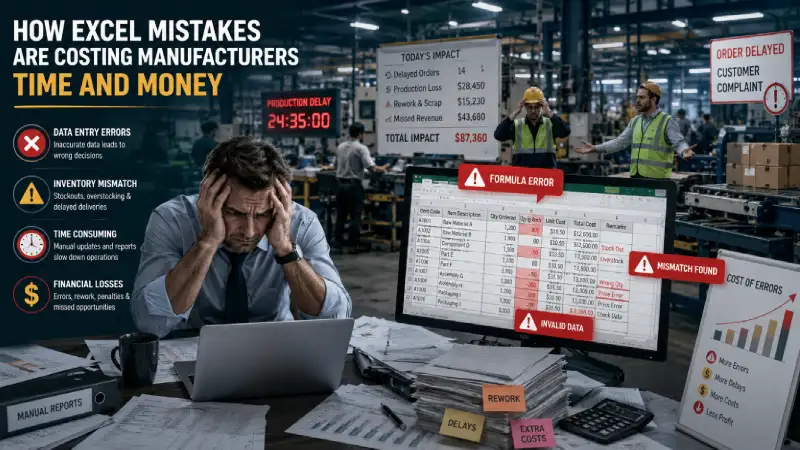
In almost every manufacturing company, there is one software that silently controls operations more than any ERP system, machine, or automation platform.
That software is Microsoft Excel.
From production planning and inventory tracking to costing and quality control, Excel has become the unofficial backbone of thousands of manufacturing businesses. It starts innocently. A few sheets to track stock. One workbook for production planning. Another for purchase follow-up. Over time, those files become “the system.”
And that is where the real problem begins.
After spending years working with manufacturing companies across pharmaceuticals, engineering, packaging, chemicals, food processing, and trading industries, I have noticed one common pattern: businesses rarely calculate the actual cost of depending on Excel.
Most companies think Excel is saving money because it does not require a large software investment. But in reality, Excel quietly creates operational losses every single day.
The most dangerous part?
These losses are usually invisible.
Why Manufacturing Businesses Love Excel
To be fair, Excel is powerful.
It is flexible, easy to use, and almost everyone in the organization already knows it. A production manager can quickly create a planning sheet. Stores can maintain stock movement. Accounts can prepare costing calculations. Purchase teams can track vendors.
There is no dependency on IT teams. No implementation project. No training cost.
For small businesses in the early stage, Excel genuinely works well.
The problem starts when the business grows.
Suddenly:
- Multiple users update different versions of the same file
- Formula mistakes begin affecting calculations
- Inventory numbers stop matching physical stock
- Production planning becomes chaotic
- Management loses real-time visibility
- Decision-making slows down
At that point, Excel stops being a tool and becomes a risk.
Signs Your Manufacturing Business Has Outgrown Excel
Many manufacturing companies do not realize how much operational damage Excel is causing because the problems develop slowly over time.
If your business is facing the following situations regularly, it may be a strong indication that Excel is no longer sufficient for managing operations:
- Inventory never matches physical stock
- Production gets delayed because material is unavailable
- Different departments use different report versions
- Costing calculations take hours or days
- Management does not receive real-time reports
- Employees spend more time updating spreadsheets than improving operations
- Multiple Excel files exist for the same process
- Production planning changes daily due to poor visibility
- Audit preparation becomes stressful
- Reporting depends on one or two specific employees
If even half of these issues sound familiar, your business is already paying the hidden cost of Excel.
The Hidden Costs Nobody Talks About
1. Inventory Errors That Slowly Kill Profits
One of the biggest problems I have seen in manufacturing companies is inventory mismatch caused by Excel tracking.
A company may believe they have sufficient raw material because the spreadsheet says so. But during production, they discover the stock is either already consumed, damaged, or incorrectly entered.
Production stops.
Machines remain idle.
Workers wait.
Dispatch gets delayed.
Customers become unhappy.
All because one Excel cell contained incorrect data.
Real-Life Example
A pharmaceutical manufacturer was maintaining raw material stock in Excel while production consumption was updated manually at the end of the day.
One evening, a user accidentally copied the wrong formula while updating closing stock.
The next morning, the planning department released a batch assuming sufficient stock was available.
Halfway through production, they discovered the actual stock was short by 40 kilograms.
The entire production line stopped for almost 8 hours.
The management initially blamed procurement. Procurement blamed stores. Stores blamed production.
But the real issue was simple: Excel had no real-time inventory control.
That single error cost the company far more than the price of a proper Manufacturing ERP software solution.
2. Dependency on One “Excel Expert”
Almost every manufacturing company has one employee who becomes the “Excel master.”
Nobody else fully understands the formulas, macros, linked sheets, or hidden calculations.
Everything depends on that person.
Now imagine:
- That employee resigns
- Goes on leave
- Falls sick
- Joins a competitor
Suddenly the entire operation becomes unstable.
I have personally seen businesses panic because nobody knew how a costing sheet was calculating material consumption or overhead allocation.
This creates a dangerous business dependency.
A manufacturing process should depend on systems, not individuals.
3. No Real-Time Visibility
Manufacturing decisions need speed.
Management should know instantly:
- Current stock availability
- Production status
- Machine utilization
- Pending purchase orders
- Material shortages
- Rejection quantities
- Actual production cost
Excel cannot provide true real-time information because it depends on manual updates.
By the time data reaches management, the situation has already changed.
This delay affects:
- Production planning
- Customer commitments
- Procurement decisions
- Financial forecasting
And in manufacturing, delayed information often becomes expensive information.
This is exactly why many growing manufacturers are shifting toward integrated ERP platforms like Cyprus ERP and Onfinity ERP that provide real-time operational visibility.
4. Costing Mistakes That Disturb Pricing
One of the most underestimated risks of Excel is incorrect product costing.
Many manufacturers still calculate BOM cost, labor absorption, machine overhead, and wastage manually in spreadsheets.
But manufacturing costing is dynamic.
Raw material prices change.
Electricity costs increase.
Labor efficiency changes.
Machine downtime affects overhead absorption.
When costing calculations remain outdated, companies unknowingly:
- Sell products below actual cost
- Reduce profit margins
- Lose competitiveness
- Make incorrect pricing decisions
Real-Life Scenario
An engineering company was using Excel to calculate product costing.
Their costing sheet was updated every quarter manually.
But steel prices increased significantly during one month, and the updated rates were not reflected immediately in the Excel formula references.
For almost six weeks, they continued selling products using old costing.
The sales looked healthy.
But the company was actually losing money on every order.
Management realized the problem only during quarterly profit analysis.
By then, the damage was already done.
5. Production Planning Chaos
Excel-based production planning looks manageable until order volume increases.
Then problems start appearing:
- Duplicate planning
- Missed production orders
- Incorrect machine allocation
- Material shortages
- Last-minute rescheduling
- Delayed dispatches
In many factories, planners spend more time updating Excel than actually planning production.
This creates operational stress across departments.
A Common Manufacturing Reality
A production planner creates a weekly schedule in Excel.
Meanwhile:
- Sales adds urgent orders
- Purchase delays raw material
- Machines break down
- Quality rejects material
Now the planner manually updates multiple sheets again.
Version confusion starts.
Different departments work with different files.
Nobody knows which plan is correct anymore.
This situation is extremely common in growing manufacturing businesses.
6. Quality Control Becomes Difficult
Manufacturing industries require traceability.
Especially sectors like:
- Pharmaceuticals
- Food processing
- Chemicals
- Medical devices
- Automotive
Excel cannot efficiently manage:
- Batch traceability
- QC approvals
- Rejection analysis
- Audit records
- Compliance documentation
When auditors ask for historical records, Excel-based companies often spend hours searching files across systems and emails.
That creates operational risk and compliance pressure.
A proper ERP for manufacturing companies provides centralized quality records, real-time batch tracking, and complete traceability.
7. Reporting Takes Too Much Time
Many companies proudly say:
“We have all reports in Excel.”
But nobody talks about how much manpower is wasted preparing those reports.
Employees spend hours every day:
- Copying data
- Cleaning files
- Matching sheets
- Correcting formulas
- Preparing pivots
- Verifying totals
Instead of focusing on productivity, teams become data-entry operators.
One finance manager once told me:
“We are not running manufacturing. We are running spreadsheets.”
That statement perfectly described their organization.
The Emotional Cost Nobody Measures
The hidden cost of Excel is not only financial.
It also affects people.
I have seen:
- Production teams working late nights because reports were incorrect
- Stores teams getting blamed for stock mismatches
- Accounts departments struggling during audits
- Management losing trust in data
- Employees constantly firefighting operational issues
- Department heads blaming each other during review meetings
- Customer commitments getting missed because information was outdated
- Staff burnout increasing because everything depended on manual follow-up
When systems are weak, stress increases across the organization.
People stop focusing on improvement and start focusing only on fixing problems.
Over time, the company culture becomes reactive instead of proactive.
Excel vs ERP: The Operational Difference
| Area | Excel | ERP System |
| Inventory Tracking | Manual | Real-Time |
| Production Planning | Spreadsheet-Based | Integrated |
| Multi-User Access | Risky | Controlled |
| Traceability | Difficult | Built-In |
| Costing | Formula Dependent | Dynamic |
| Reporting | Time-Consuming | Instant |
| Data Accuracy | Error-Prone | Centralized |
| Audit Readiness | Stressful | Structured |
| Department Coordination | Fragmented | Unified |
| Decision Making | Delayed | Real-Time |
This is why Manufacturing ERP software is no longer optional for growing businesses.
When Does Excel Become Dangerous?
Excel becomes dangerous when:
- Multiple departments depend on it
- Business data grows rapidly
- Production complexity increases
- Inventory value becomes large
- Compliance becomes important
- Multiple plants or warehouses exist
- Real-time decisions are required
At that stage, Excel is no longer a support tool.
It becomes an operational liability.
Why ERP Changes Everything
A properly implemented ERP system transforms manufacturing operations because it creates one integrated system instead of disconnected spreadsheets.
With ERP:
- Inventory updates happen in real time
- Production consumption is tracked automatically
- Costing becomes dynamic
- BOMs remain controlled
- Planning becomes centralized
- Traceability improves
- Reports generate instantly
- Departments work on the same data
Most importantly, management gains visibility and control.
The biggest advantage is not automation.
The biggest advantage is accuracy.
ERP Is Not About Software — It Is About Control
Many businesses think ERP is only for large enterprises.
That mindset is outdated.
Today, even mid-sized manufacturers need proper systems because operational complexity has increased significantly.
Customers expect faster delivery.
Margins are tighter.
Competition is higher.
Compliance requirements are growing.
A business cannot scale using disconnected spreadsheets forever.
ERP implementation is not simply a software deployment project.
It is a business transformation initiative.
The Biggest Myth: “Excel Is Free”
Excel is not free.
You are already paying for it through:
- Production delays
- Wrong inventory
- Costing mistakes
- Manual manpower
- Reporting inefficiencies
- Decision delays
- Operational stress
- Customer dissatisfaction
The problem is that these costs appear slowly and indirectly, so companies fail to notice them.
But over time, they become massive.
A Balanced Reality
This does not mean Excel should completely disappear.
Excel is still useful for:
- Quick analysis
- Simulations
- Data comparison
- Temporary calculations
- Management presentations
But Excel should support the ERP system — not replace it.
That difference is critical.
How Cyprus ERP and Onfinity ERP Help Manufacturing Businesses
Over the years, while working with different manufacturing industries, one thing became very clear: businesses do not just need software. They need practical operational control.
That is exactly where Cyprus ERP and Onfinity ERP help manufacturers.
These ERP solutions are designed specifically to solve real operational problems faced by manufacturing companies, including:
- Production planning software
- BOM management
- Inventory management system
- Batch management
- Quality control
- Material requirement planning (MRP)
- Warehouse management
- Manufacturing costing
- Purchase and sales management
- Financial integration
- Real-time manufacturing reporting
Instead of depending on multiple spreadsheets, businesses get a centralized ERP platform where every department works together using accurate real-time information.
For manufacturing businesses moving from Excel-based operations to structured digital processes, ERP implementation becomes a major turning point.
And the biggest benefit is not only automation.
It is peace of mind.
A Real Transformation Example
One mid-sized manufacturing company was spending almost 5 to 6 hours daily on production planning and inventory reconciliation using Excel sheets maintained across departments.
Production delays were common.
Inventory mismatches happened regularly.
Management meetings were filled with arguments over whose report was correct.
After implementing ERP, their planning process became centralized.
Inventory visibility improved significantly.
Production planning time reduced from several hours to less than 45 minutes.
Most importantly, management finally trusted the numbers they were seeing.
That trust changed the entire operational culture of the organization.
Still Managing Manufacturing Through Excel?
If your team is spending more time correcting spreadsheets than improving operations, it may be time to evaluate a proper ERP system.
Cyprus ERP and Onfinity ERP help manufacturing businesses gain real-time control over inventory, production, costing, quality, warehouse operations, and reporting — without depending on disconnected Excel sheets.
Whether you are facing:
- inventory mismatch,
- production planning delays,
- costing confusion,
- reporting issues,
- or operational inefficiencies,
a properly implemented ERP system can help you bring structure, visibility, and control to your manufacturing operations.
To discuss your manufacturing challenges or ERP requirements, visit BRS Infotek and connect with an ERP manufacturing expert.
Final Thoughts
Excel is one of the greatest business tools ever created.
But manufacturing businesses often push it far beyond its intended purpose.
What starts as convenience slowly becomes operational dependency.
And dependency eventually becomes risk.
The hidden cost of Excel is not visible in one day, one month, or even one year.
But over time, it quietly impacts profitability, productivity, planning, employee efficiency, and customer satisfaction.
Manufacturing businesses that want to grow sustainably need systems that provide control, visibility, accuracy, and scalability.
Because in manufacturing, small mistakes do not remain small for long.
They multiply.
About the Writer
Surya Sagar is an ERP Solution Architect and Founder of BRS Infotek with more than 18 years of experience in ERP implementation, manufacturing process consulting, costing systems, warehouse management, and production automation.
He has worked extensively with manufacturing industries across pharmaceuticals, engineering, trading, process manufacturing, and discrete manufacturing sectors, helping businesses streamline operations through practical ERP solutions like Cyprus ERP and Onfinity ERP.
His focus is always on solving real business problems using simple, practical, and scalable ERP approaches that improve operational visibility, operational control, and business efficiency.


